From the Classroom · Reading Fluency
A 10-Minute Daily Reading Fluency Routine That actually sticks.
A simple, repeatable fluency routine with differentiated passages, so every reader in your class builds accuracy, phrasing and expression in 10 minutes a day.
- One focus a week
- Differentiated passages
- 10 minutes a day
Fluency is the bridge between decoding and understanding. A student who reads word by word, or races through without pausing, is using all their energy just to get the words out. There's very little left over for meaning.
The good news is that fluency improves with short, regular, focused practice. You don't need a long block. You need a routine your students know so well that it runs itself in about 10 minutes a day.
Here's the routine I use in my fluency units, and why it works.
What is reading fluency?
Fluent reading has a few parts working together:
- Accuracy: reading the words correctly
- Rate: reading at a natural pace, not too slow and not rushed
- Phrasing: grouping words into meaningful chunks
- Expression: reading with feeling that matches the text
- Punctuation: using full stops, commas and question marks to guide the voice
Trying to teach all of these at once is overwhelming. Focusing on one at a time, over a few weeks, works much better.
One focus each week
A five-week cycle gives each part of fluency its own week:
- Week 1: Accuracy
- Week 2: Rhythm and phrasing
- Week 3: Expression and volume
- Week 4: Punctuation for fluency
- Week 5: Automaticity and pace
Students read one passage across the whole week, rereading it with that week's focus in mind. Repeated reading of the same text is one of the most reliable ways to build fluency, because students can stop working on the words and start working on how they sound.
The daily routine
 Each day has a clear job:
Day 1: Model and choral read. You read the passage aloud first, showing what fluent reading sounds like with the week's focus. Then the group reads it together with you. Choral reading gives every student a safe way to practise without being put on the spot.
Day 2: Echo read. You read a sentence or short section, and students echo it straight back, copying your phrasing and expression. This is where students really hear the difference between choppy and fluent reading.
Day 3: Partner read and check-in. Students read with a partner, taking turns and giving each other simple feedback. You use this time to do a quick words correct per minute (WCPM) check-in with a few students, and each student sets a fluency goal.
Day 4: Goal practice and reflection. Students practise towards their goal, you do a final WCPM check-in, and students reflect on how their reading has changed since Day 1.
That leaves a spare day for catch-ups, a fun performance read or simply giving the time back to your literacy block.
Differentiation without three different lessons
 The biggest challenge with fluency is that one passage rarely suits every reader. Too hard, and struggling readers can't practise fluency at all. Too easy, and stronger readers aren't stretched.
The solution is to use three versions of the same passage: the same story, with different levels of complexity and length. Everyone reads about the same characters and ideas, so you can still discuss the text as a class, but each group practises at the right level.
On Day 1, the routine runs as a rotation. You choral read with one group while the other two groups reread their own version and highlight the week's vocabulary in the passage. Then the groups rotate, so every group gets their turn with you.
Connect fluency to the rest of your block
Fluency practice works even harder when the passage links to what students are reading and writing about. If your mentor text explores belonging, a fluency passage on the same theme builds background knowledge and vocabulary that students then use in comprehension and writing. (Read more about connected literacy blocks.)
Tips to keep the routine running smoothly
 A few things that make the biggest difference:
- Keep it short. Ten focused minutes beats thirty distracted ones.
- Keep it the same. The routine should be predictable, so students know exactly what to do each day.
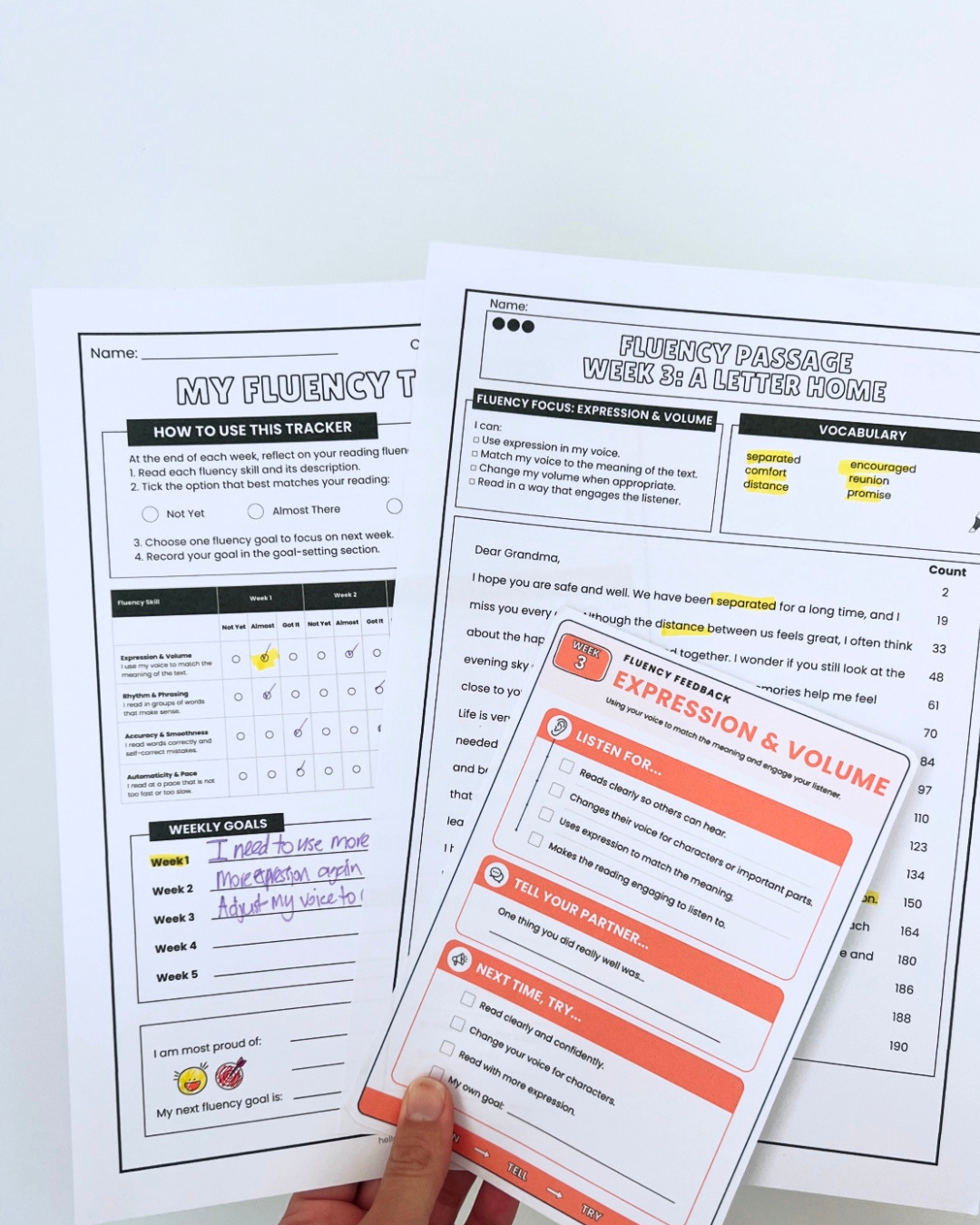
- Make progress visible. Students love seeing their WCPM grow across a week, and a simple tracker lets them rate each skill and set their next goal.
- Celebrate expression, not just speed. Fast reading isn't the goal. Reading that sounds like talking is.
Ready-to-go fluency passages
 If you'd like this routine set up for you, my Reading Fluency Mini Units for Years 2–6 include five weeks of differentiated passages, each in three levels, with the daily routine built in.
Everything you need sits in one place: the routine overview, the weekly passages, the assessment recording sheets and the student trackers.
Say hello to less planning + more time for you.