From the Classroom · Writing
Quick Writes: Getting Students Writing Every Day Without writing whole texts.
Quick Writes are short, focused bursts of writing that build stamina, confidence and skill, without needing a whole text every day.
- 5 minutes of writing
- Visual prompts
- Every day
Ask most teachers how often their students write, and the honest answer is usually “not as often as I’d like”.
Between assessments, interruptions and everything else in a school week, writing lessons are often the first thing to get squeezed. When students do write, it’s usually a whole text, which can feel overwhelming for reluctant writers.
Students only get better at writing by writing, so they need to do it often. They don’t need to write a whole text every day, but they do need to write every day, even if it’s only for a few minutes. That’s where Quick Writes come in.
What is a Quick Write?
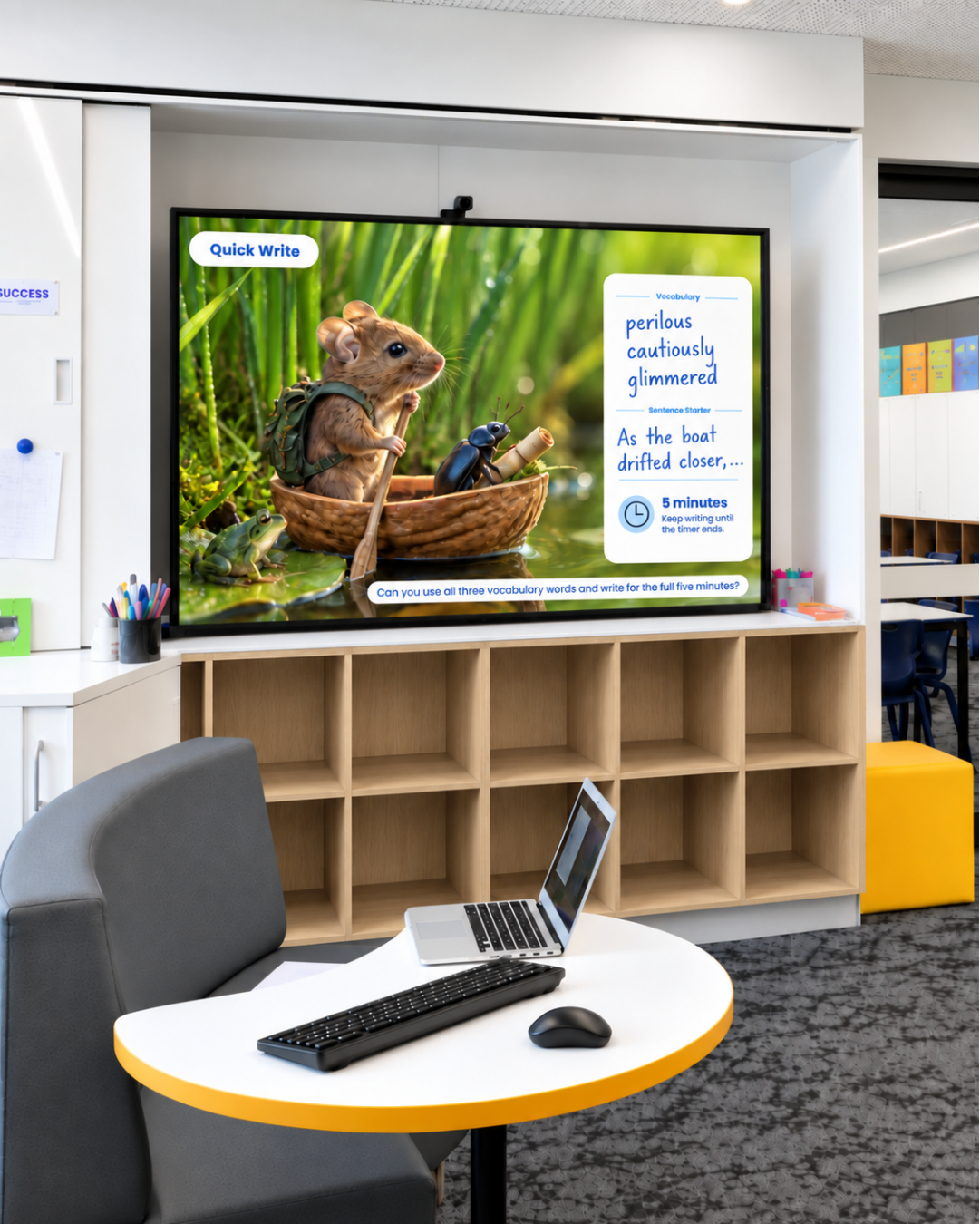
A Quick Write is a short, focused burst of writing, usually around five minutes. Students respond to an engaging visual prompt, often with a sentence starter and a few vocabulary words to use.
The goal is to get words down, not to produce a polished piece. Quick Writes don’t replace explicit writing instruction but sit alongside it, giving students a daily chance to build stamina, experiment with language and practise the skills they’re learning.
Why a little writing every day makes a big difference
It builds stamina. Students who write a little every day find it much easier to keep going when it’s time for a longer task, including NAPLAN.
It lowers the stakes. Five minutes and a picture is far less daunting than a blank page and a whole text, so reluctant writers get started and experience success quickly.
It gives new learning somewhere to go. When students meet a new word in their fluency passage or practise a sentence skill in Sentence of the Day, a Quick Write gives them a real reason to use it.
It shows you what students can do. A quick glance shows you who’s applying their learning and who needs more support, without a pile of marking.
The Quick Write routine
Each Quick Write follows the same simple routine:
- Look and talk (1–2 minutes). Display the visual prompt. Students notice what they can see and share an idea with a partner, because talking first gives them something to write about.
- Read the supports (1 minute). Read the vocabulary words and sentence starter together, so every student has a way in.
- Write (5 minutes). Students write independently until the timer ends, with the aim of keeping their pencil moving the whole time.
- Share (2 minutes). A few students read their writing aloud, and the class notices what works.
In around ten minutes, every student in the room has written something.
What it looks like in practice
 Let’s say students are exploring space. The Quick Write slide shows a spacecraft approaching an enormous planet, with three vocabulary words: enormous, planet and solar system.
The sentence starter is “As our spacecraft approached the enormous…” and the challenge is: Can you use all three vocabulary words and write for the full five minutes?
Some students might describe the planet, while others might write the start of an adventure, but every student is practising the same vocabulary in their own way.
The vocabulary also connects to the week’s fluency passage and comprehension text, so students aren’t starting from nothing and already have the words and ideas they need.
Where Quick Writes fit in a connected literacy block
In my literacy block, the Quick Write is one of five consistent routines, alongside Fluency, Spelling and Vocabulary, Comprehension and Writing. (Read more about how to plan a connected literacy block.)
Some teachers start the literacy block with a Quick Write as a warm-up, while others use it to finish, so students can apply what they’ve just learnt.
Tips to keep Quick Writes running smoothly
- Quick Writes aren’t designed to be marked. They’re a chance for students to freely practise the skills they’ve been learning. Give them a quick glance for formative assessment when you need to, or finish by asking students to highlight examples of noun groups or adverbial phrases they’ve used in their writing.
- Use mini whiteboards or writing books. There’s no need for worksheets, and writing books give you a record of growth over time.
- Write with your students sometimes. Modelling your own thinking shows students that writers make choices and changes.
- Celebrate attempts. The goal is for students to write every day, not to write perfectly.
Ready-to-go Quick Writes
 If you’d like Quick Writes ready to put on the board, my Quick Write Mini Units give you five weeks of visual prompts connected to the same themes as my fluency and Sentence of the Day units.
My Quick Write Prompts collections include narrative and poetry prompts you can use any time, from adventure stories to short poetic forms like the cinquain.
Say hello to less planning + more time for you.