
Literacy, Unpacked · Practical guide
Quick Writes & Daily Review, unpacked
Two short daily routines with one goal: every student writing, and revisiting what they've learnt, every single day.
What you'll learn
- Why short, daily writing builds fluency, stamina and confidence
- How the five-step Quick Write routine works
- The difference between ready-made and co-constructed prompts
- How a spiralled Daily Literacy Review keeps skills from fading
No. 01 — Why write every day
Little and often, every day
Writing is like reading: students get better at it by doing a lot of it. But in many classrooms, writing happens in long blocks a few times a week, often as whole texts that take days to finish. In between, some students barely write at all.
Students don't need to write a whole text every day to grow as writers. Five focused minutes, every day, adds up quickly. Short, regular writing builds writing fluency (getting ideas down without stalling), stamina (keeping going for longer) and confidence, especially for reluctant writers who freeze in front of a blank page.
Because it's short and low pressure, a Quick Write is also the perfect place for students to try out new vocabulary and sentence skills in their own writing.
No. 02 — The Quick Write routine
Five steps, five minutes
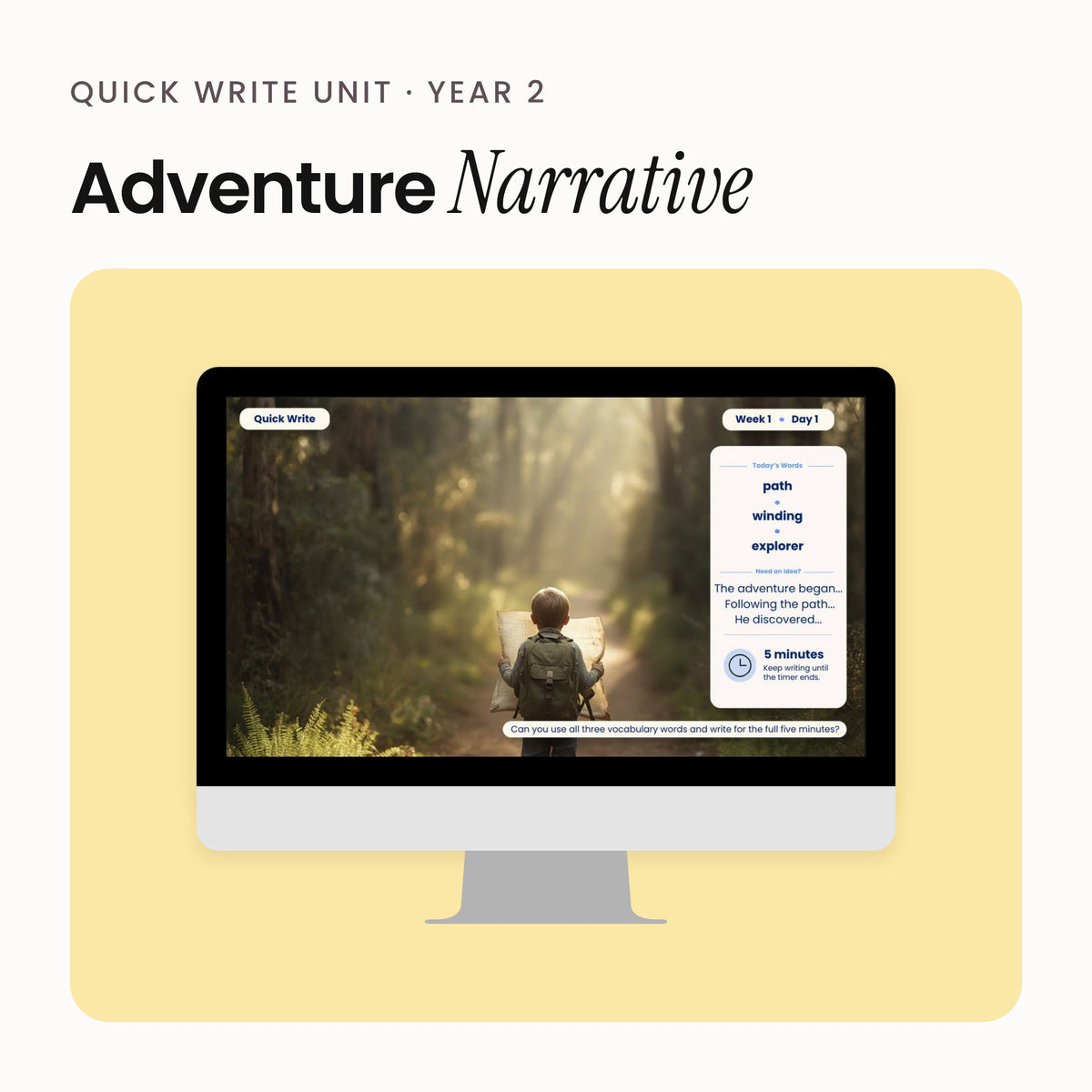
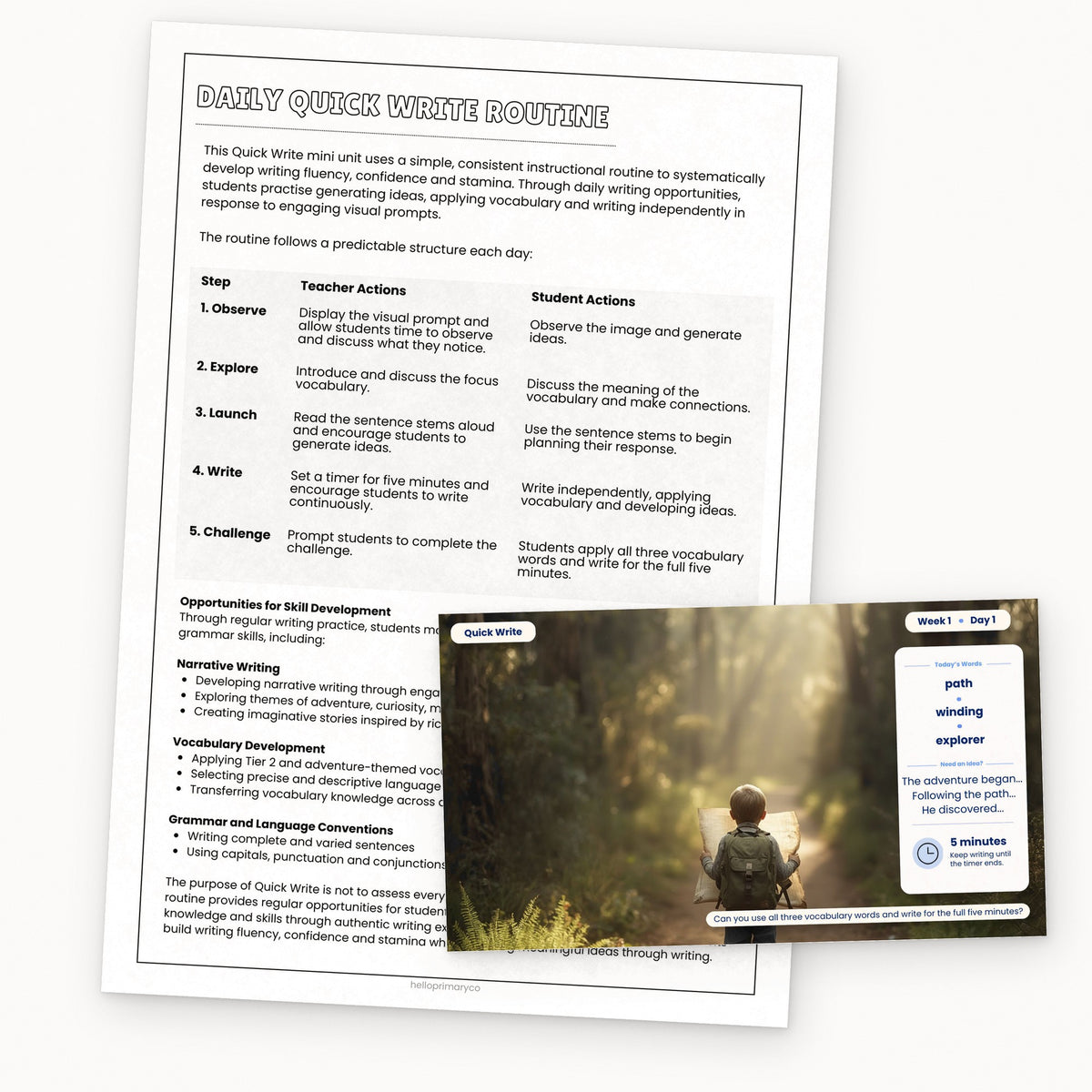
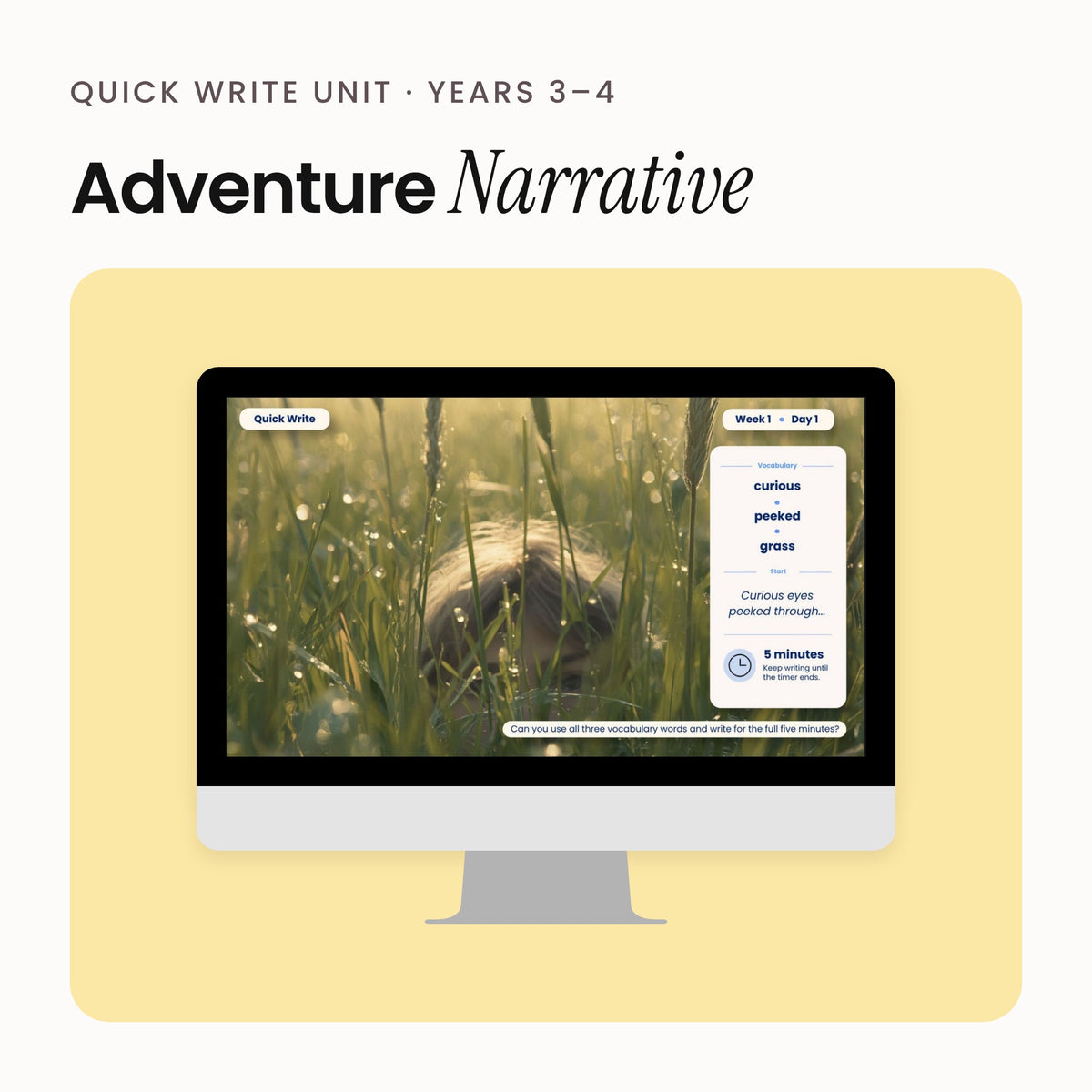
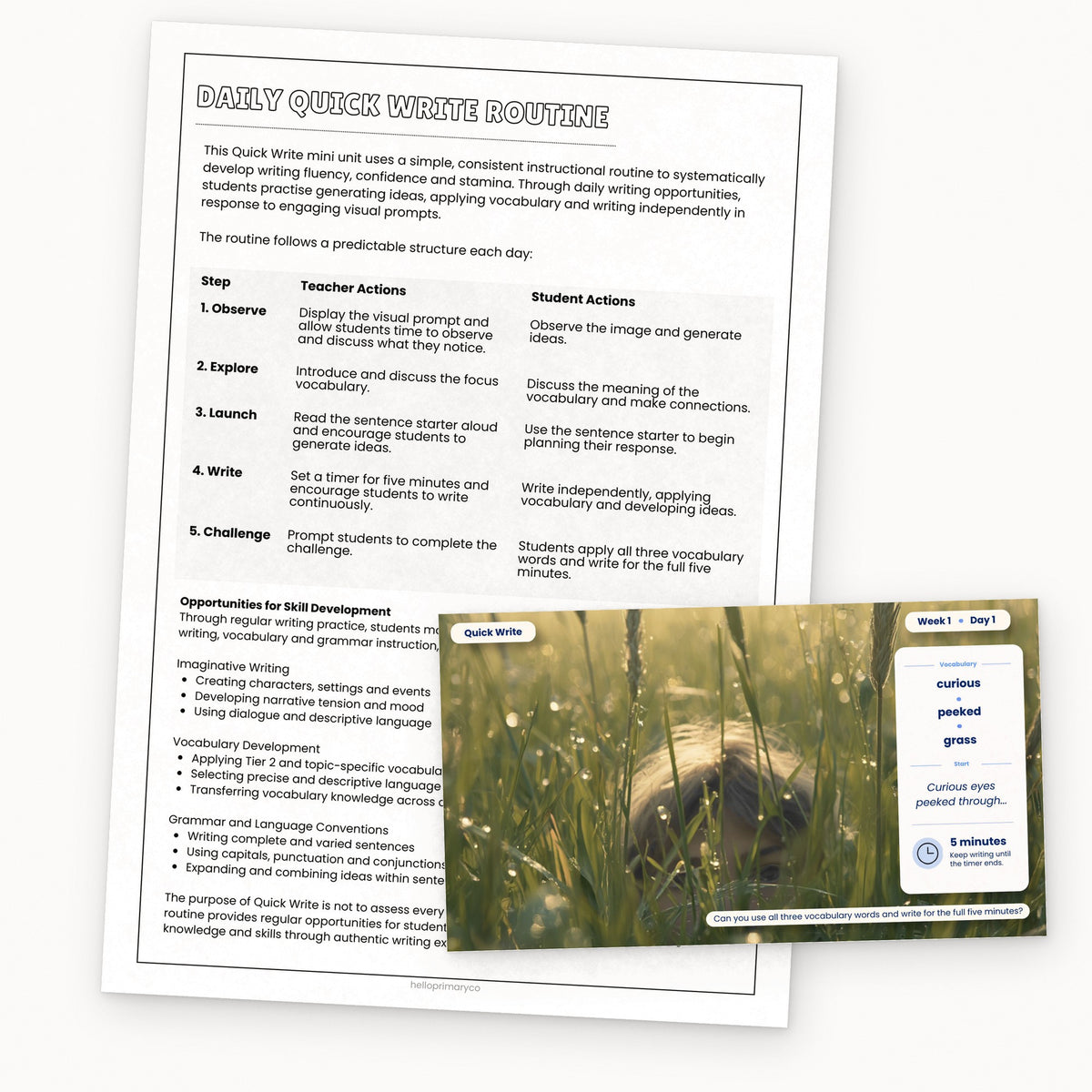
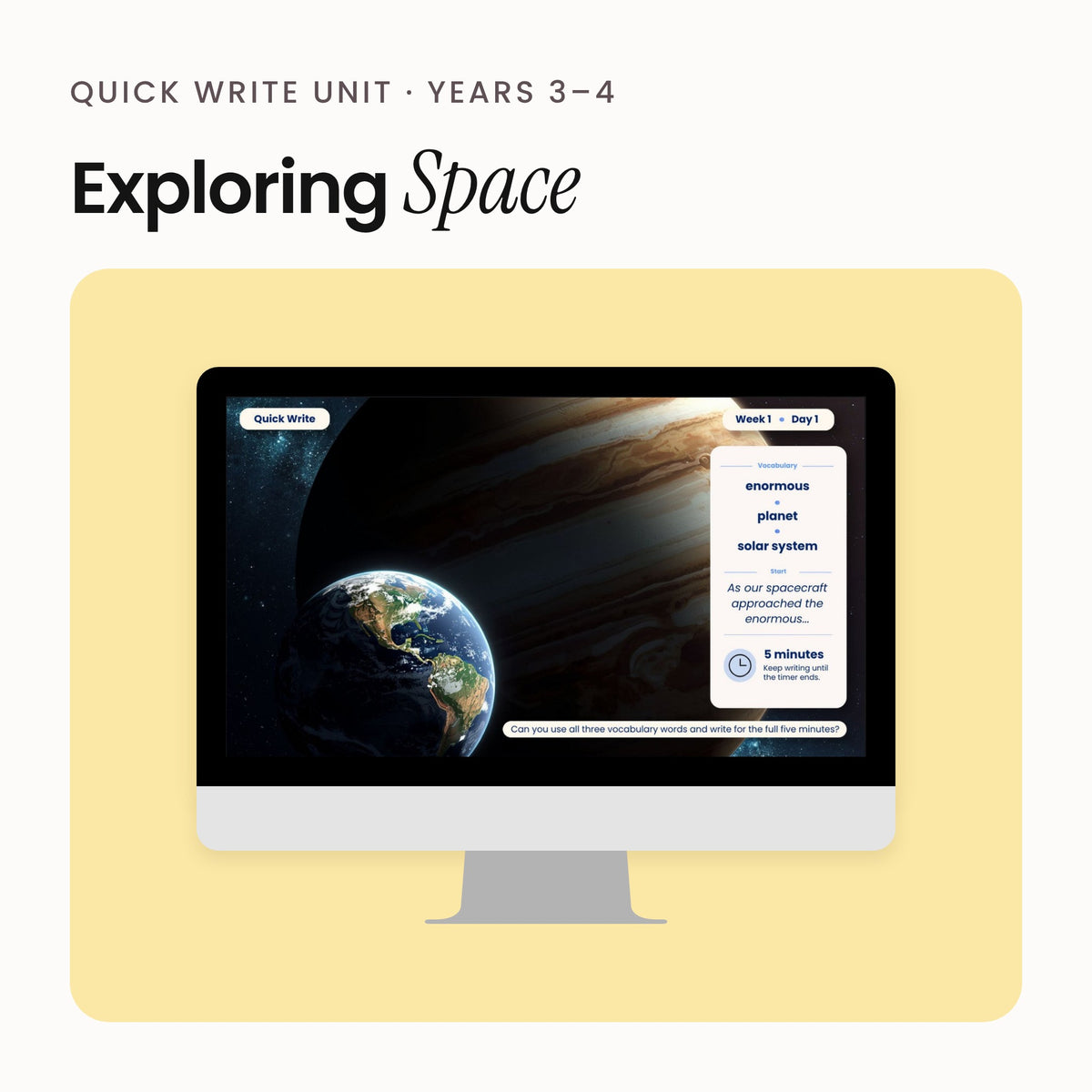
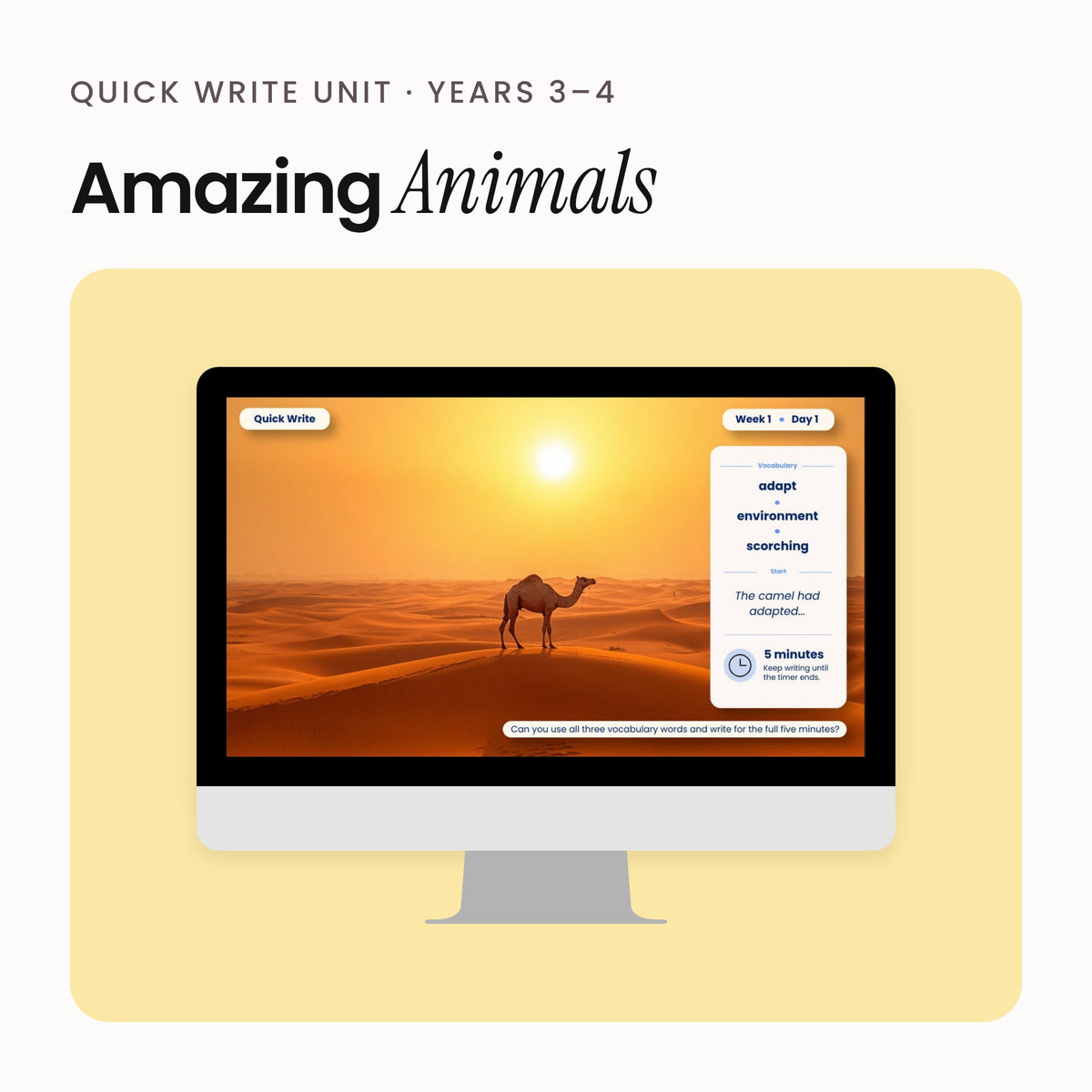
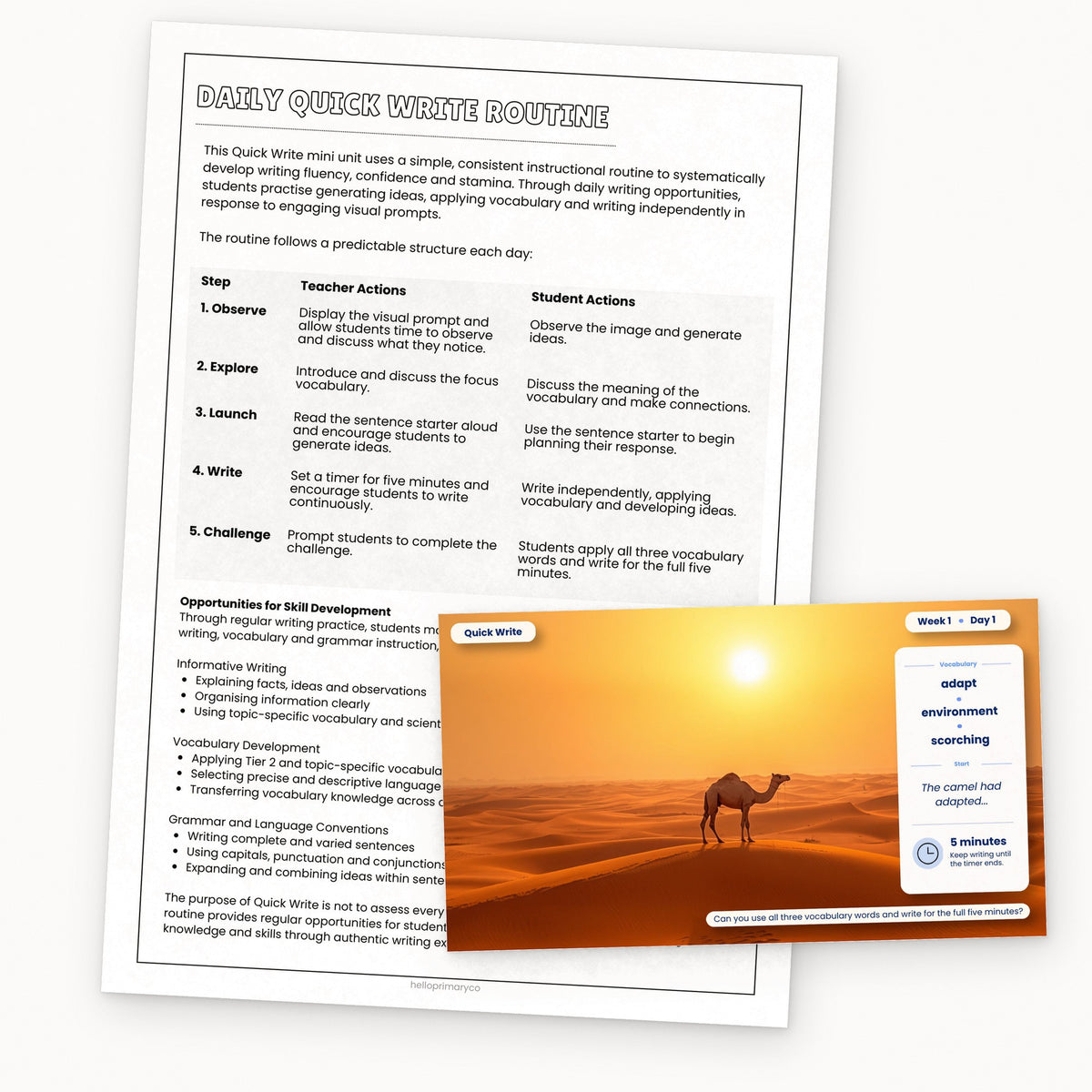
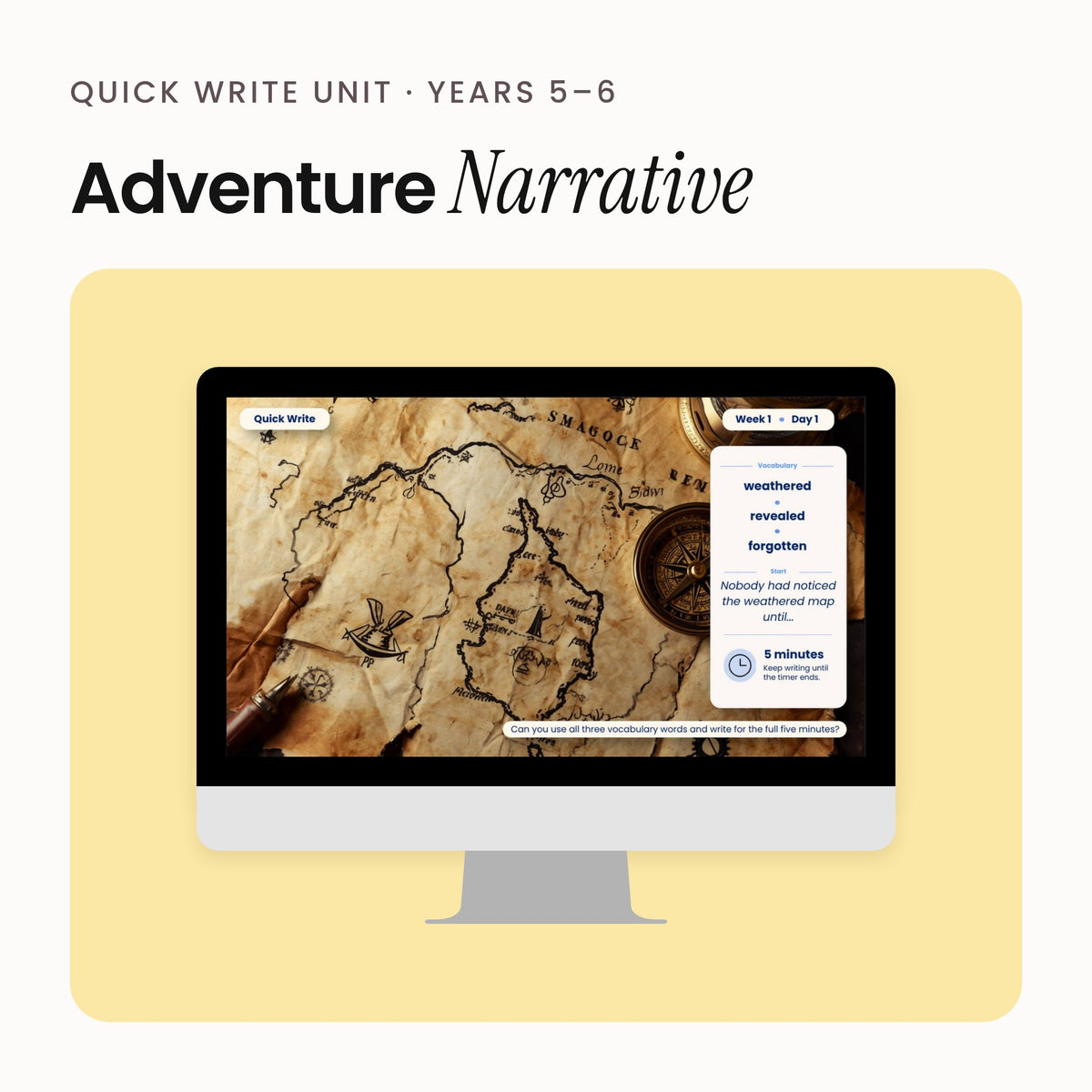
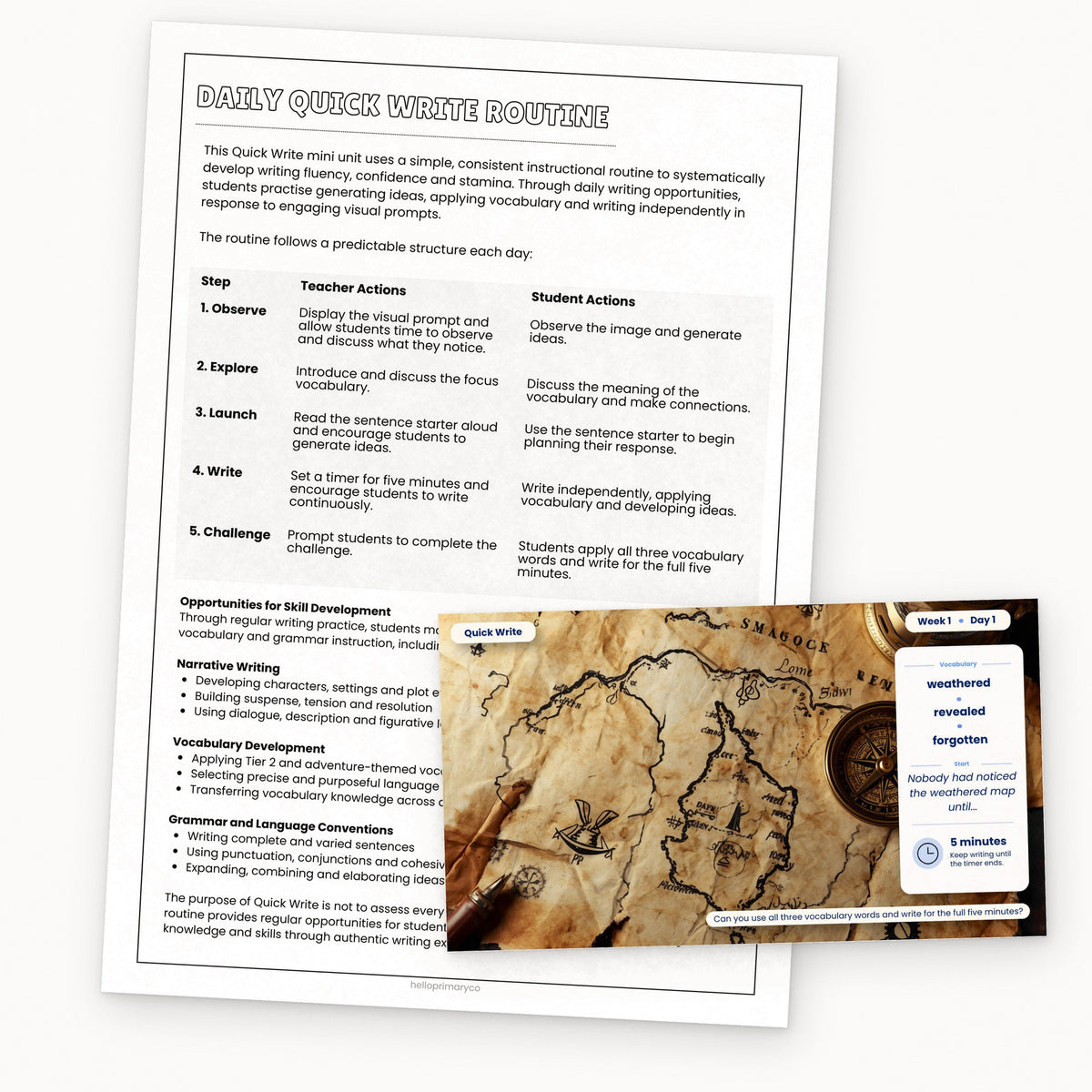
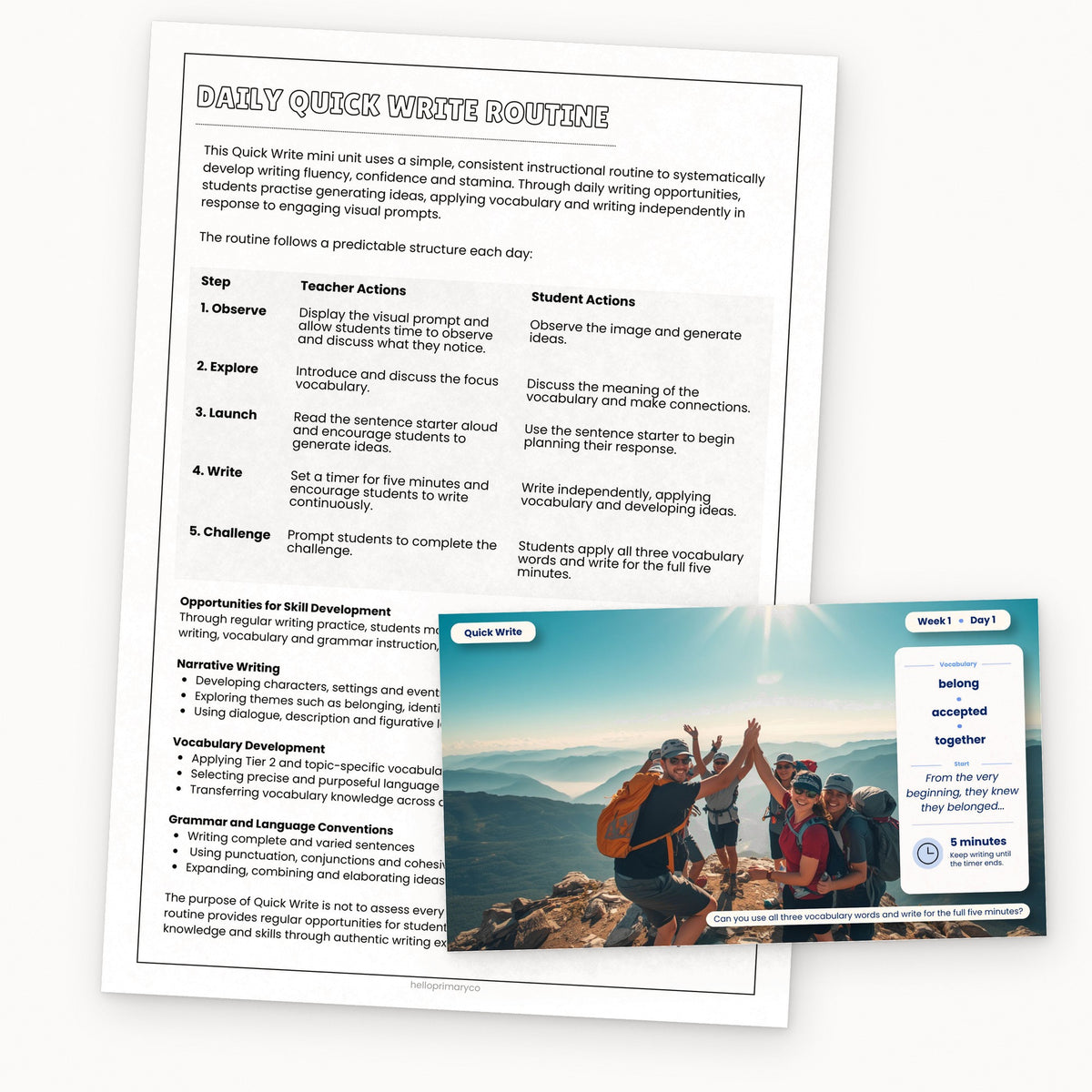
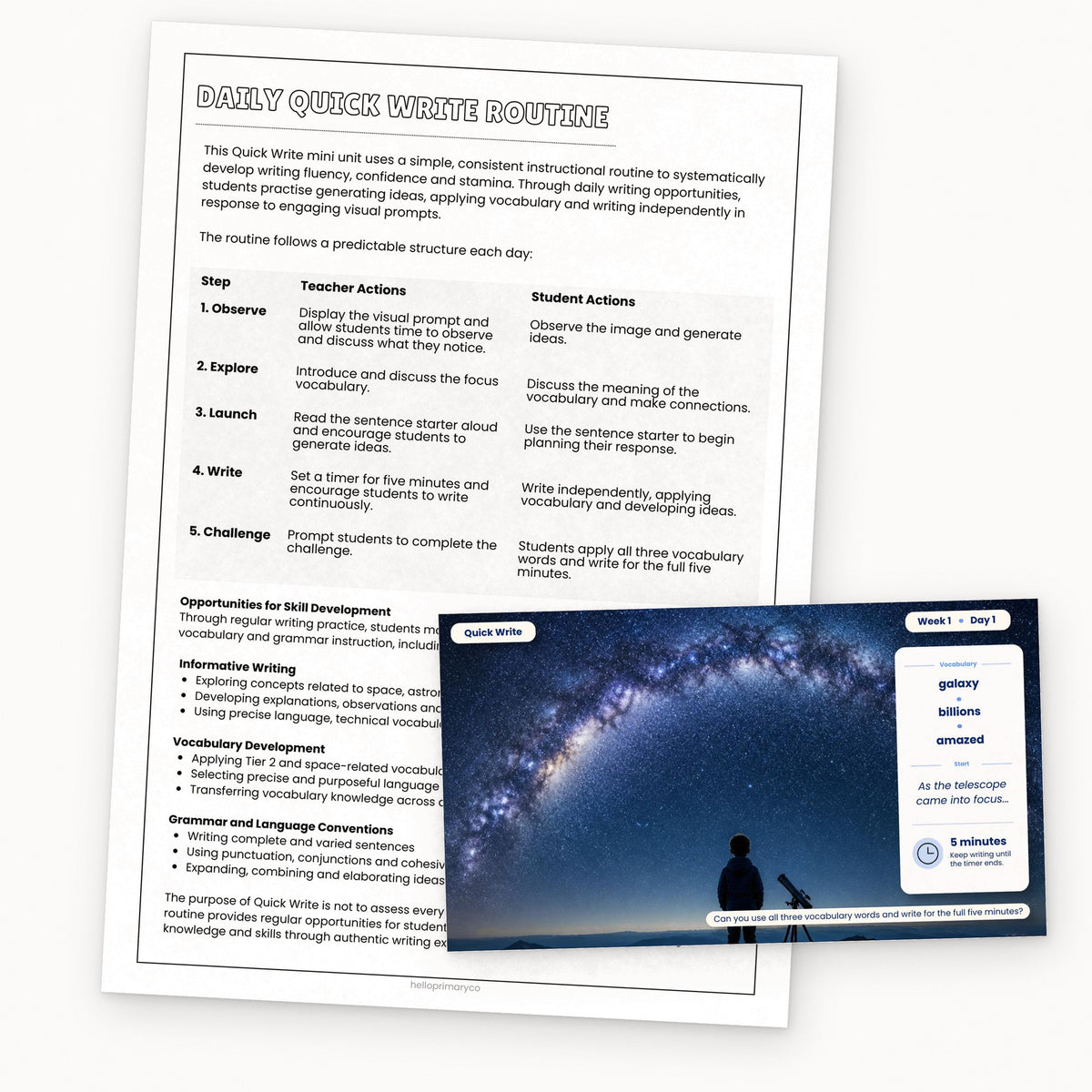
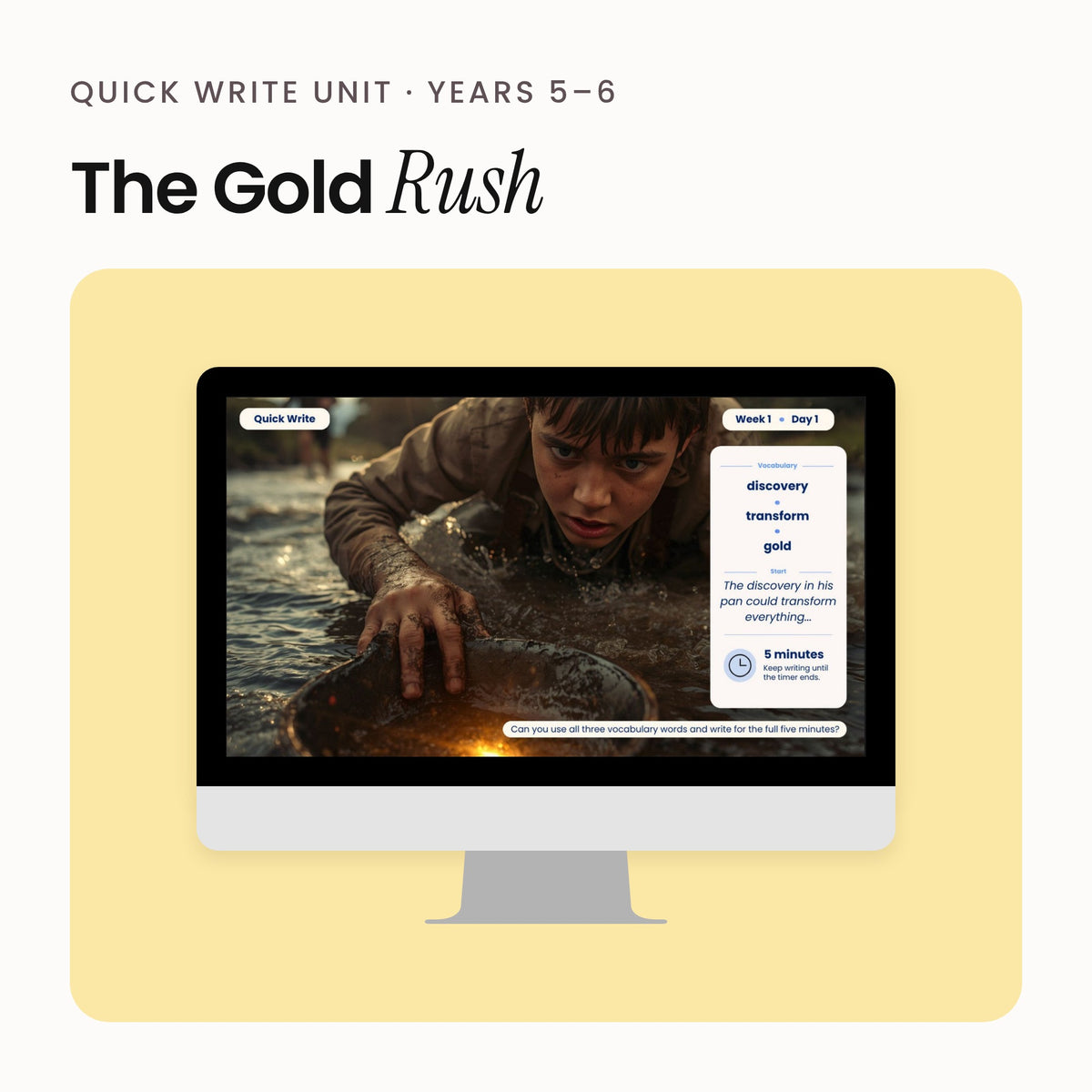
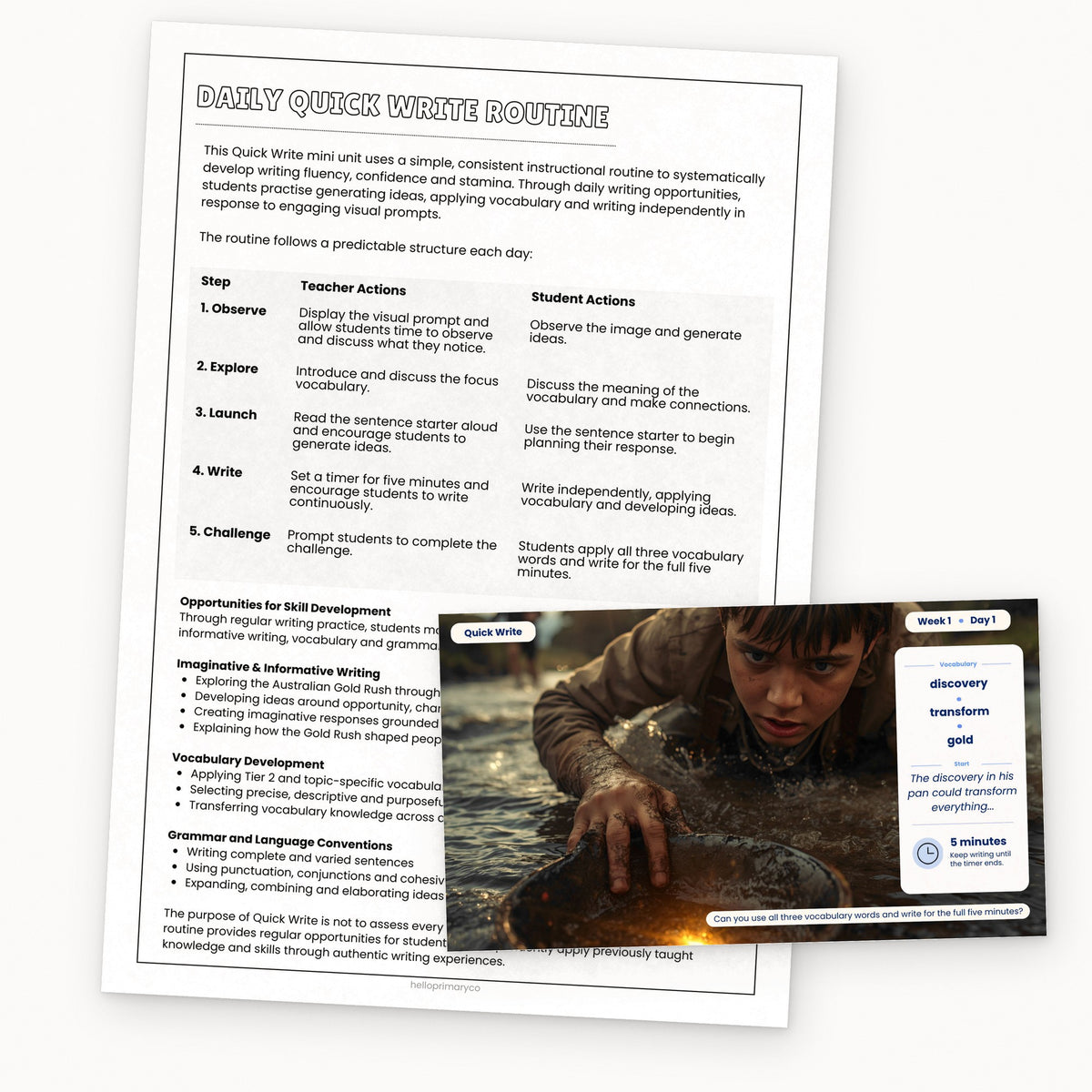
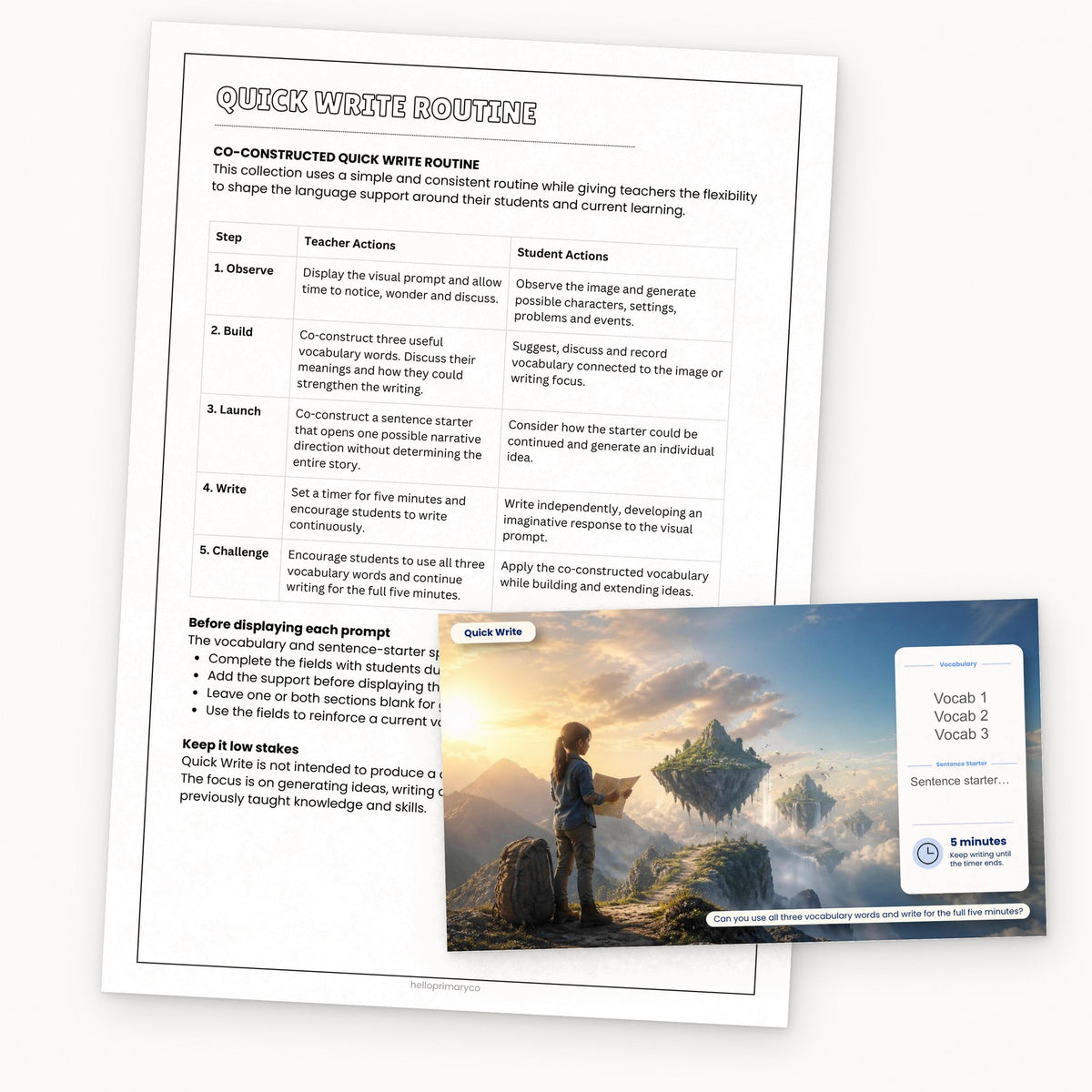
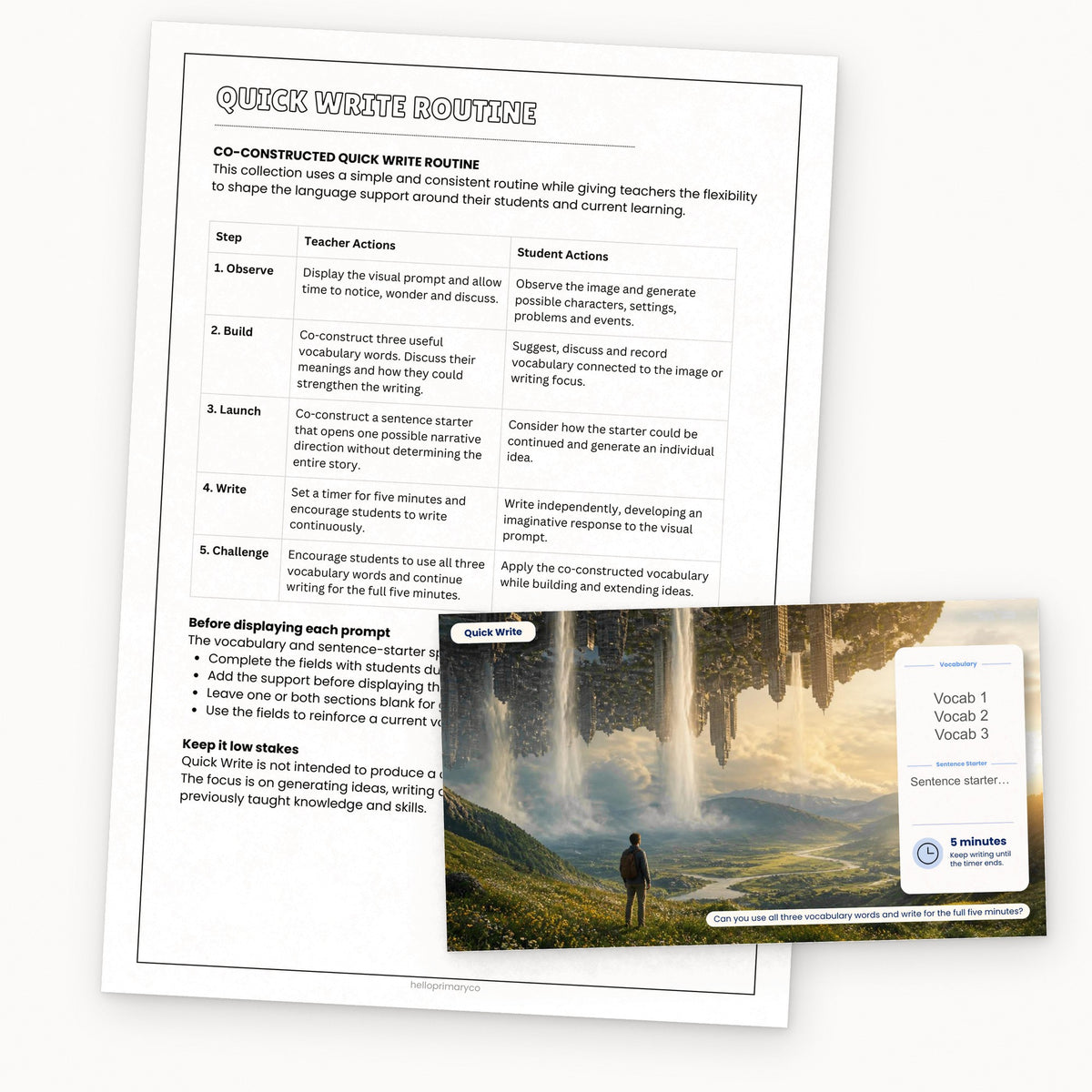
Every Quick Write follows the same five steps, so students know exactly what to do and can get straight into writing.
| Step | What happens | Why it helps |
|---|---|---|
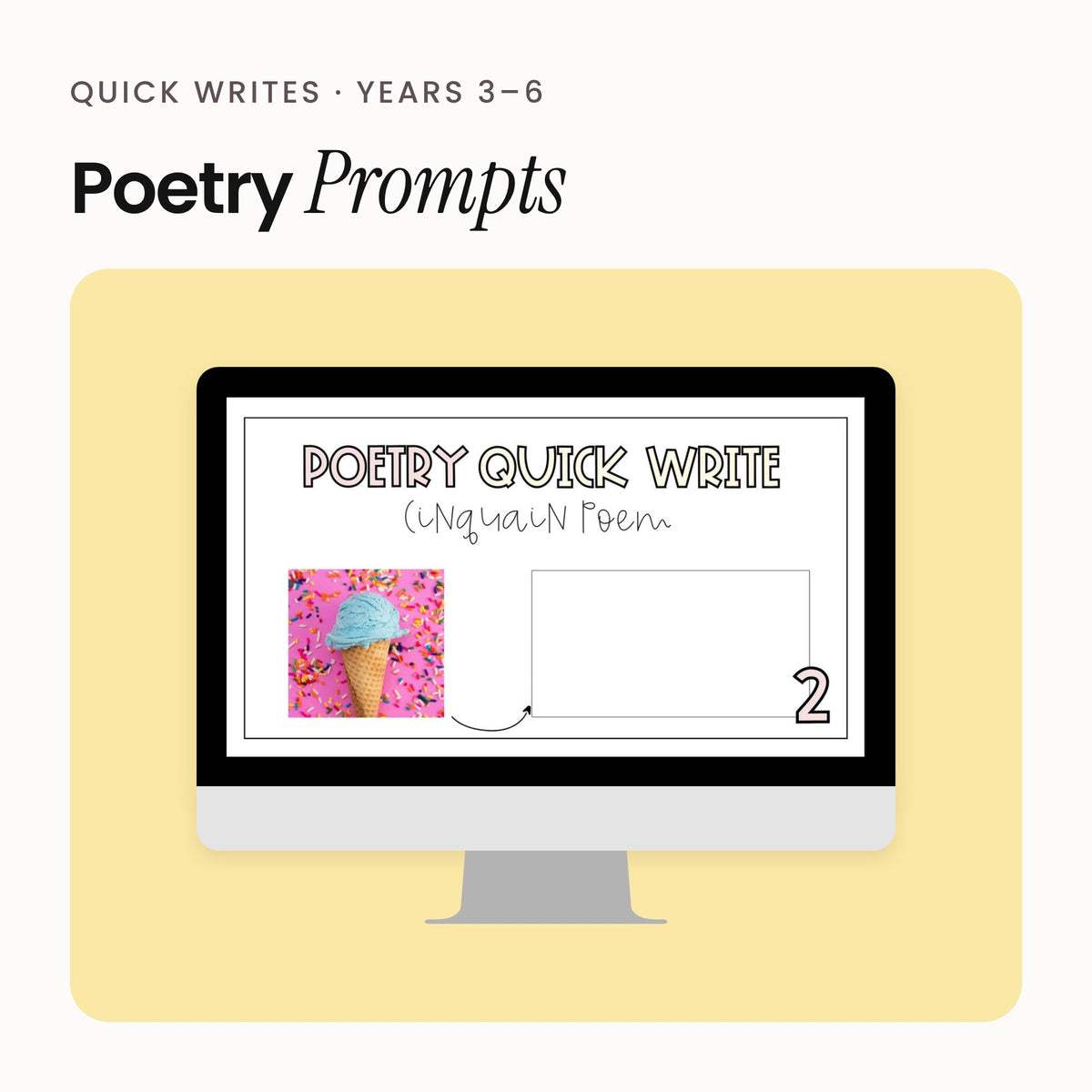
| Observe | Students look closely at a visual prompt and share ideas about what they notice. | Gives every student something to write about. |
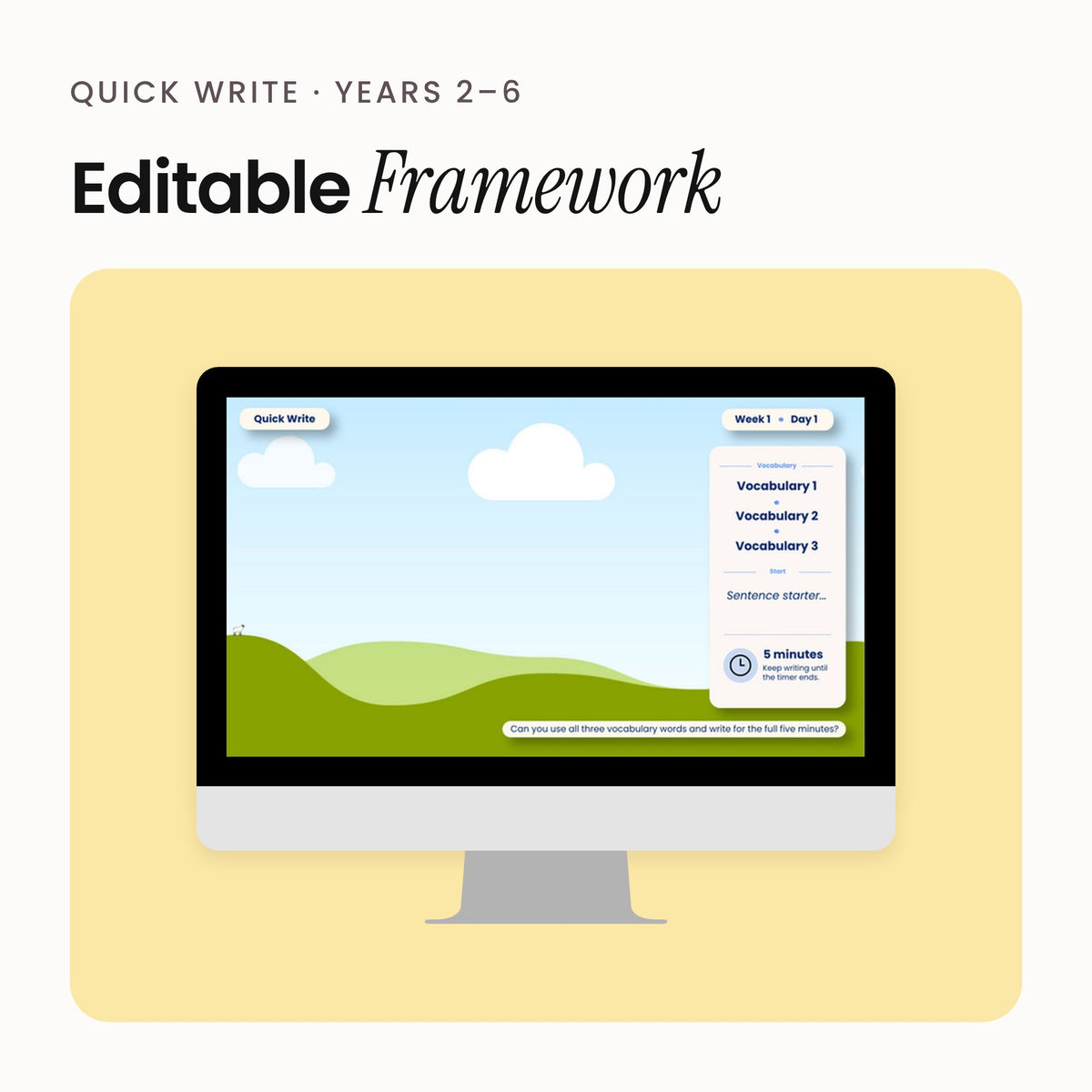
| Explore | The class discusses three focus vocabulary words. | Puts precise words within easy reach. |
| Launch | Students plan, using a sentence starter. | Removes the hardest part: the first sentence. |
| Write | Students write independently for five minutes. | Builds fluency and stamina. |
| Challenge | Students try to use all three words and keep writing for the full five minutes. | Stretches confident writers without slowing others down. |
Part of the connected literacy block. In the Quick Write mini units, the three focus words come from that week's fluency passage and Sentence of the Day, so students apply words they've already read and practised.
No. 03 — Two ways to use prompts
Ready-made, or built together
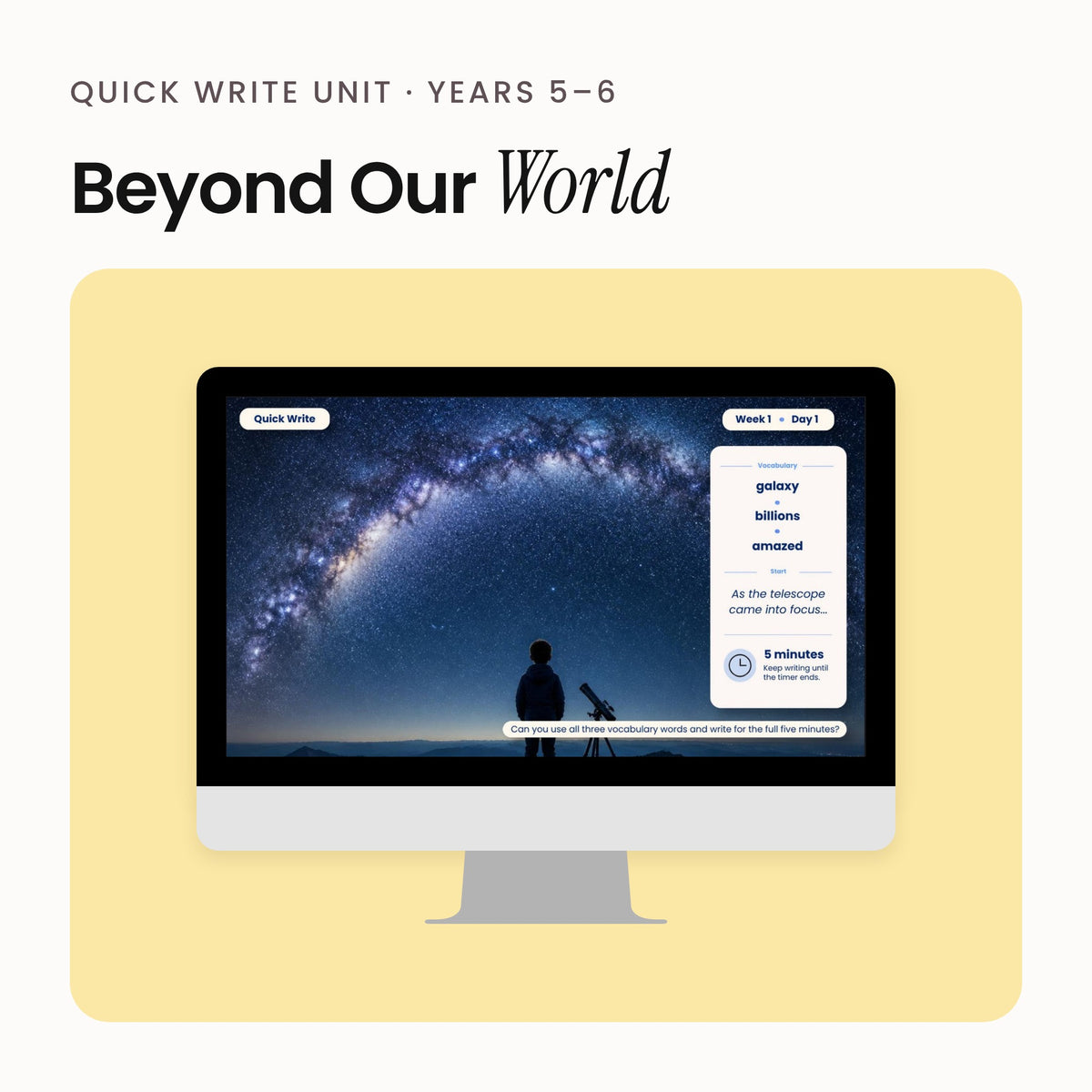
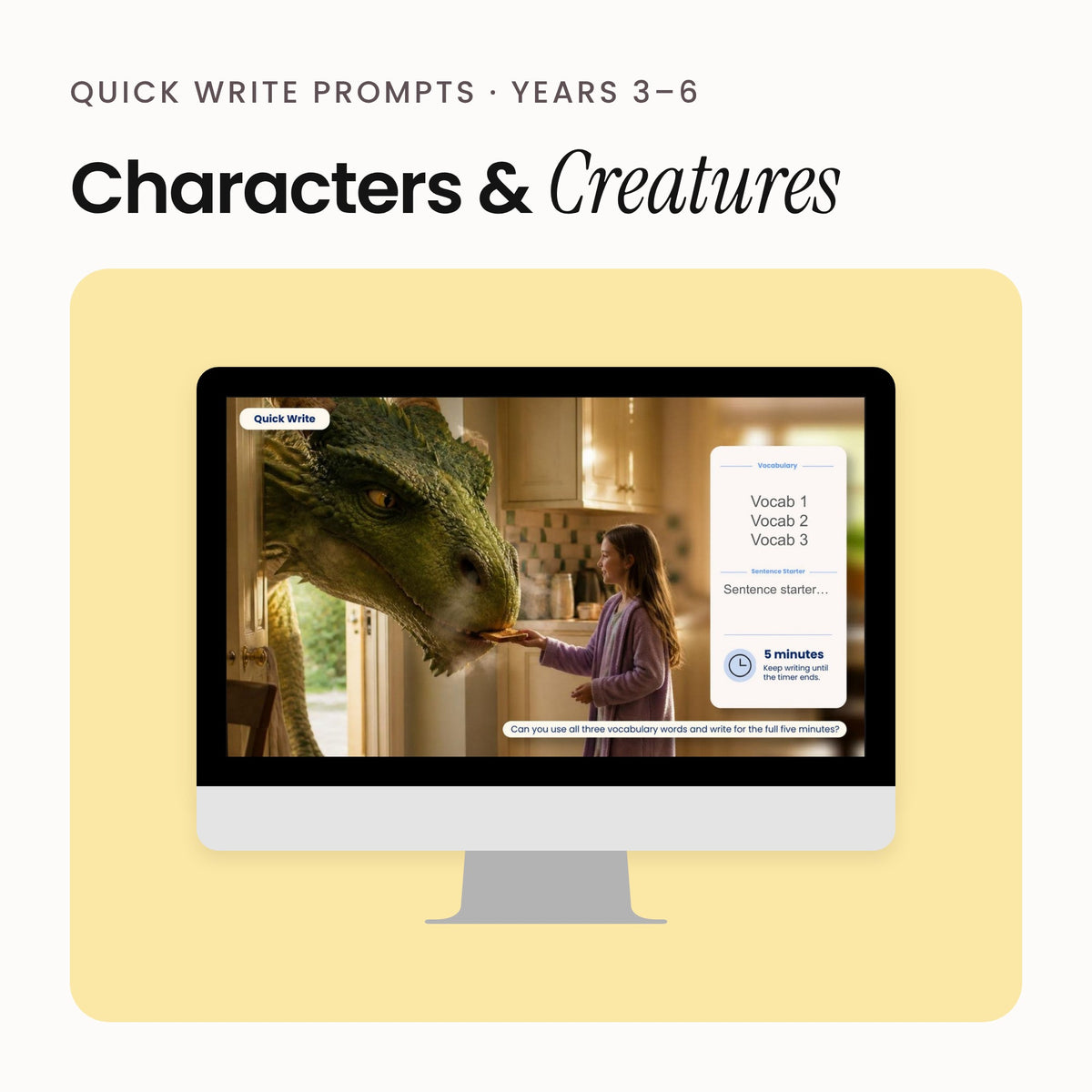
Ready-made. In the Quick Write mini units, every prompt comes with its three vocabulary words and sentence starter already chosen. They're linked to the week's theme, so there's nothing to prepare.
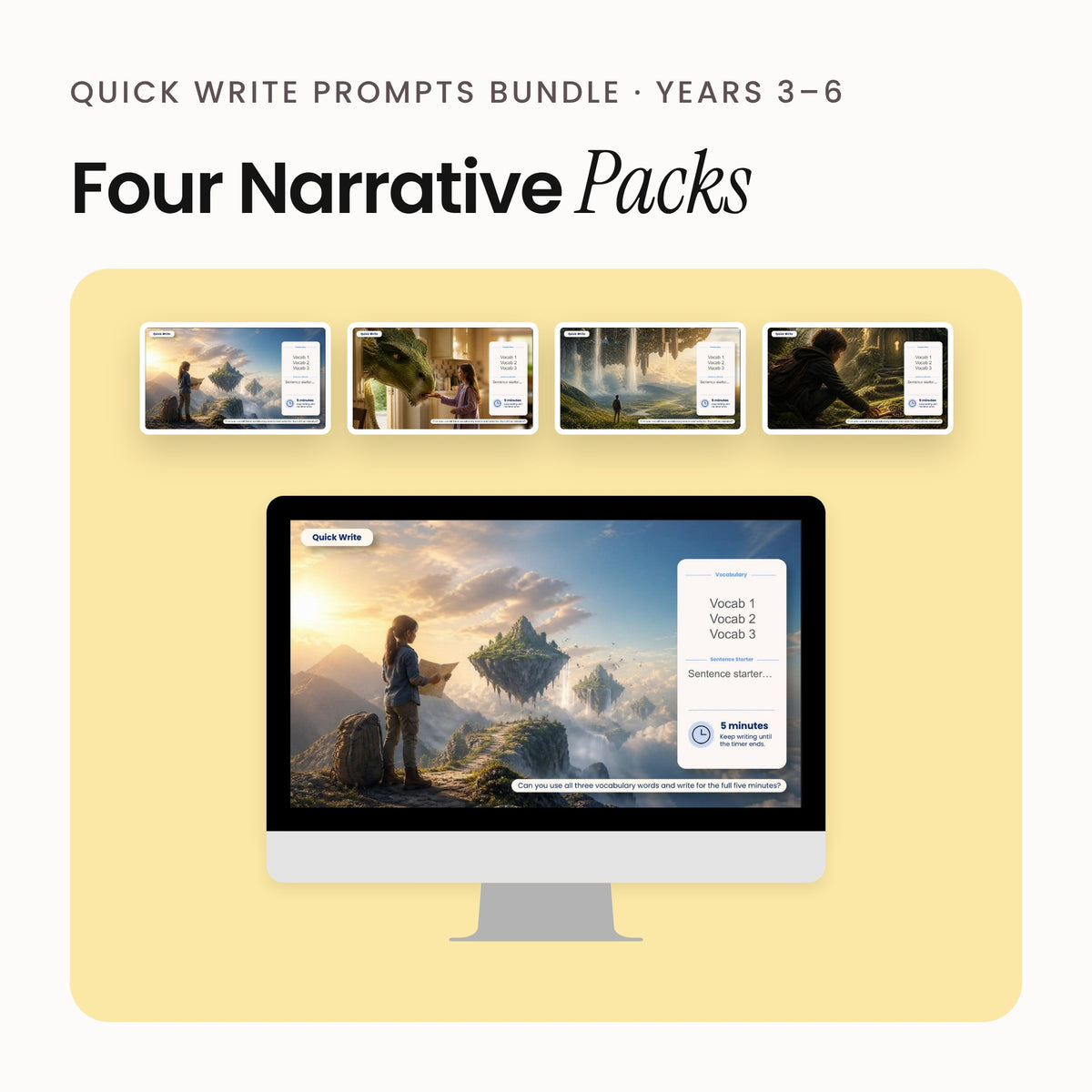
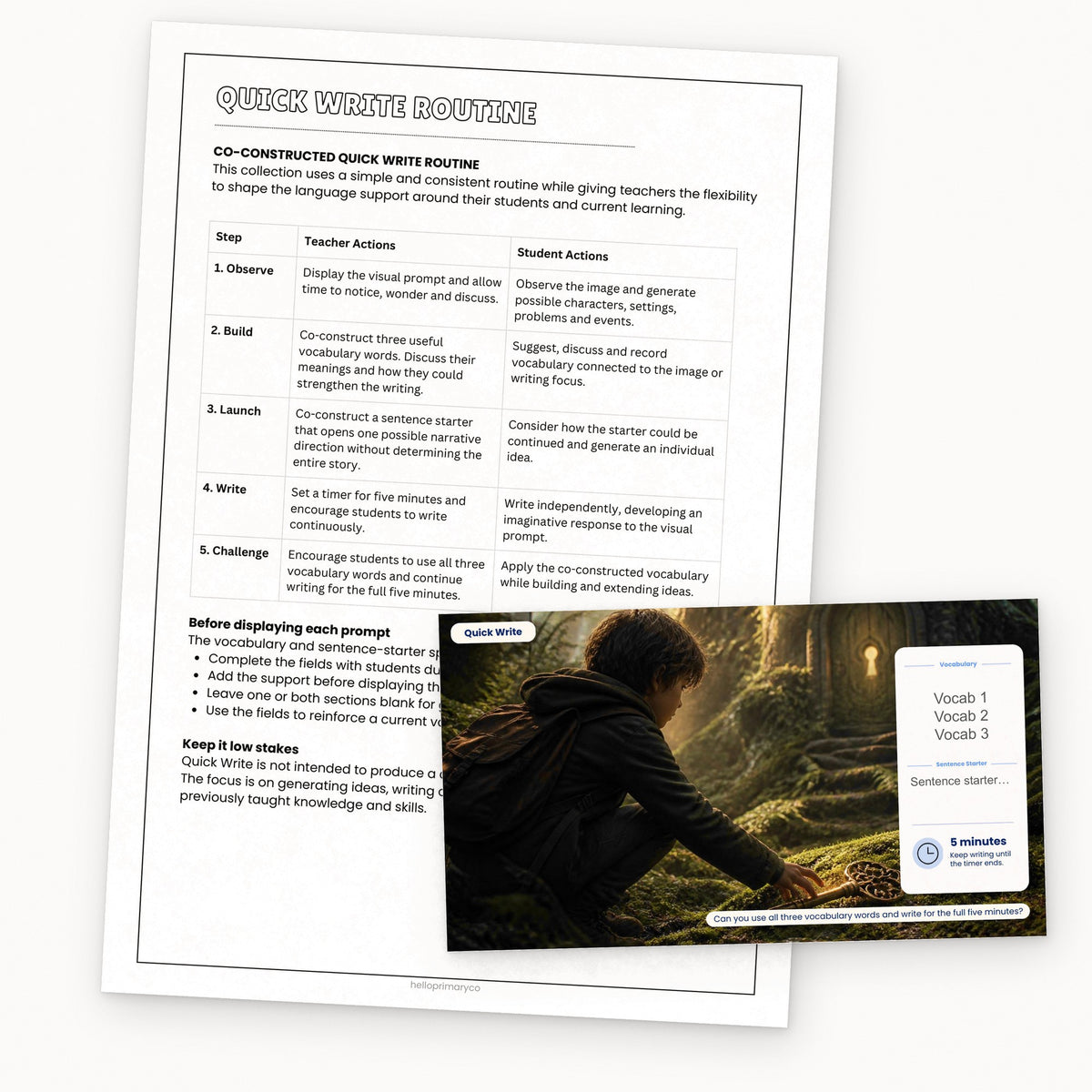
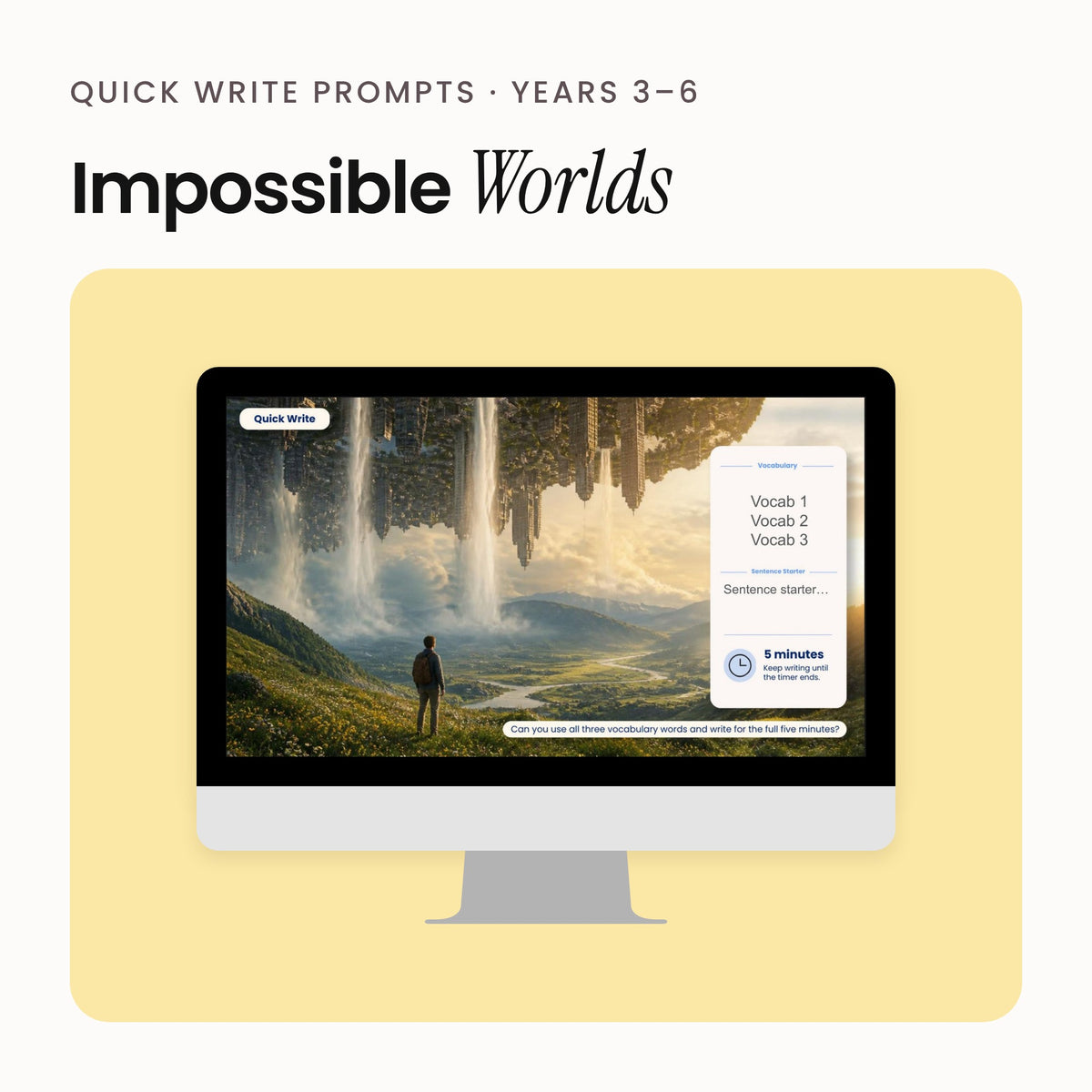
Co-constructed. In the Quick Write prompt collections, the spaces for the vocabulary words and sentence starter are left blank. Before writing, you fill them in together with your class: observe the image, choose three words, write a sentence starter together, then write.
Co-construction lets you revisit recent vocabulary, target the grammar or writing focus you're teaching right now, and adjust the support for your class. As students grow more confident, you can leave the spaces blank and let them build their own.
Whichever you use, finish by inviting a few students to share a sentence they're proud of. It takes a minute and shows the whole class what good writing sounds like.
No. 04 — Daily Literacy Review
Ten minutes, seven skills
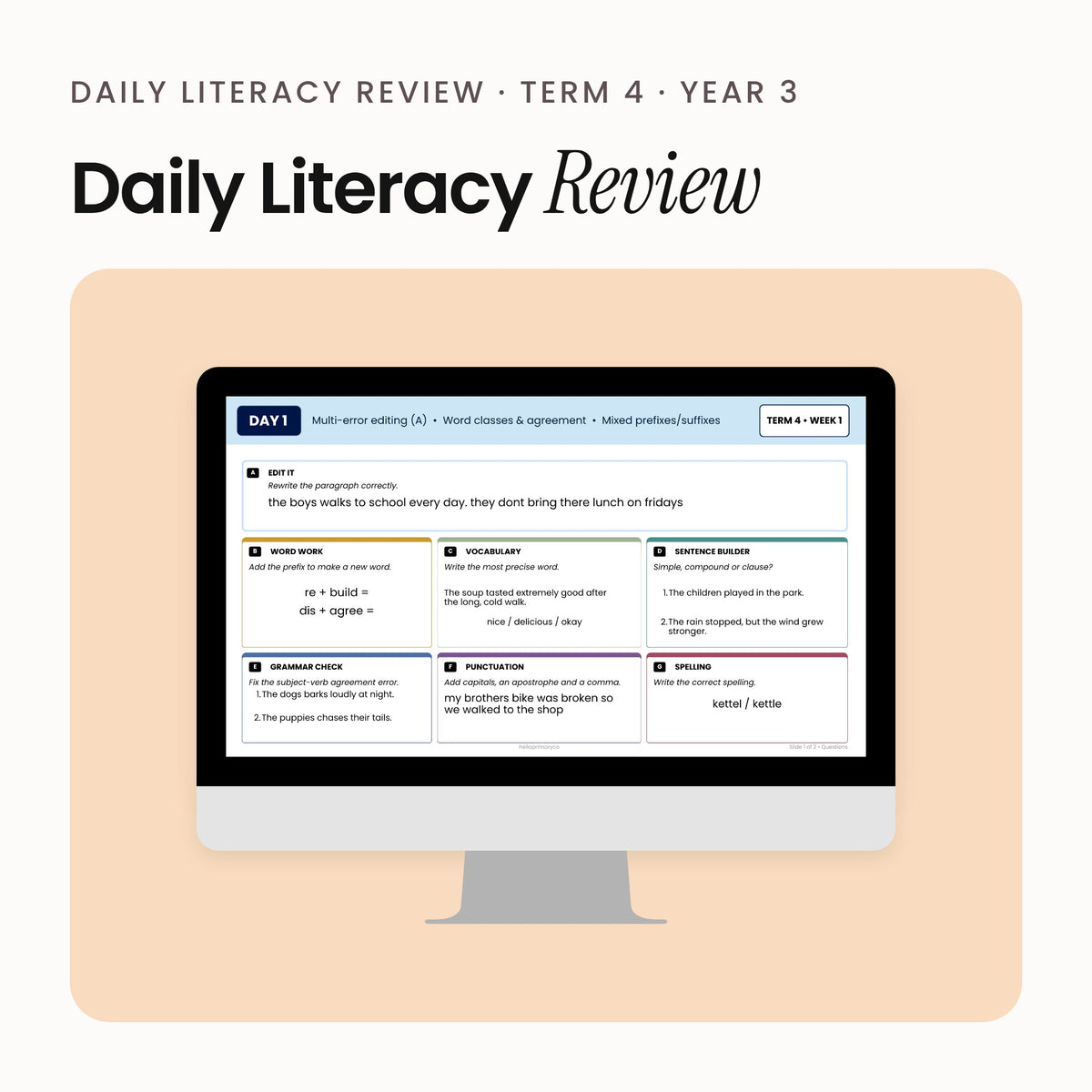
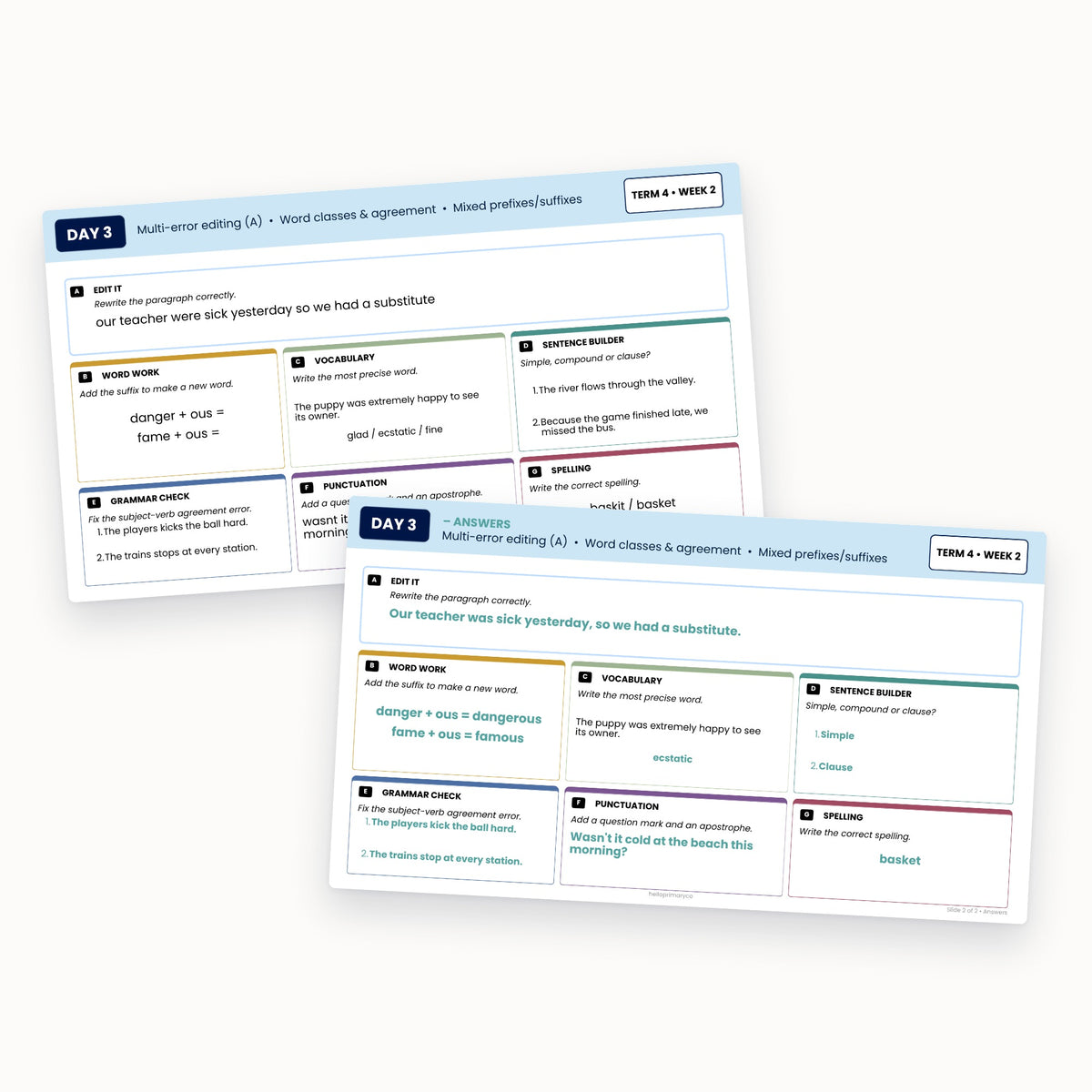
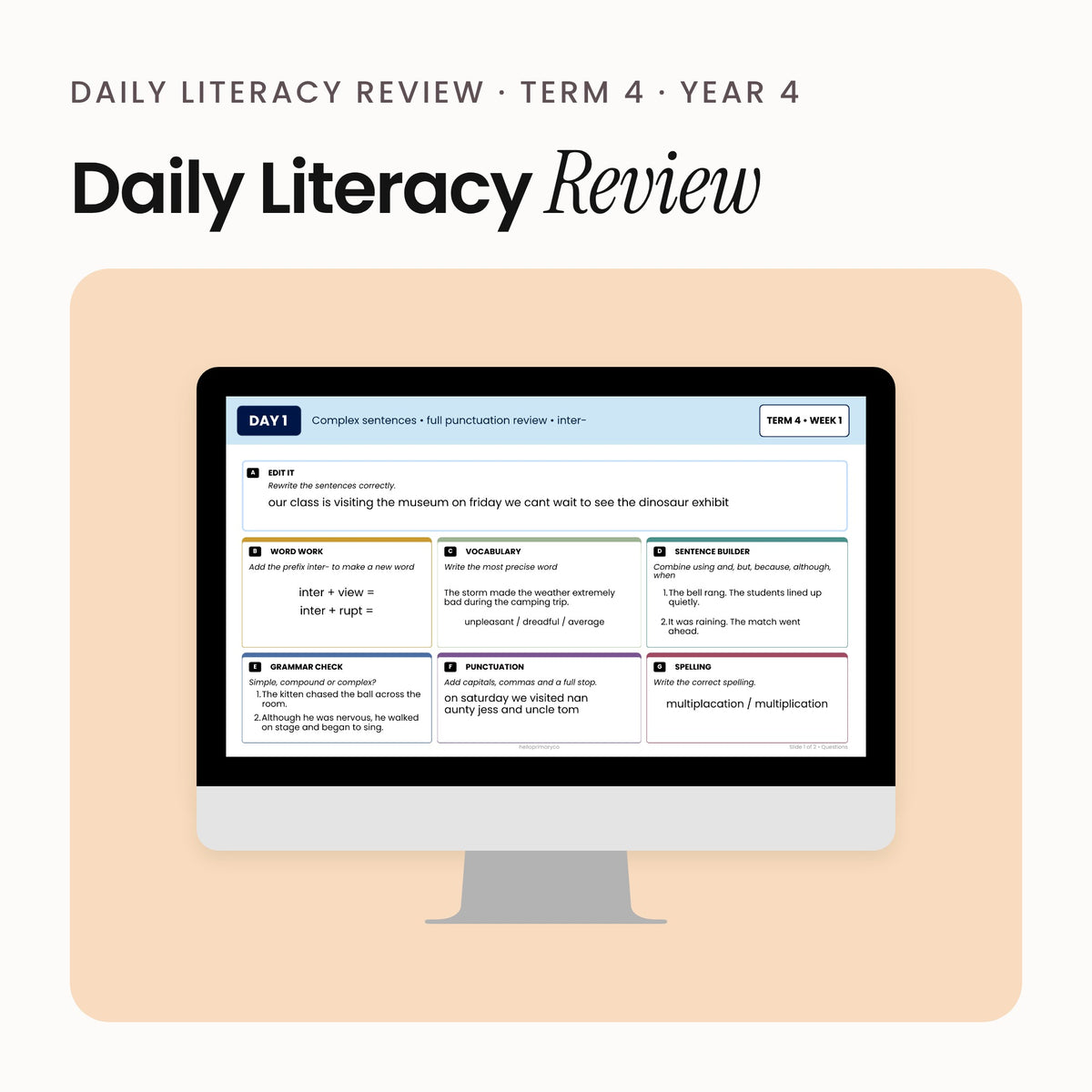
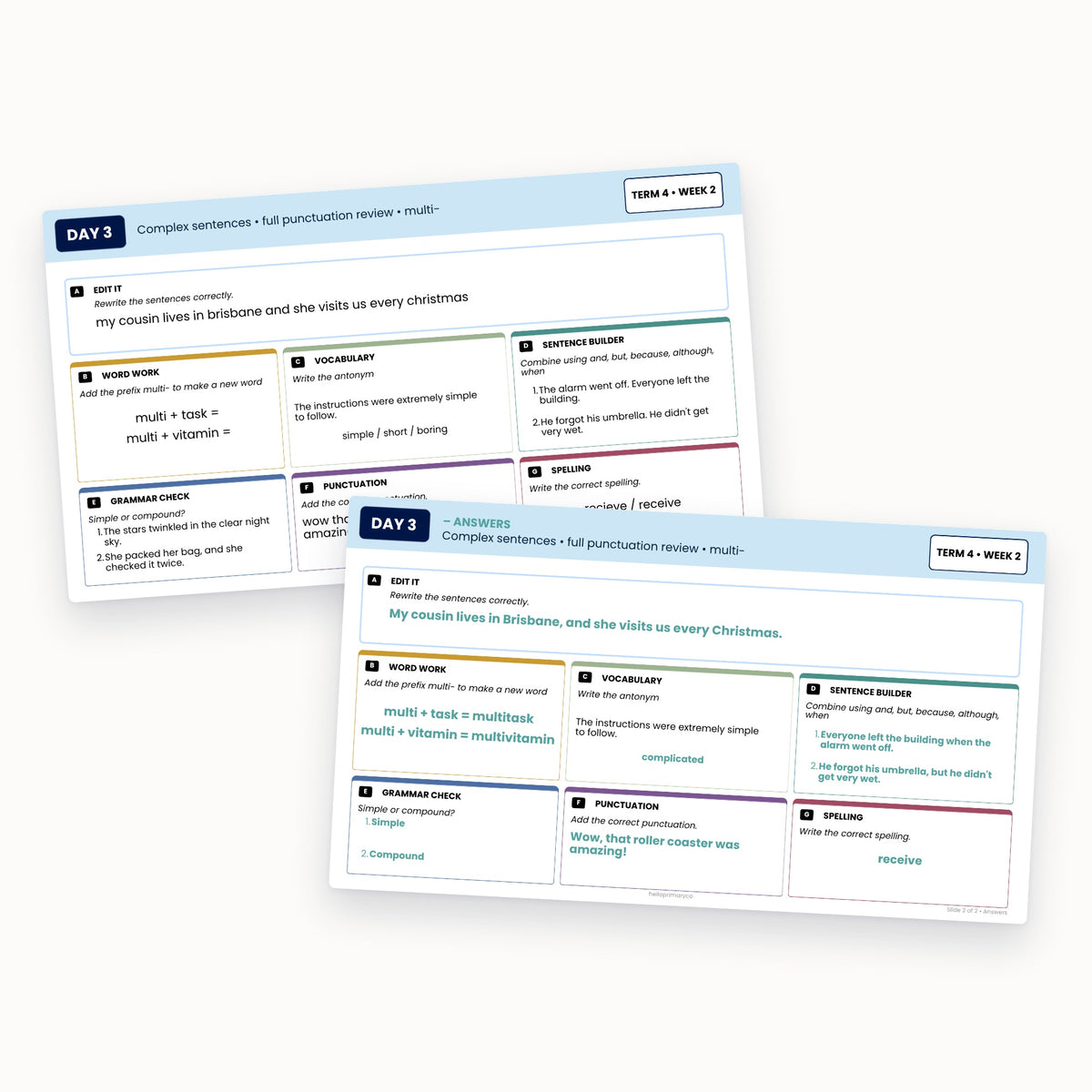
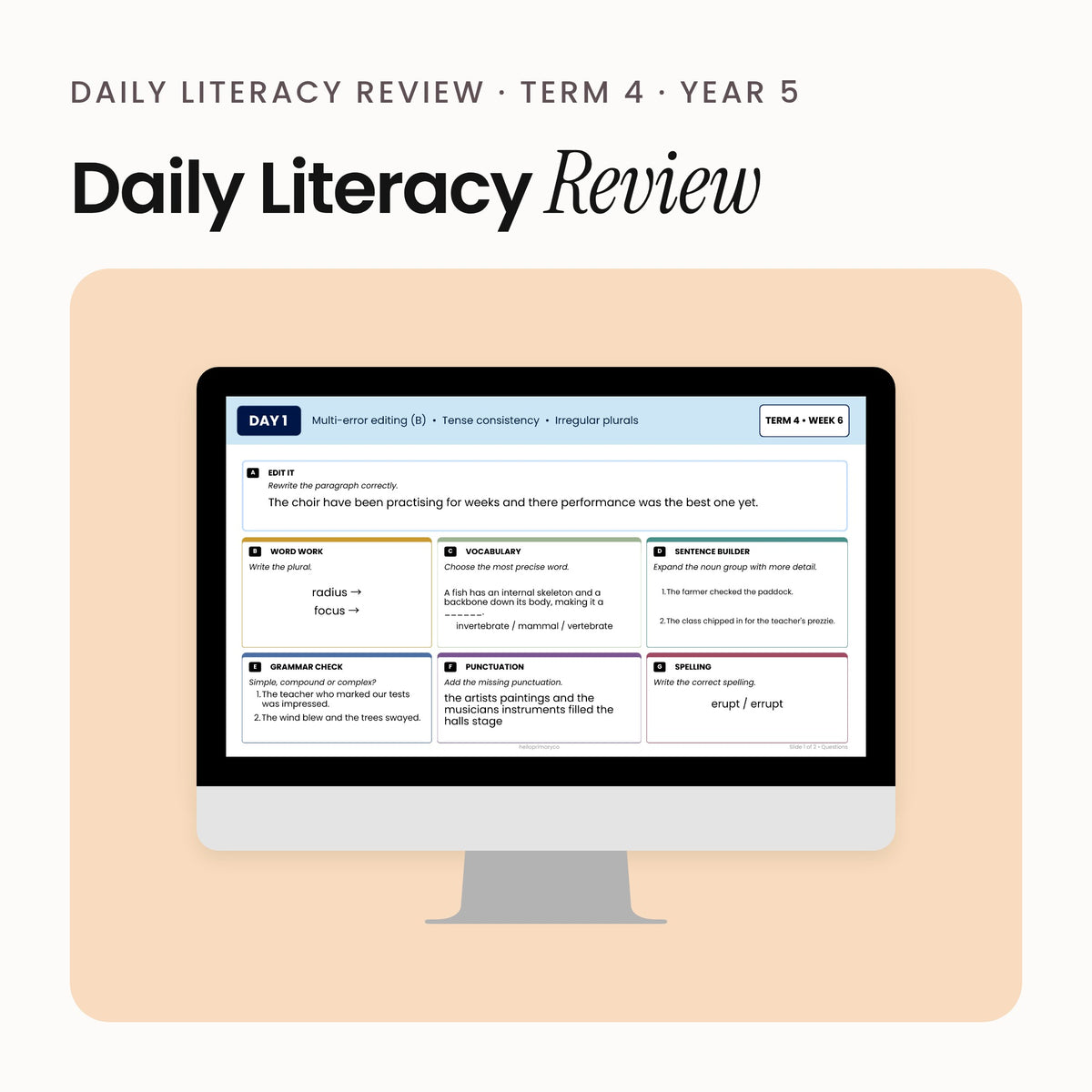
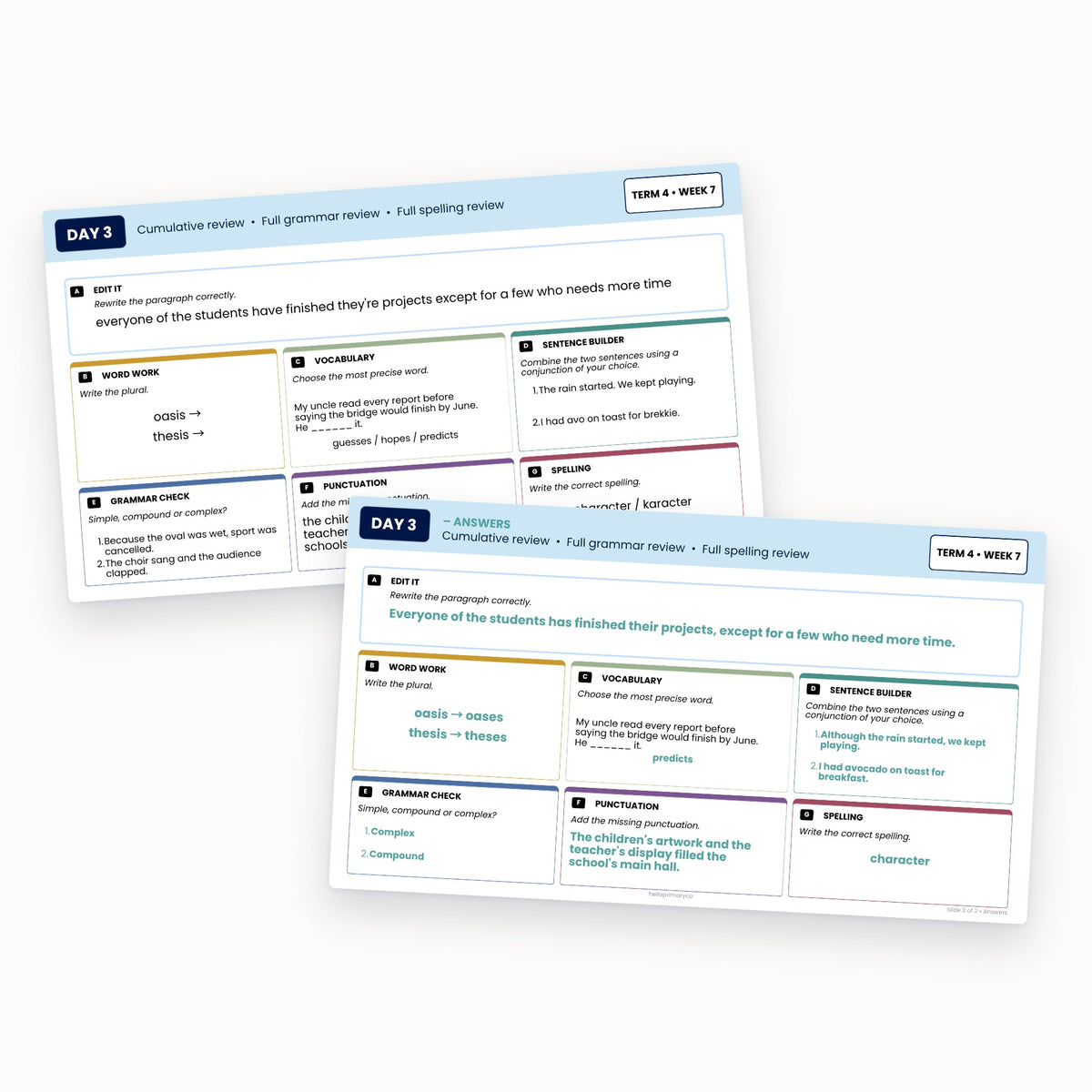
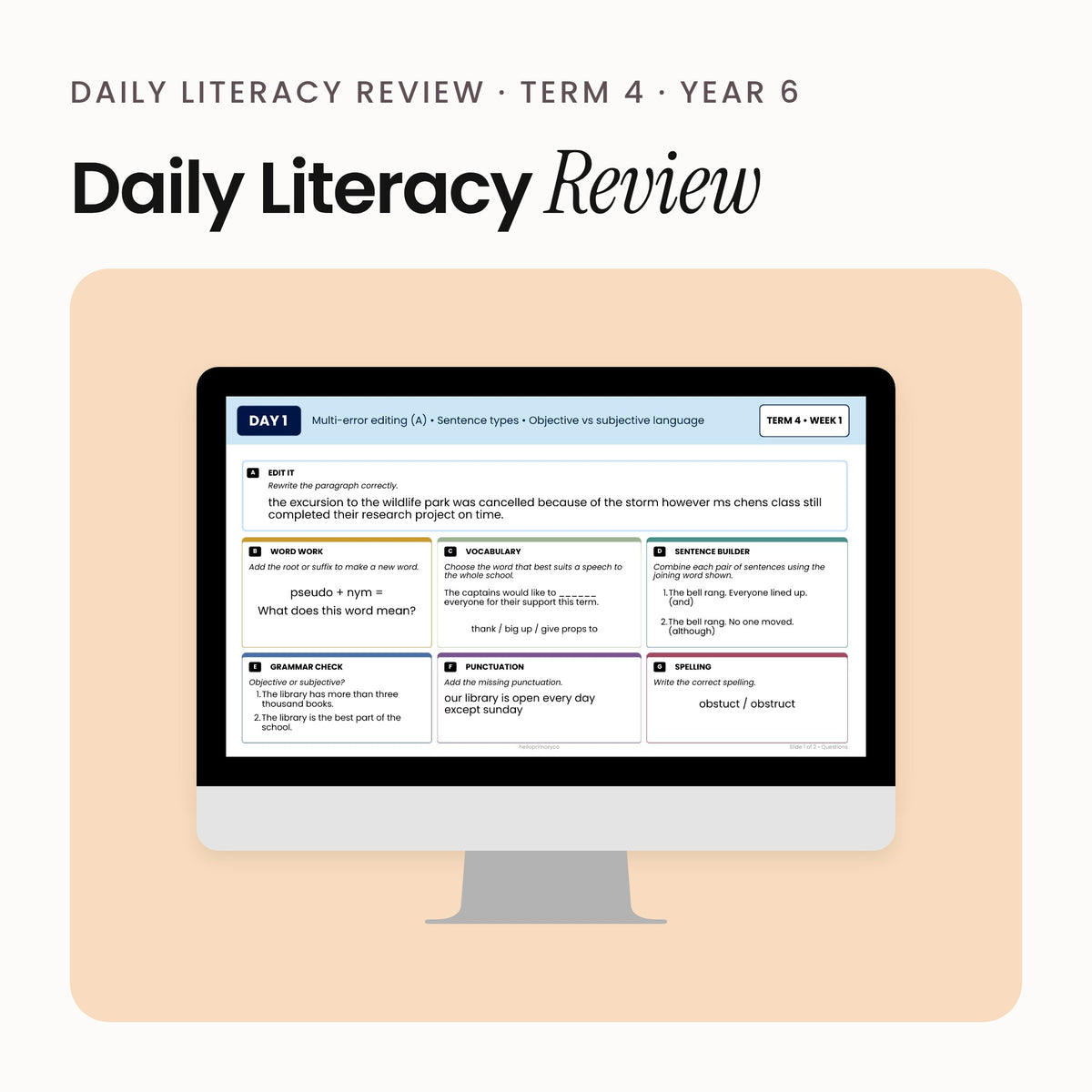
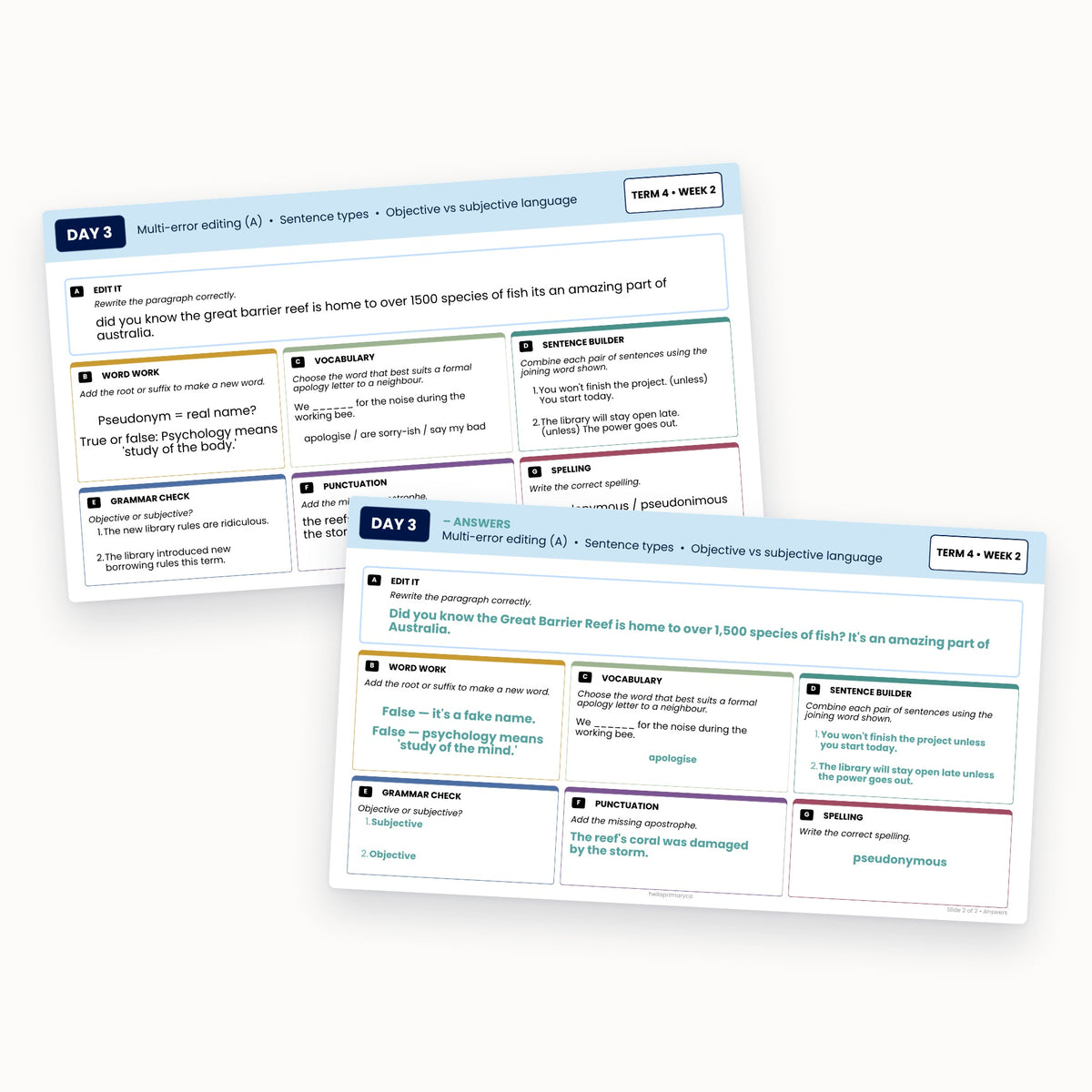
Daily Literacy Review is a ten-minute warm-up that revisits grammar, vocabulary, sentence construction, punctuation and spelling in one short sitting. Every day follows the same seven-part routine, so students spend their time practising the skills, not working out the format.
| Part | What students practise |
|---|---|
| Edit It | Finding and fixing errors in a short paragraph. |
| Word Work | Word parts, such as roots, prefixes and suffixes. |
| Vocabulary | The meaning and use of new words. |
| Sentence Builder | Constructing and improving sentences. |
| Grammar Check | Applying a grammar skill. |
| Punctuation | Using punctuation correctly. |
| Spelling | Spelling patterns and generalisations. |
Each day has a question slide followed by a fully worked answer slide, so students get feedback straight away. A weekly response sheet includes a check-in and a challenge that asks students to use one of the week's skills in their own writing.
No. 05 — Why spiralled review works
Use it, or lose it
A skill taught once, in one week, often fades by the end of the term. Students might use apostrophes correctly during the apostrophe lesson, then forget them a month later.
Spiralled review returns to skills regularly over time. Each time students retrieve and apply a skill, it becomes more secure. Mixing several skills in one short session also helps students learn to recognise which skill a task needs, just as they have to in their own writing.
Two things make it work in the classroom: keep it short, so it happens every day, and keep the format the same, so the thinking goes into the skills. Immediate feedback and a weekly chance to use the skills in their own writing help them transfer.
No. 06 — Curriculum links
Where it sits in the curriculum
These routines address these outcomes from the NSW English K–10 Syllabus (2022) and these content descriptions from the Australian Curriculum: English v9.0.
NSW English K–10 Syllabus
| Focus | Stage 2Years 3–4 | Stage 3Years 5–6 |
|---|---|---|
| Writing | EN2-CWT-01, 02, 03Creating written texts for imaginative, informative and persuasive purposes | EN3-CWT-01Creating written texts for multiple purposes and audiences |
| Vocabulary | EN2-VOCAB-01Vocabulary | EN3-VOCAB-01Vocabulary |
| Spelling | EN2-SPELL-01Spelling | EN3-SPELL-01Spelling |
Australian Curriculum: English v9.0
| Focus | Years 3–4Year 3 · Year 4 | Years 5–6Year 5 · Year 6 |
|---|---|---|
| Creating written texts | AC9E3LY06 · AC9E4LY06Planning, creating and editing written texts | AC9E5LY06 · AC9E6LY06Planning, creating and editing written texts |
| Vocabulary | AC9E3LA10 · AC9E4LA11Extending vocabulary | AC9E5LA08 · AC9E6LA08Vocabulary for precision and effect |
| Sentences | AC9E3LA06 · AC9E4LA06Clauses and complex sentences | AC9E5LA05 · AC9E6LA05Complex sentences and embedded clauses |
| Spelling and word parts | AC9E3LY10 · AC9E4LY10Base words, prefixes and suffixes | AC9E5LY09 · AC9E6LY09Building and spelling new words from word parts and origins |
Each Daily Literacy Review lists the specific outcomes and content descriptions for its year level. Year 2 resources link to the matching NSW Stage 1 outcomes and Year 2 content descriptions.
Quick Writes & Daily Review resources
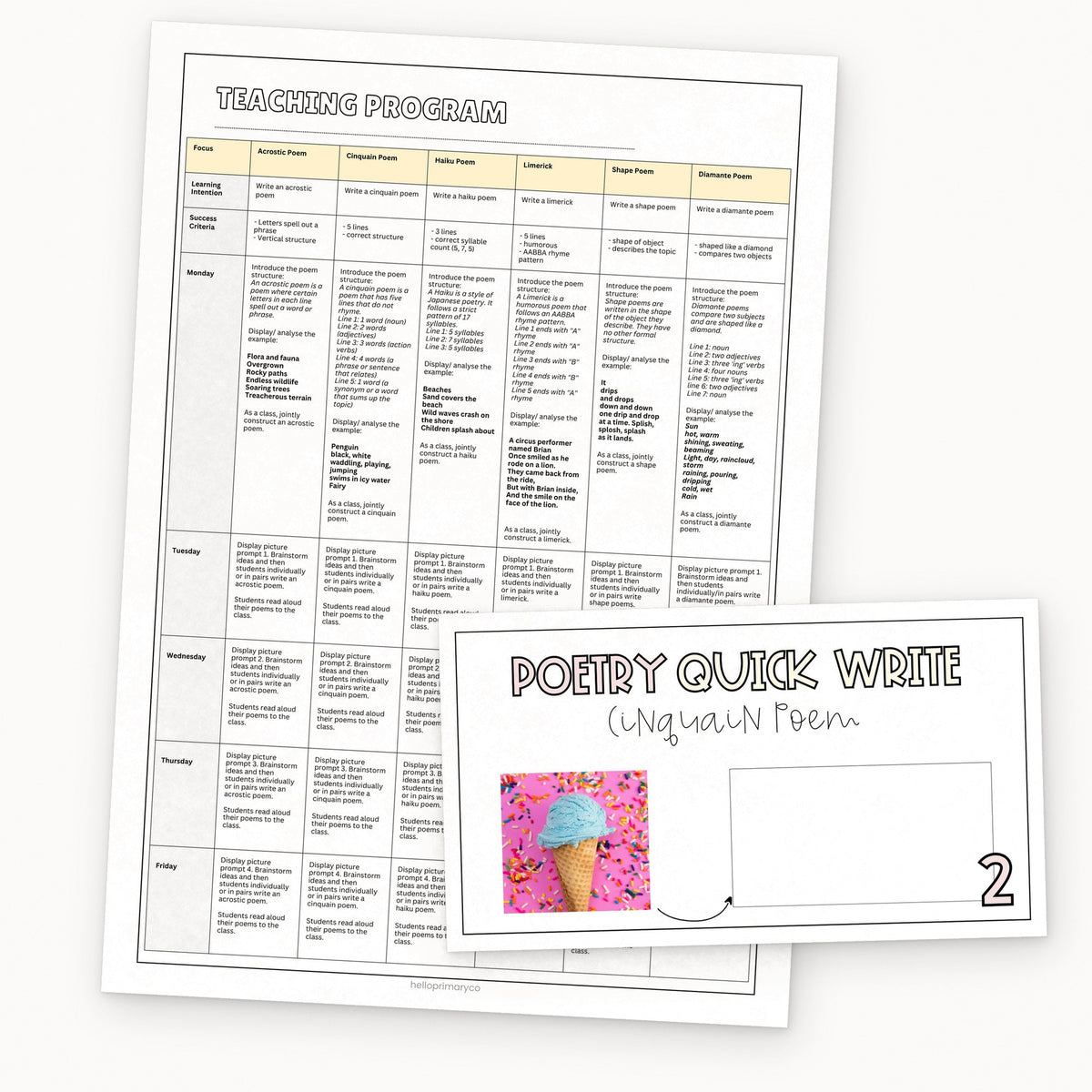
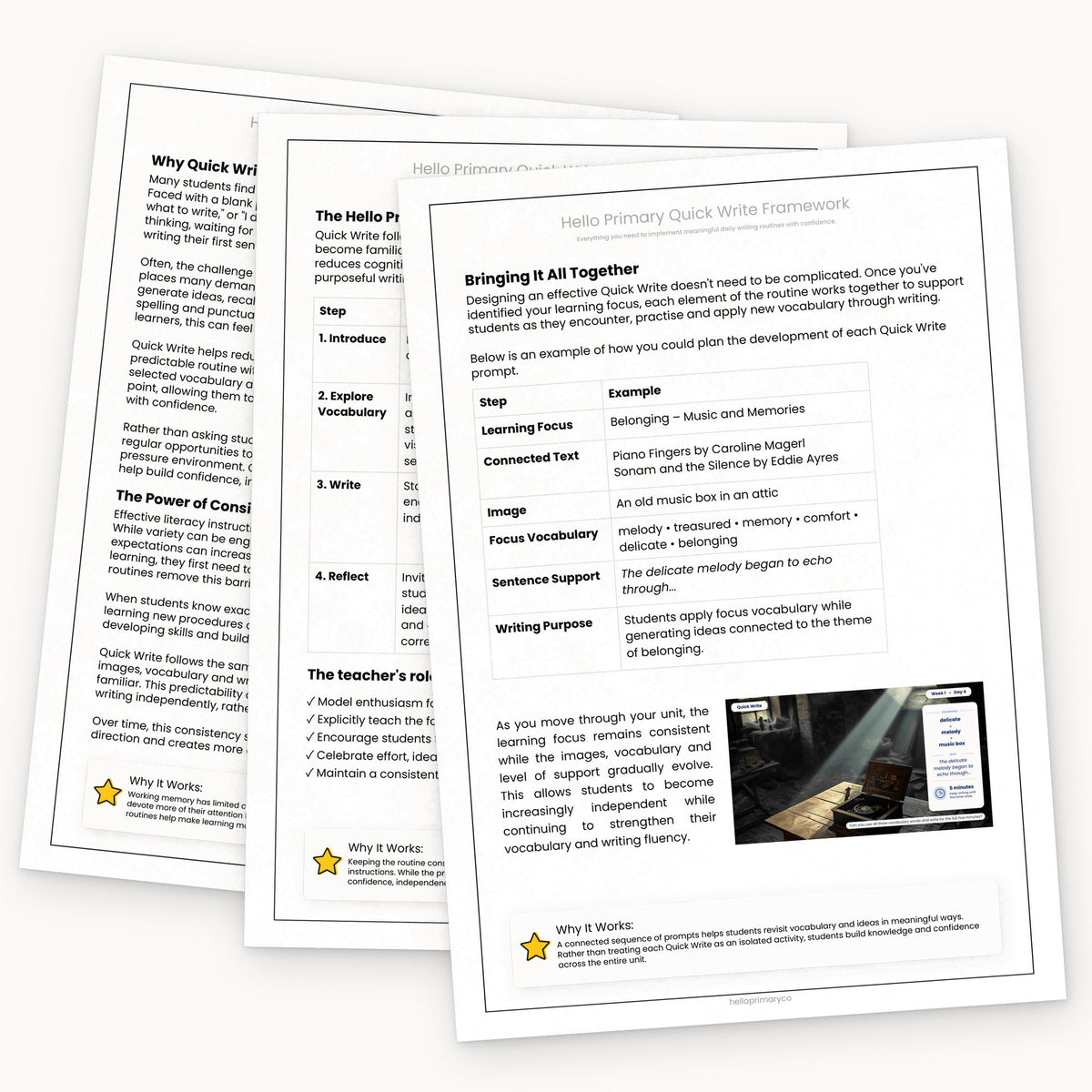
Five-week Quick Write units, co-constructed prompt collections and Daily Literacy Review for Years 3–6. Want to write your own Quick Writes? The Quick Write Framework shows you how.





Literacy, Unpacked
Keep exploring
The connected literacy block
How fluency, Sentence of the Day and Quick Writes share one theme and one set of words.
Reading fluency
What fluent reading sounds like and how to run a four-day routine with three levels of one passage.
Spelling & vocabulary
A four-lesson weekly sequence for vocabulary, spelling and Sentence of the Day.
- Coming soon
Reading comprehension
Literal and inferential understanding, thinking routines and measuring growth.
- Coming soon
Teaching writing
Explicit mini lessons, mentor sentences, revising and editing, and matched writing assessments.