
Literacy, Unpacked · Practical guide
Spelling & vocabulary, unpacked
A four-lesson weekly sequence that brings vocabulary, spelling and sentence work together, so students learn how words work, how to spell them and how to use them in their writing.
What you'll learn
- Which words to teach, and how to introduce them so they stick
- How a four-lesson weekly sequence connects vocabulary, spelling and sentences
- How spelling investigation builds knowledge of phonemes and graphemes
- How word study, dictation and Sentence of the Day help students apply it all
No. 01 — Choosing the words
Not every word, the right words
The NSW English K–10 Syllabus describes vocabulary in three tiers:
Tier 1: everyday words most students already know, like walk or happy.
Tier 2: words that appear across many texts and subjects but rarely come up in everyday talk, like curious, determined or ancient.
Tier 3: subject-specific words, like photosynthesis or federation.
Tier 2 words give you the most value for explicit teaching. Students meet them in books, but they're unlikely to pick them up from conversation, and once learnt they can be used in almost any piece of writing. Tier 3 words matter when they're central to understanding a text or topic.
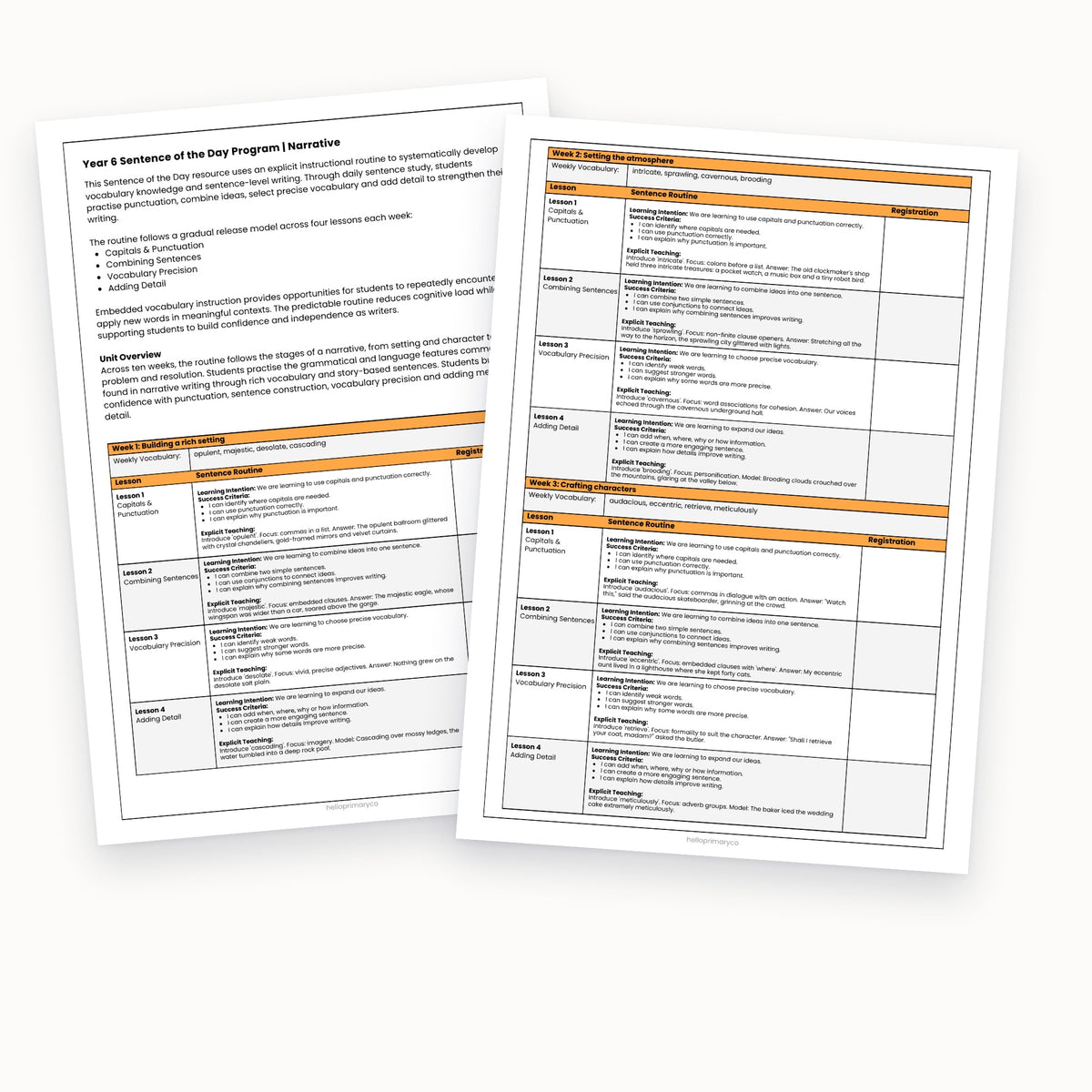
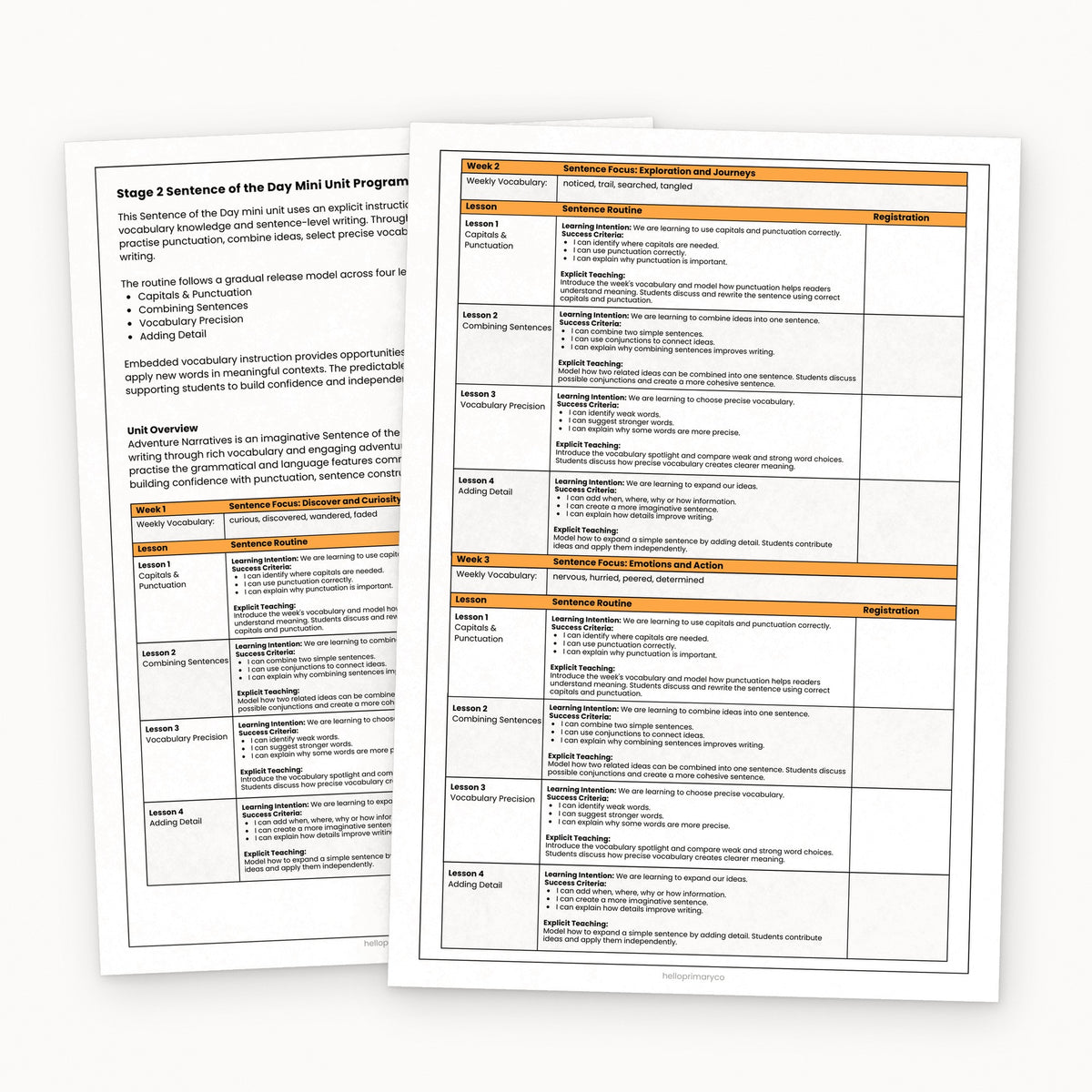
Each week, students meet six key Tier 2 and/or Tier 3 words in the fluency passage. Four of them then become the focus of Sentence of the Day, so students practise using them in their own sentences.
No. 02 — The weekly sequence
Four lessons, one connected week
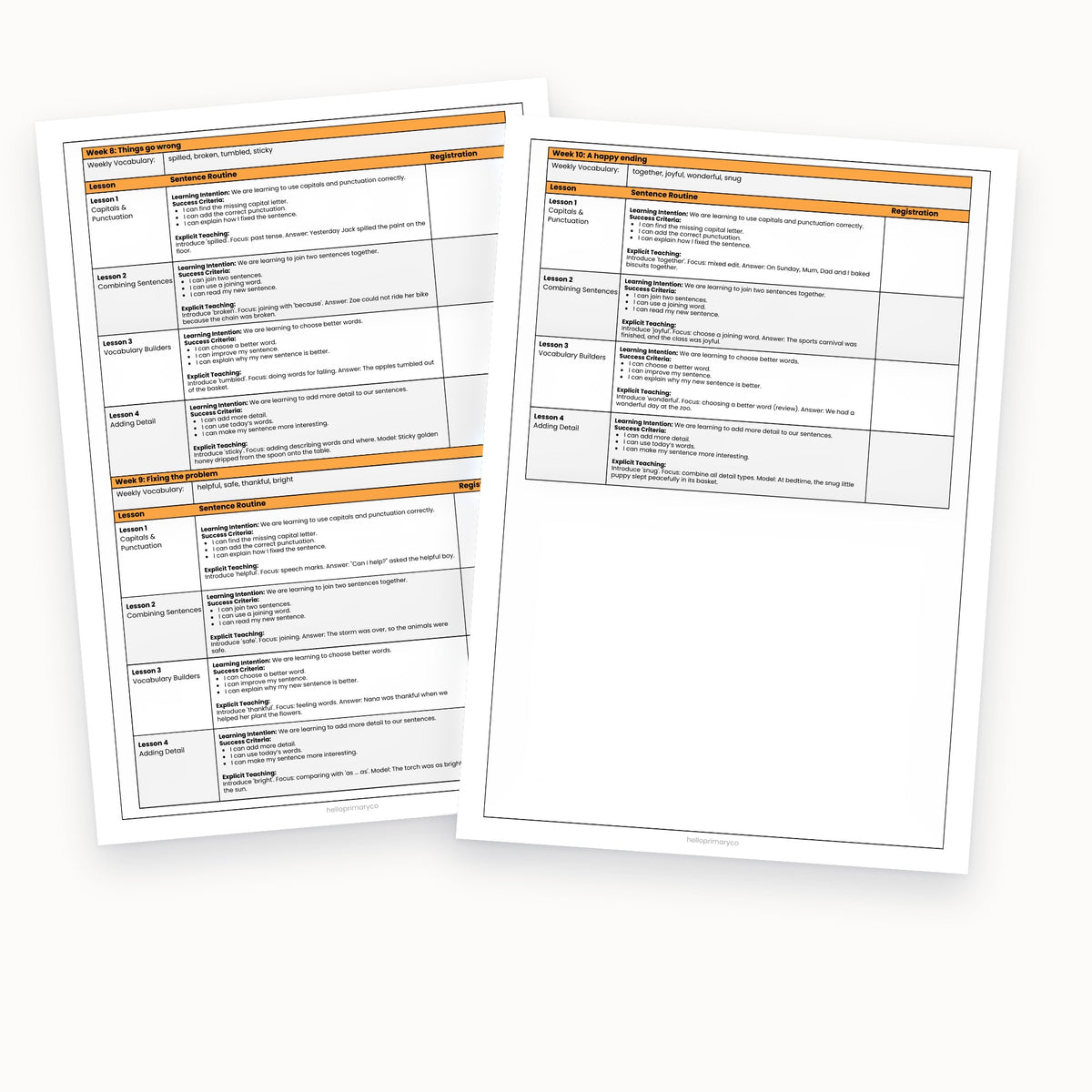
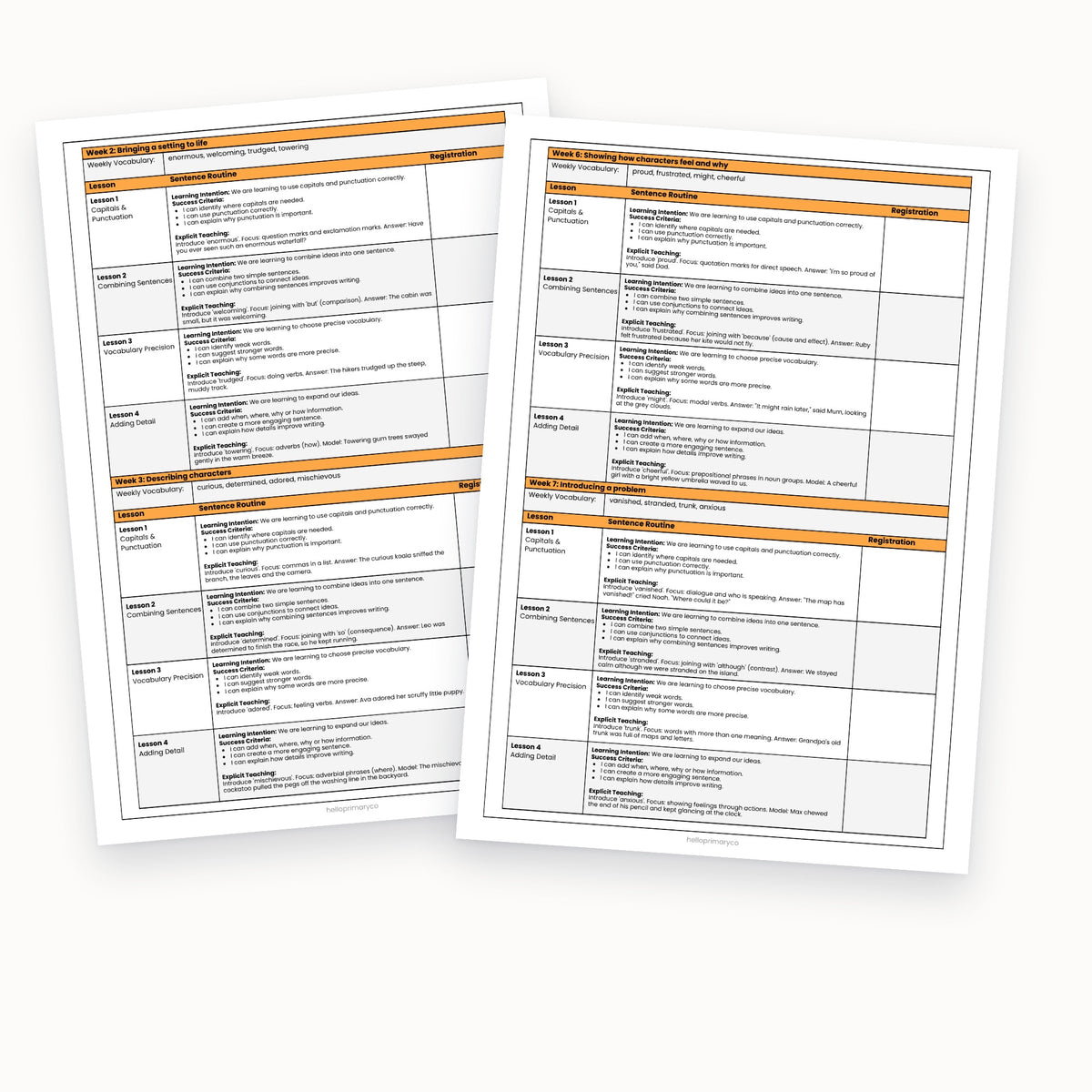
Each lesson has three parts: vocabulary, spelling or word study, and Sentence of the Day. Across the week, students move from meeting new words and sounds, to practising them, to applying them independently.
| Lesson | What happens | What's covered |
|---|---|---|
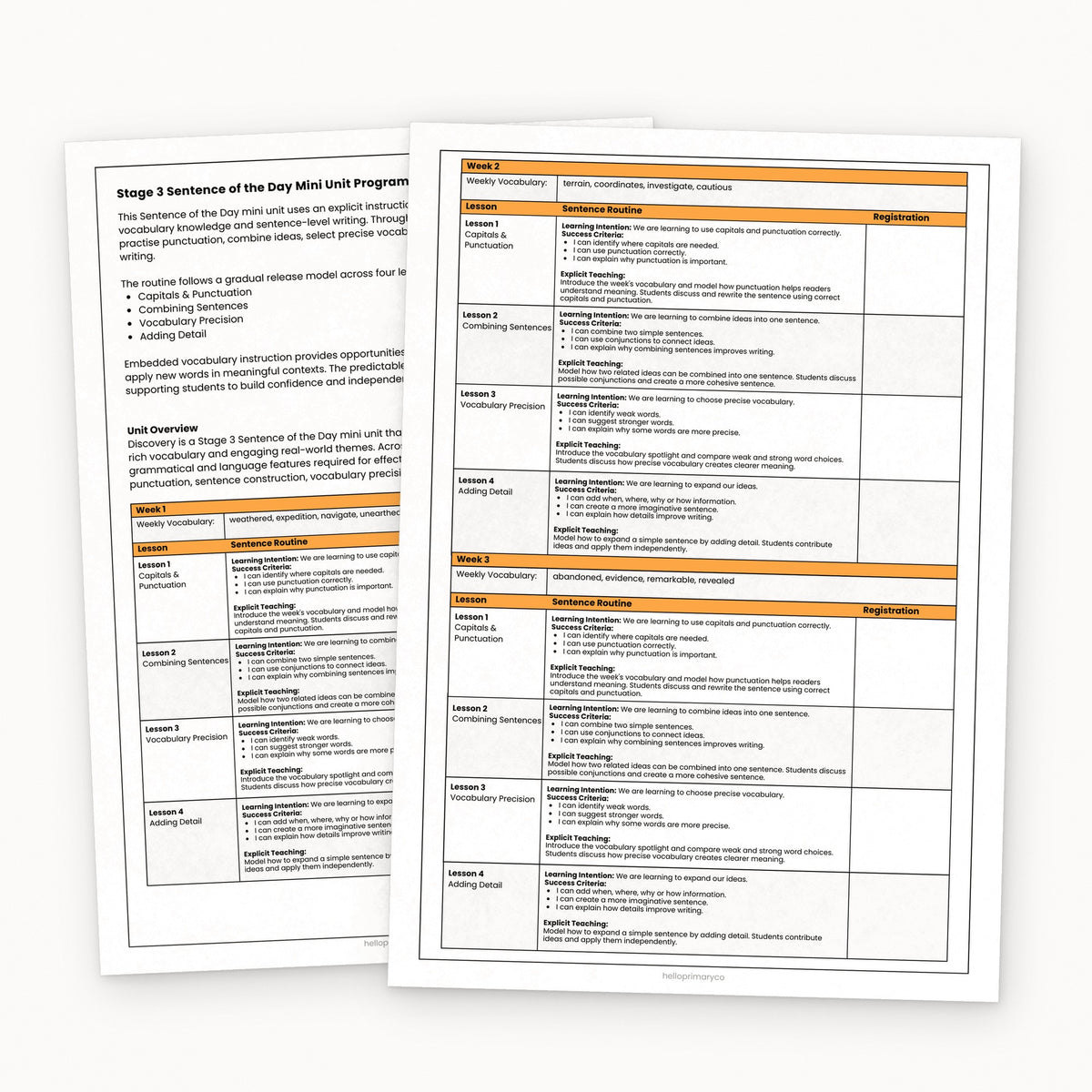
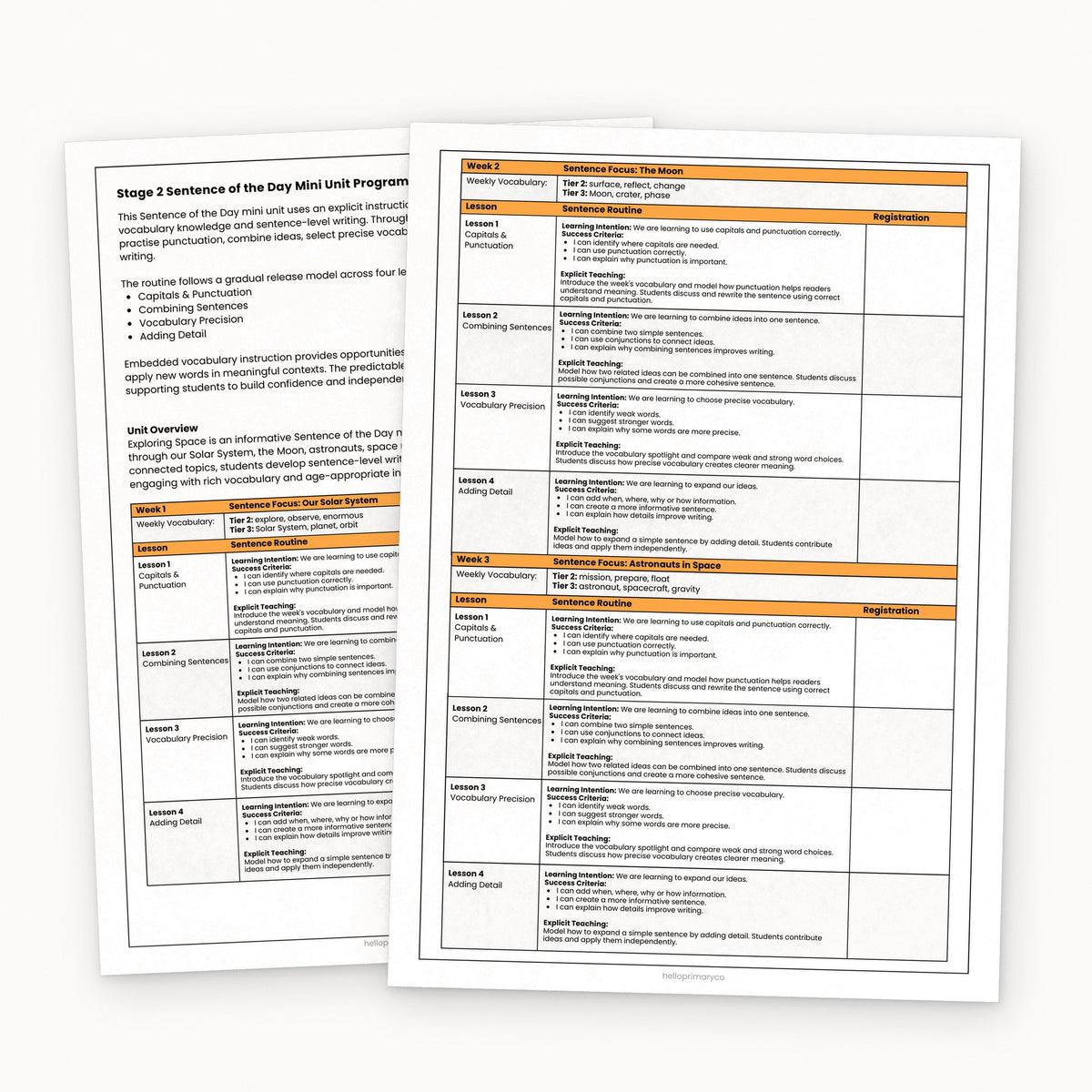
| Lesson 1Introduce & investigate | Introduce weekly vocabulary: explicitly teach the six key words from the fluency passage and add them to the Vocabulary Wall. Introduce spelling focus: introduce the focus phoneme and investigation words. Say, segment and identify the grapheme in each word, then compare and sort. Sentence of the Day: correct a sentence for capitals and punctuation, then improve it with a describing word or detail. | Vocabulary introduction, phonemic awareness, phoneme–grapheme correspondence, spelling patterns, capital letters and punctuation |
| Lesson 2Practise & apply | Vocabulary retrieval: revisit the Vocabulary Wall and orally retrieve meanings and uses. Spelling practice: read, segment and spell investigation words, then generate and sort more examples. Sentence of the Day: combine two simple sentences and discuss how ideas can be joined. | Vocabulary retrieval, phoneme–grapheme correspondence, spelling practice, spelling generalisations, sentence combining |
| Lesson 3Word study | Vocabulary retrieval: revisit and apply the week's words. Word study: explicitly investigate a feature of the week's words, such as morphology, word families or etymology. Sentence of the Day: replace general vocabulary with more precise language and discuss the effect. | Vocabulary application, morphology and word structure, orthographic knowledge, word meaning and etymology, vocabulary precision |
| Lesson 4Dictation & reflect | Spelling review: briefly retrieve the focus phoneme, graphemes and investigation words. Dictation: complete word and sentence dictation, then check and correct. Sentence of the Day: expand a sentence with meaningful detail. Review: reflect on the week's spelling patterns, vocabulary and strategies. | Spelling retrieval, word and sentence dictation, editing and self-correction, adding detail, weekly review |
No. 03 — Vocabulary
Meet it, retrieve it, use it
Knowing a word isn't all or nothing. A student might recognise determined when they read it, explain it when asked, and still never use it in their own writing. The goal is that last step, and it takes more than a definition.
Lesson 1: introduce. Say and read each word together. Explain its meaning in the context of the fluency passage, and talk about where and how it was used. Have students use the word orally in a new context, then discuss how they could use it in their own writing. Add all six words to the Vocabulary Wall for the week.
Lessons 2 and 3: retrieve. Come back to the Vocabulary Wall and retrieve the words through quick oral discussion:
What does this word mean?
Where did we meet it in the text?
Can you use it in a sentence?
How could we use it in our own writing?
Each retrieval strengthens the word a little more. Four of the six words also appear in Sentence of the Day, so by the end of the week students are reaching for them in their own writing.
No. 04 — Spelling
Investigate, don't just memorise
A spelling list learnt for Friday's test is often forgotten by Monday. Investigating how sounds are spelt builds knowledge students can use on words they've never seen.
Lesson 1: investigate. Introduce the week's focus phoneme and have students repeat it. Display the investigation words, then read each one aloud, say and segment it into phonemes, and identify the grapheme that represents the focus phoneme. Compare the different graphemes, sort the words by grapheme and add them to the class spelling chart. Ask: What do you notice? How many different ways is this phoneme represented?
Lesson 2: practise. Review the focus phoneme and graphemes. Practise selected words using say → segment → spell → check, then have students generate more words with the focus phoneme and sort them by grapheme. Talk about the patterns and clear up any misconceptions.
Lesson 4: dictate. Briefly retrieve the focus phoneme and investigation words, then dictate selected words and a sentence connected to the week's learning. Students listen, say and segment, record the word or sentence, identify the focus grapheme, then reread, check and correct. The sentence is also a chance to apply the week's vocabulary, punctuation, grammar or word study.
No. 05 — Word study
How words are built
In Lesson 3, students explicitly explore one aspect of word knowledge that connects authentically to the week's spelling, vocabulary, reading or writing. Depending on the words, that might be:
morphology and word families
base words, prefixes and suffixes
inflectional endings
spelling changes when adding suffixes
compound words
homophones and homographs
etymology and word origins
Take the base word act. Once students know it, they can build and spell action, actor, react and interactive, and make a good guess at their meanings. Model selected words and talk about how their structure, spelling, history or meaning helps us understand and spell them.
Students then complete the weekly Word Investigation Map and apply their learning in a sentence connected to the week's reading or writing.
No. 06 — Sentence of the Day
One sentence, four skills
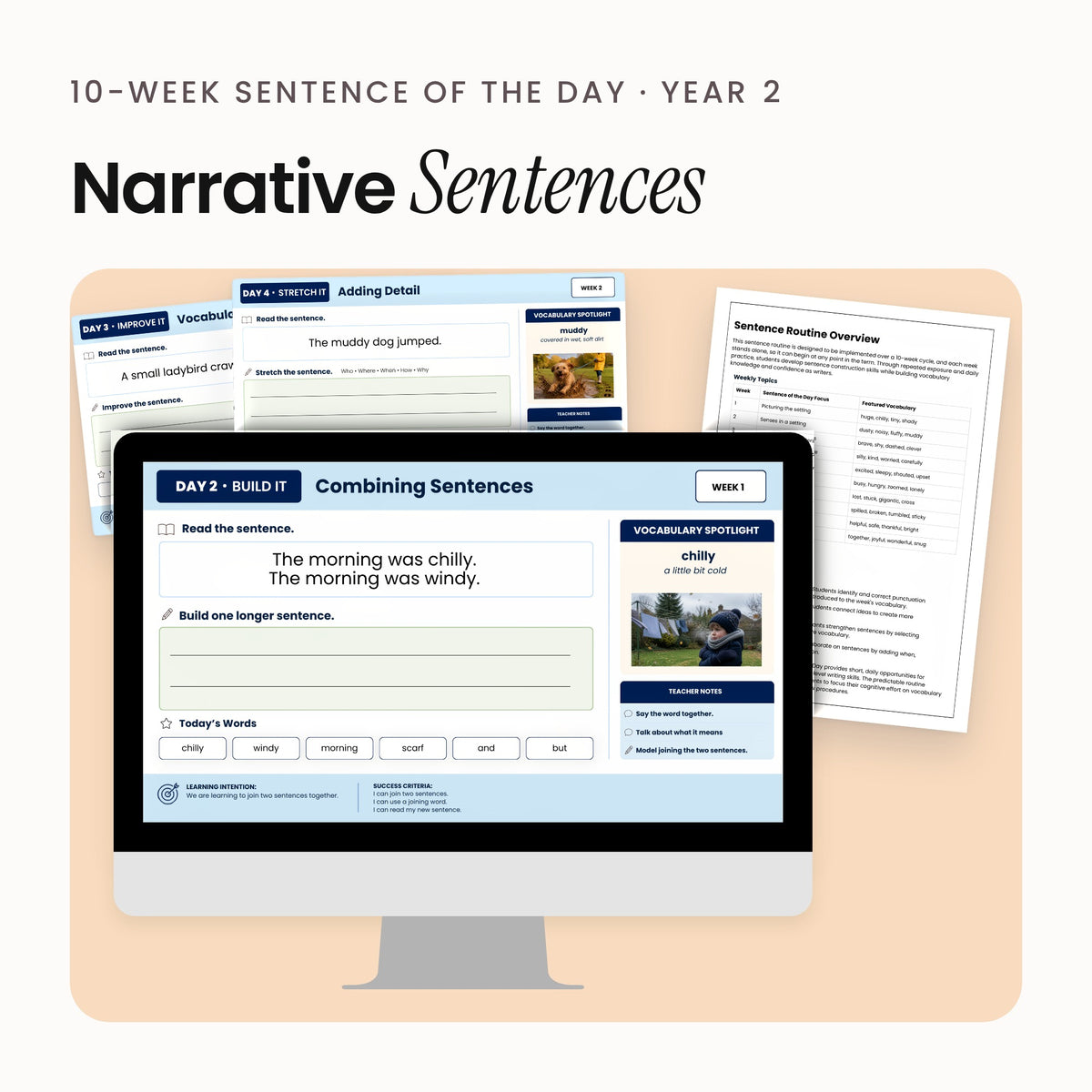
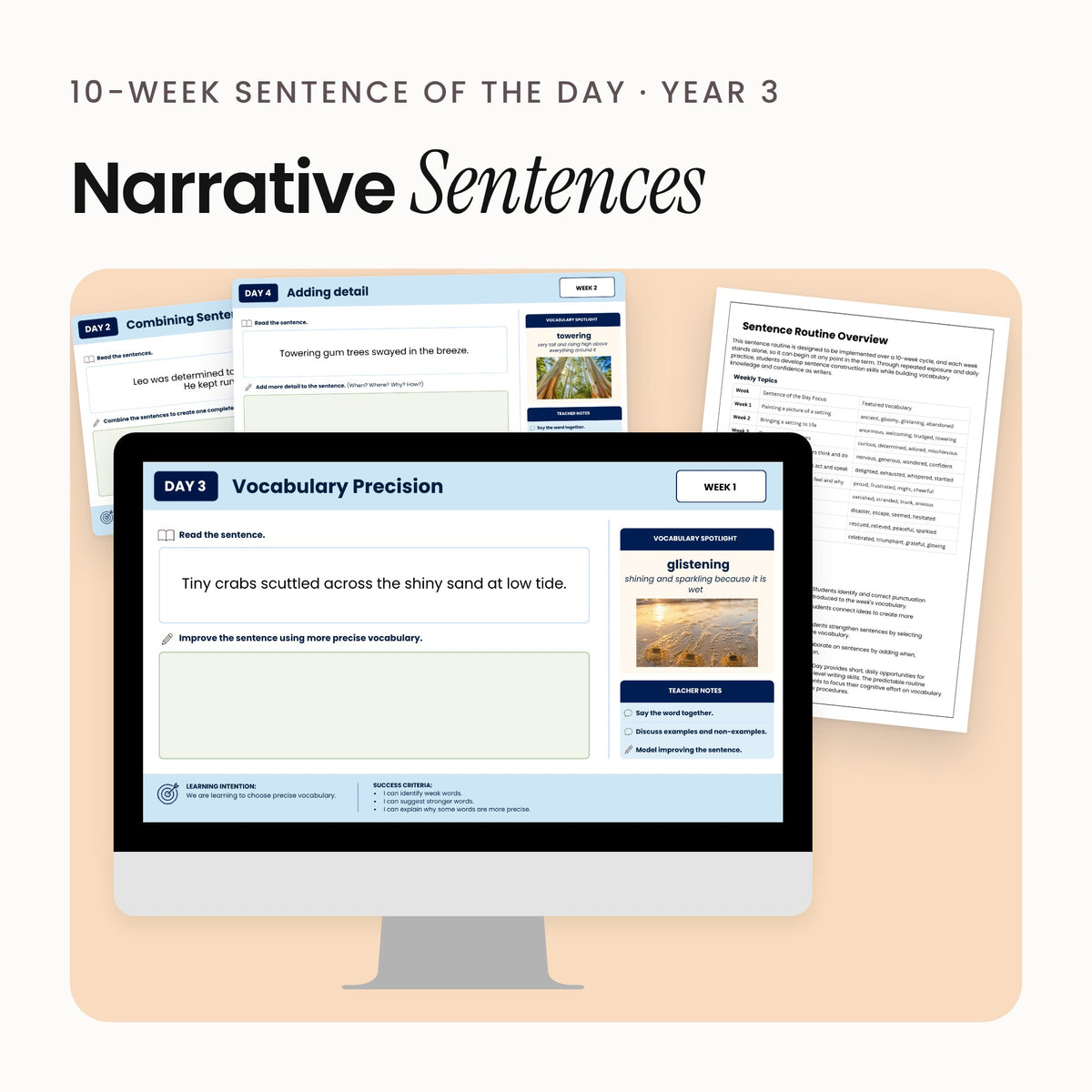
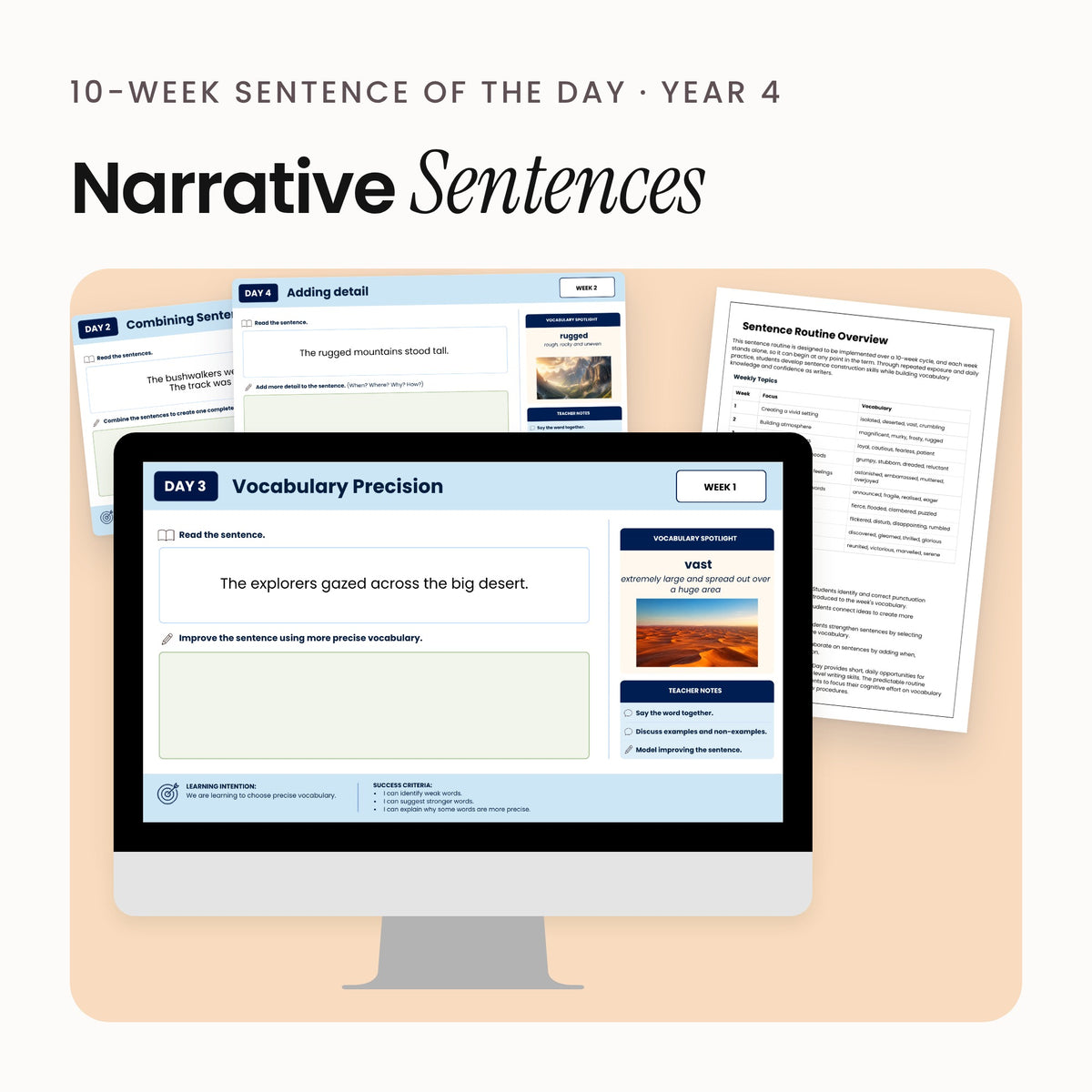
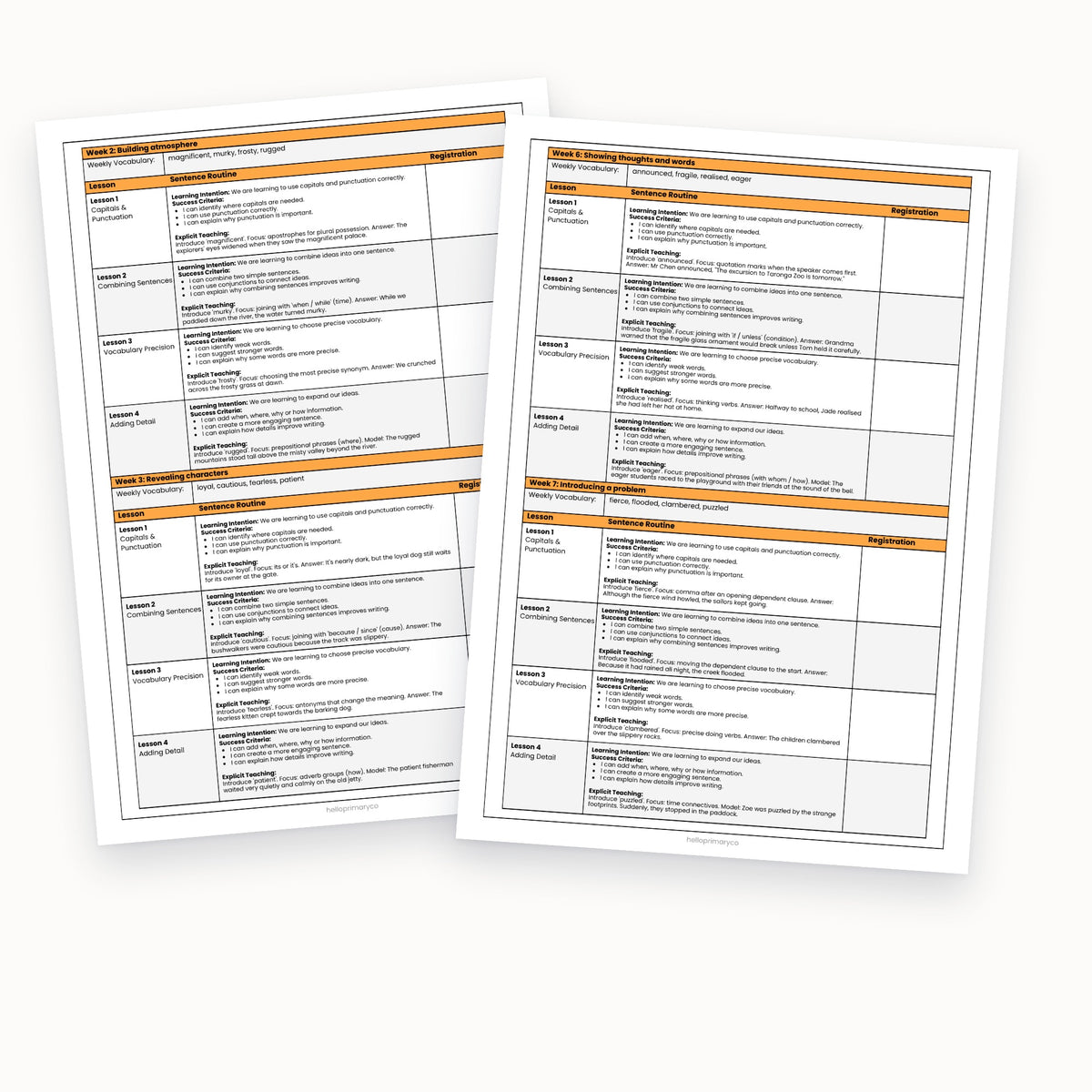
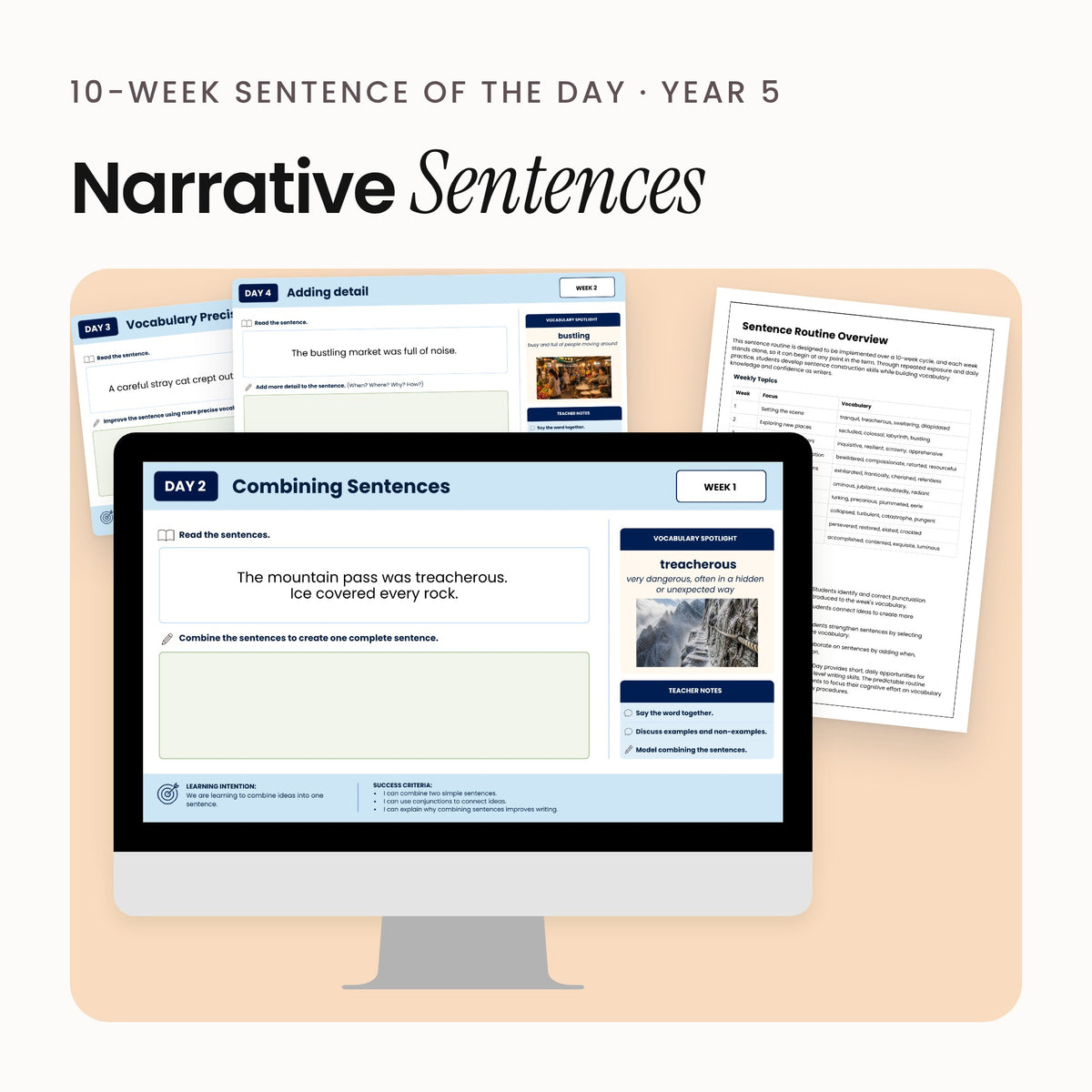
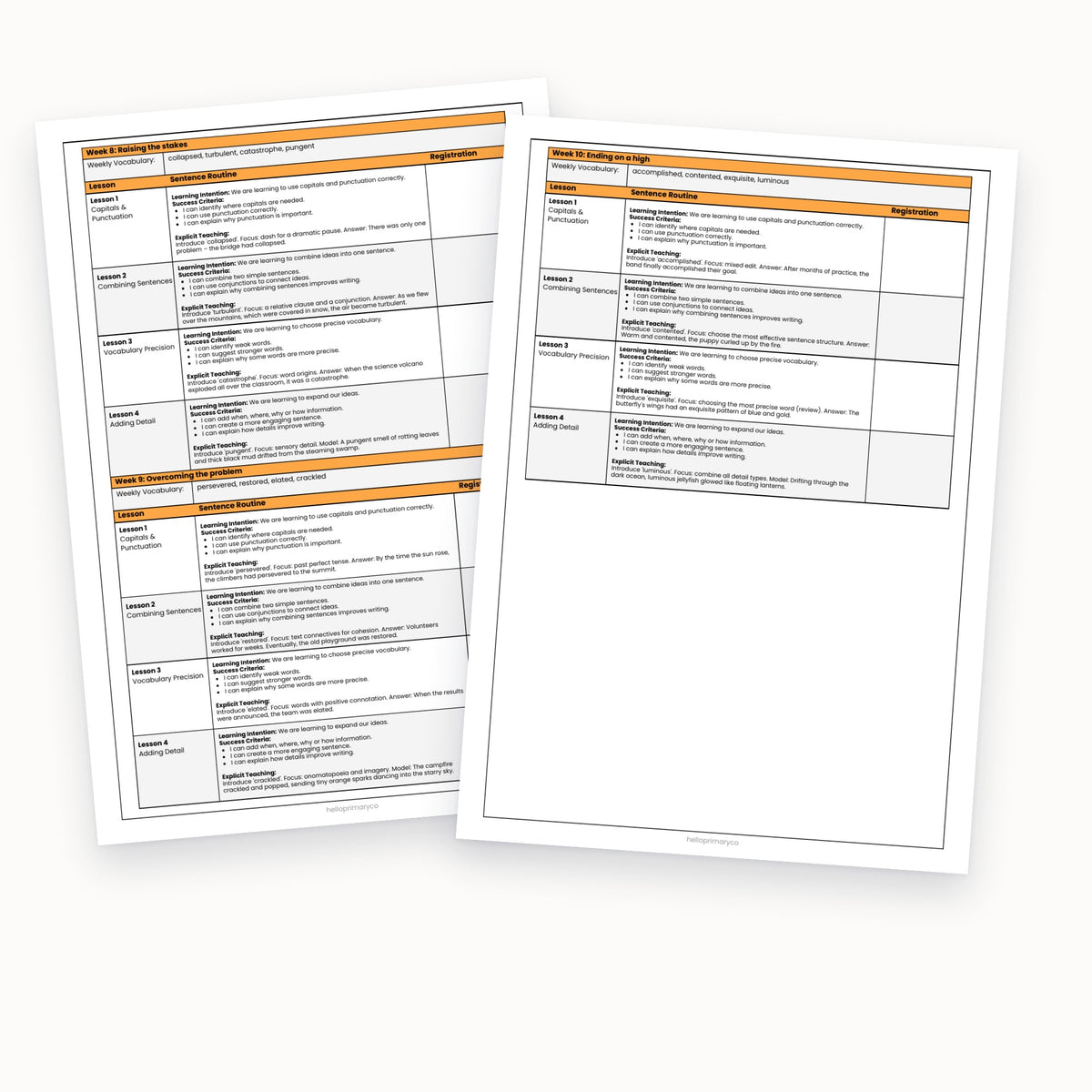
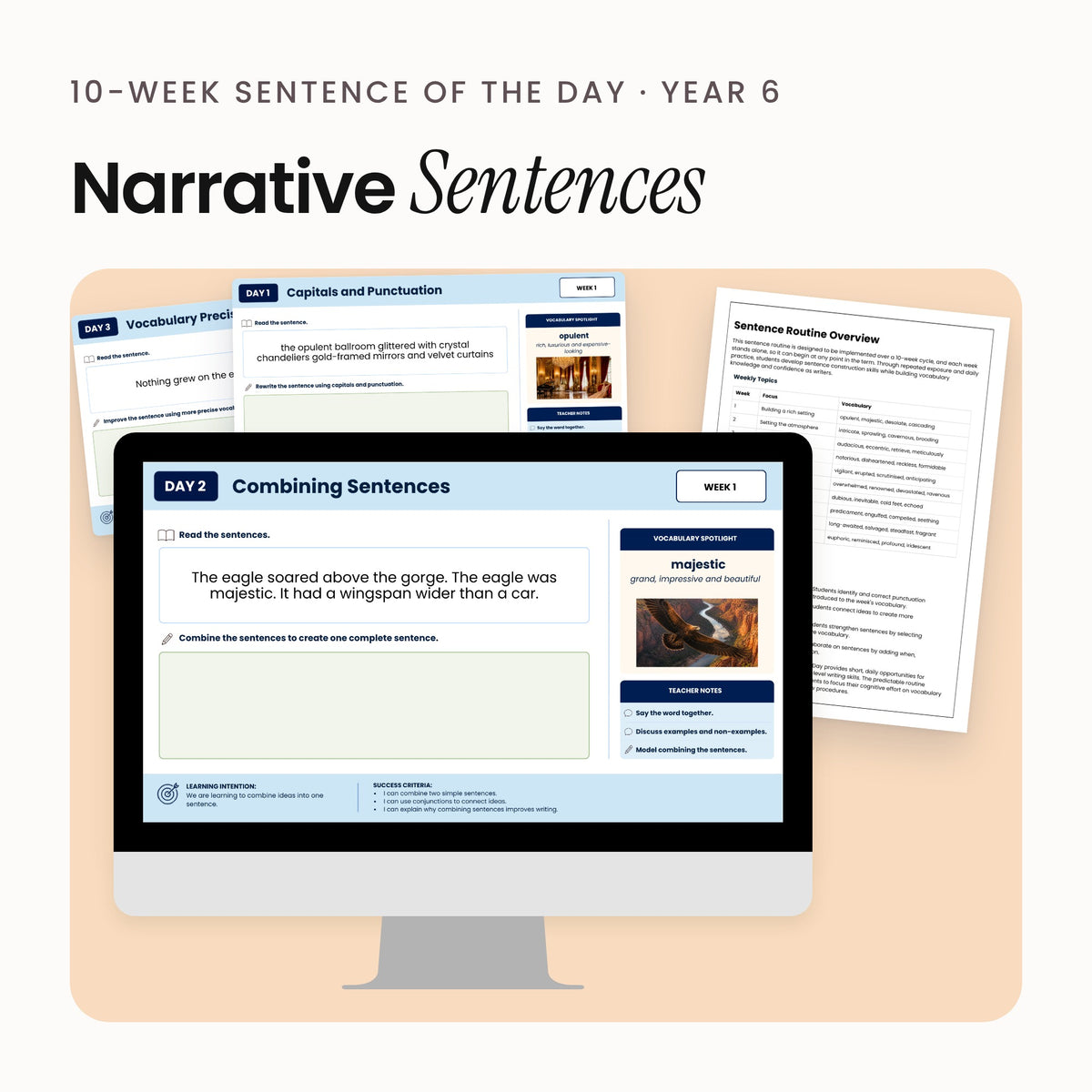
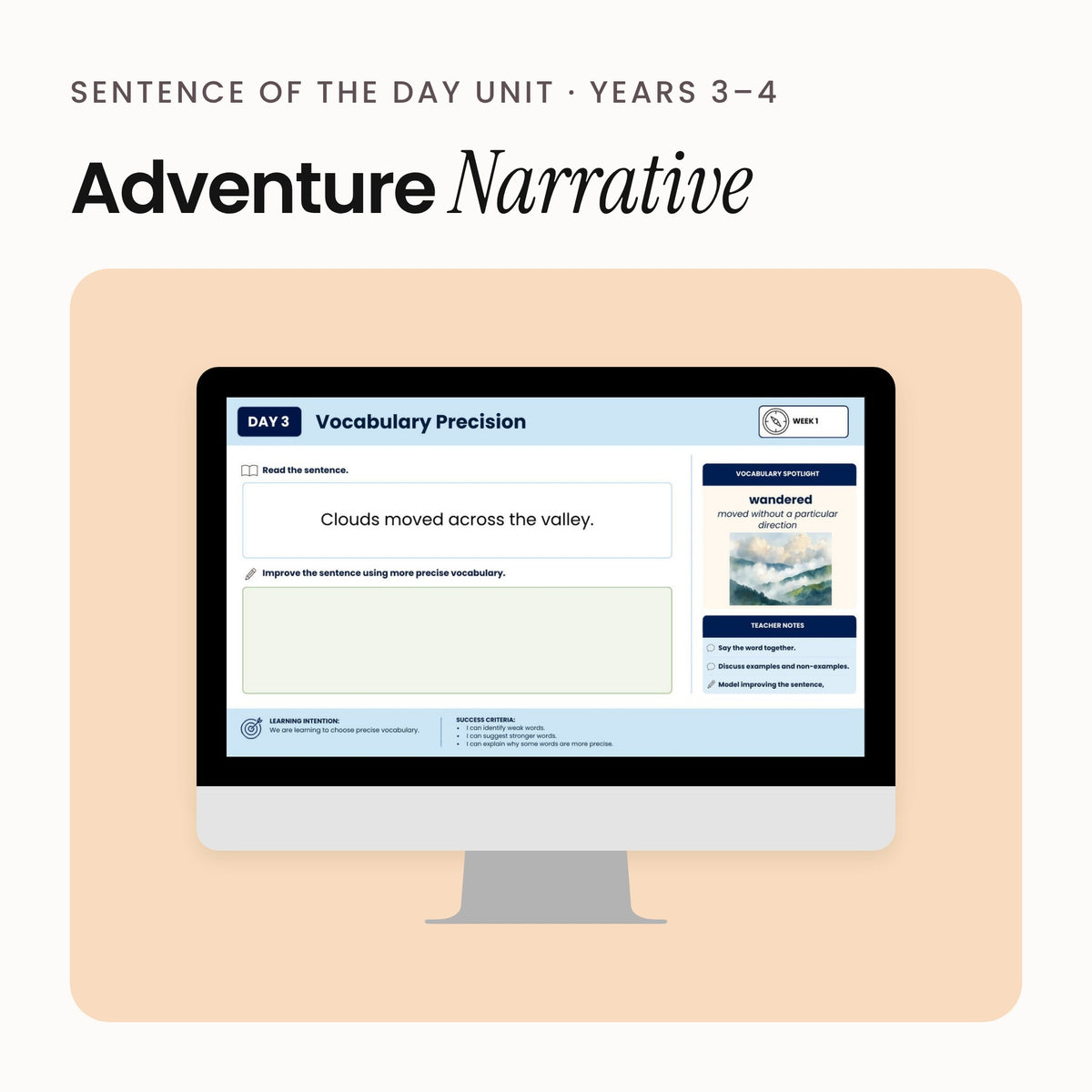
Every lesson ends with Sentence of the Day: one short sentence connected to the week's text or writing, and one sentence-level skill. Across the week, the sentences focus on four of the six vocabulary words. Students work on mini whiteboards or in their books, and the class compares versions and talks about what makes one stronger.
| Lesson | Focus | What students do |
|---|---|---|
| Lesson 1 | Capital letters and punctuation | Identify and correct the errors in an incorrectly punctuated sentence, discuss the conventions, then improve it by adding a describing word or meaningful detail. |
| Lesson 2 | Sentence combining | Orally rehearse ways to combine two simple sentences, combine them in writing, compare the possibilities and discuss how joining ideas makes writing smoother. |
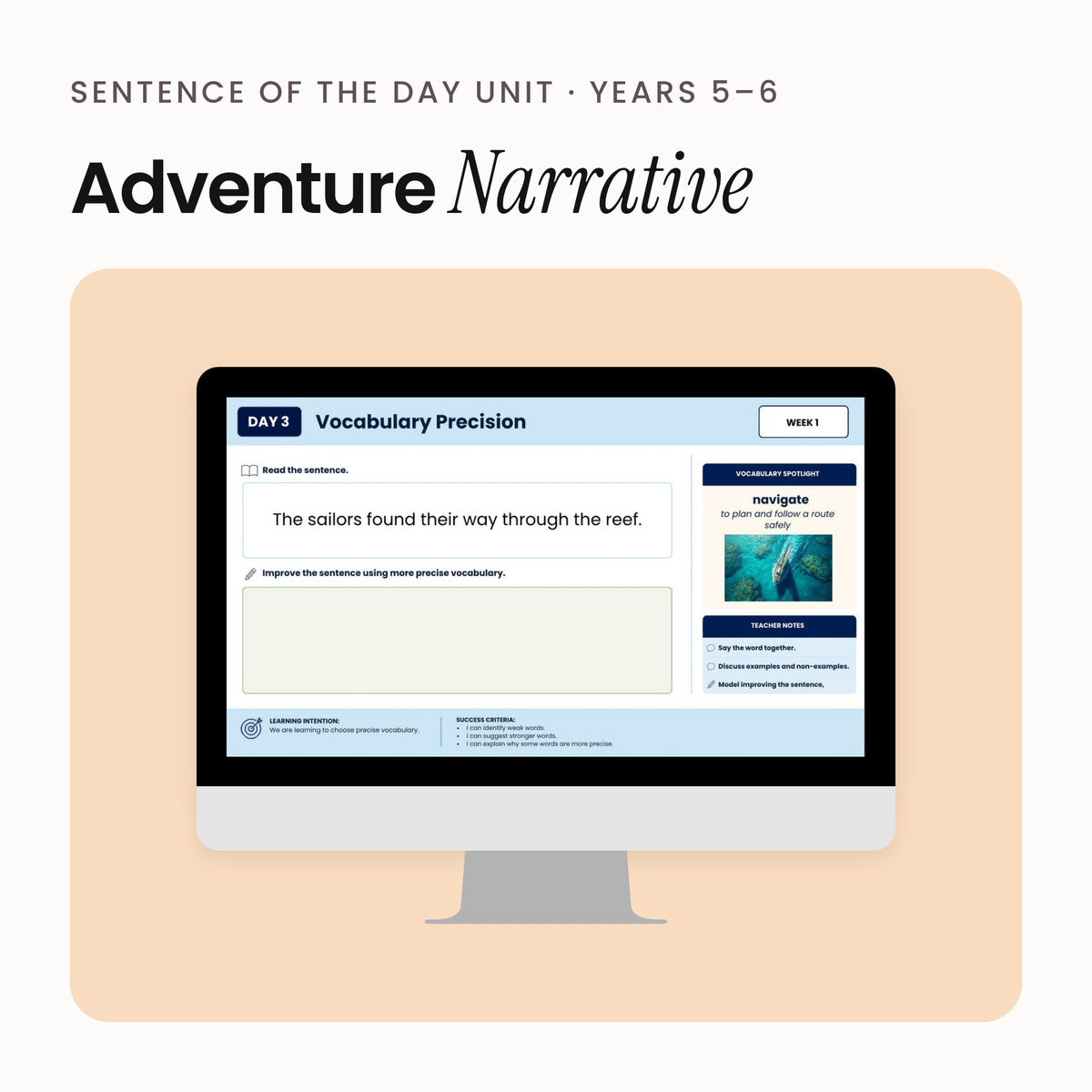
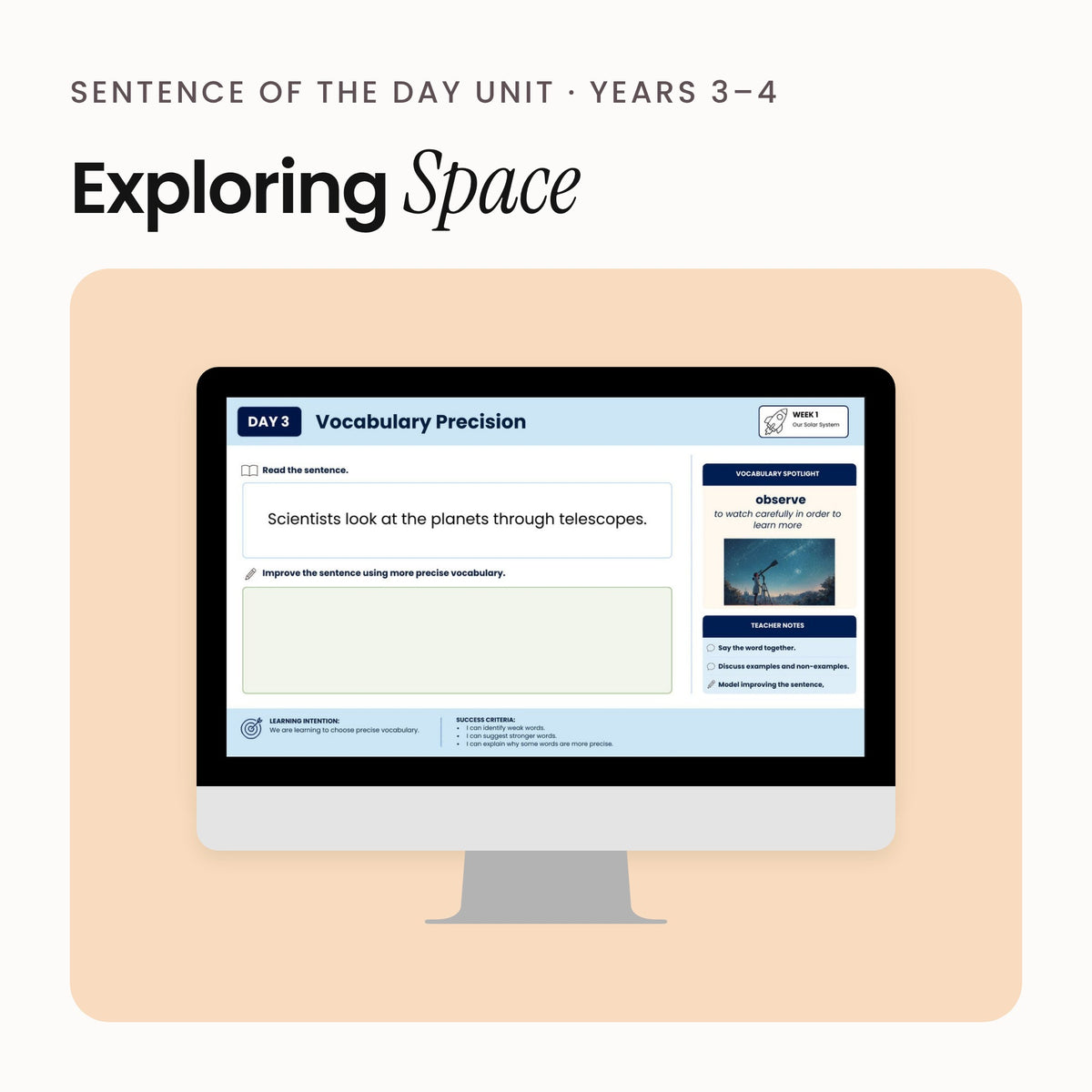
| Lesson 3 | Vocabulary precision | Identify a general word, choose a more precise alternative (often from the Vocabulary Wall), rewrite the sentence and discuss how it changes the meaning. |
| Lesson 4 | Adding detail | Identify where more information could be added, expand the sentence, compare versions and discuss what was added and how it helps the reader. |
End the week with reflection. Which graphemes represented our focus phoneme? What spelling patterns did we notice? Which words were challenging, and what strategies helped? Which new vocabulary can we now use in our reading and writing?
No. 07 — Curriculum links
Where it sits in the curriculum
This sequence addresses these outcomes from the NSW English K–10 Syllabus (2022) and these content descriptions from the Australian Curriculum: English v9.0.
NSW English K–10 Syllabus
| Focus | Stage 2Years 3–4 | Stage 3Years 5–6 |
|---|---|---|
| Vocabulary | EN2-VOCAB-01Vocabulary | EN3-VOCAB-01Vocabulary |
| Spelling and word study | EN2-SPELL-01Spelling | EN3-SPELL-01Spelling |
| Sentences and punctuation | EN2-CWT-01, 02, 03Creating written texts: sentence-level grammar and punctuation | EN3-CWT-01Creating written texts: sentence-level grammar and punctuation |
Australian Curriculum: English v9.0
| Focus | Years 3–4Year 3 · Year 4 | Years 5–6Year 5 · Year 6 |
|---|---|---|
| Vocabulary | AC9E3LA10 · AC9E4LA11Extending vocabulary | AC9E5LA08 · AC9E6LA08Vocabulary for precision and effect |
| Phonic knowledge and spelling | AC9E3LY11 · AC9E4LY09Phoneme–grapheme relationships and letter patterns | AC9E5LY08 · AC9E6LY08Phonic and morphemic knowledge to read and spell words |
| Word study | AC9E3LY10 · AC9E4LY10Base words, prefixes, suffixes and word families | AC9E5LY09 · AC9E6LY09Building and spelling new words from word parts and origins |
| Combining sentences | AC9E3LA06 · AC9E4LA06Clauses and complex sentences | AC9E5LA05 · AC9E6LA05Complex sentences and embedded clauses |
| Adding detail | AC9E4LA08Adverb groups and prepositional phrases | AC9E5LA06Expanding noun groupsAC9E6LA06Precise verbs and adverb groups |
Year 2 resources link to the matching NSW Stage 1 outcomes and Year 2 content descriptions.
Spelling & vocabulary resources
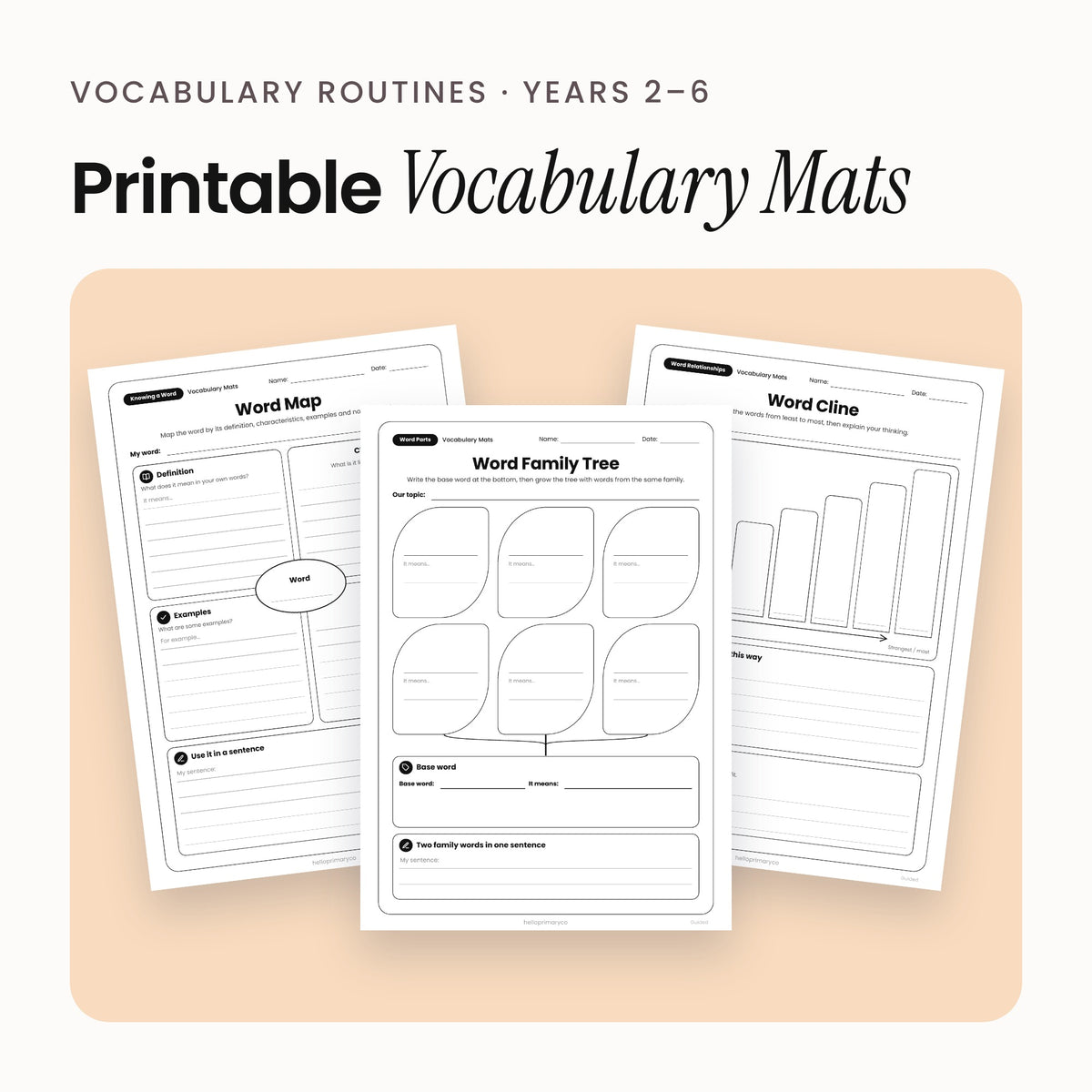
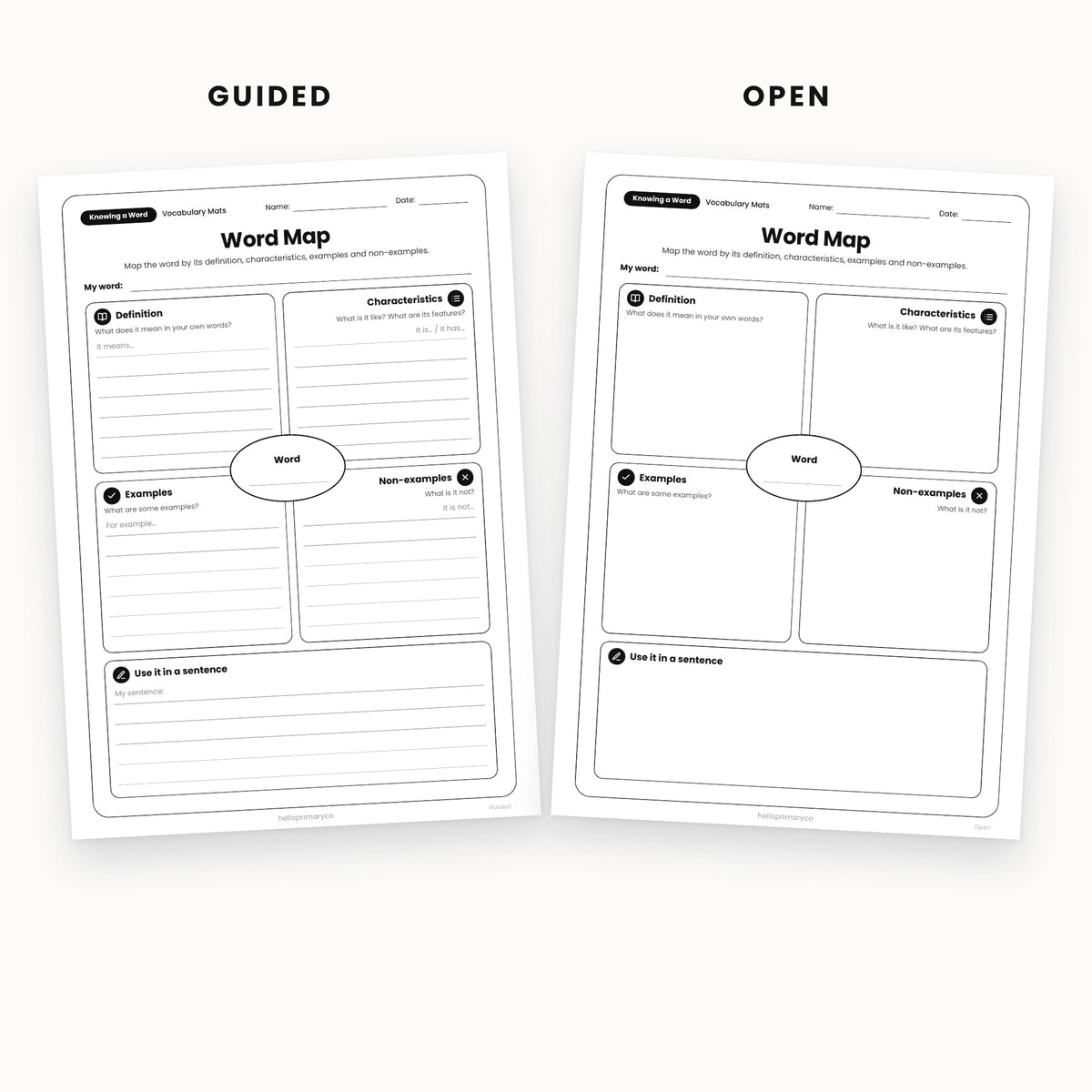
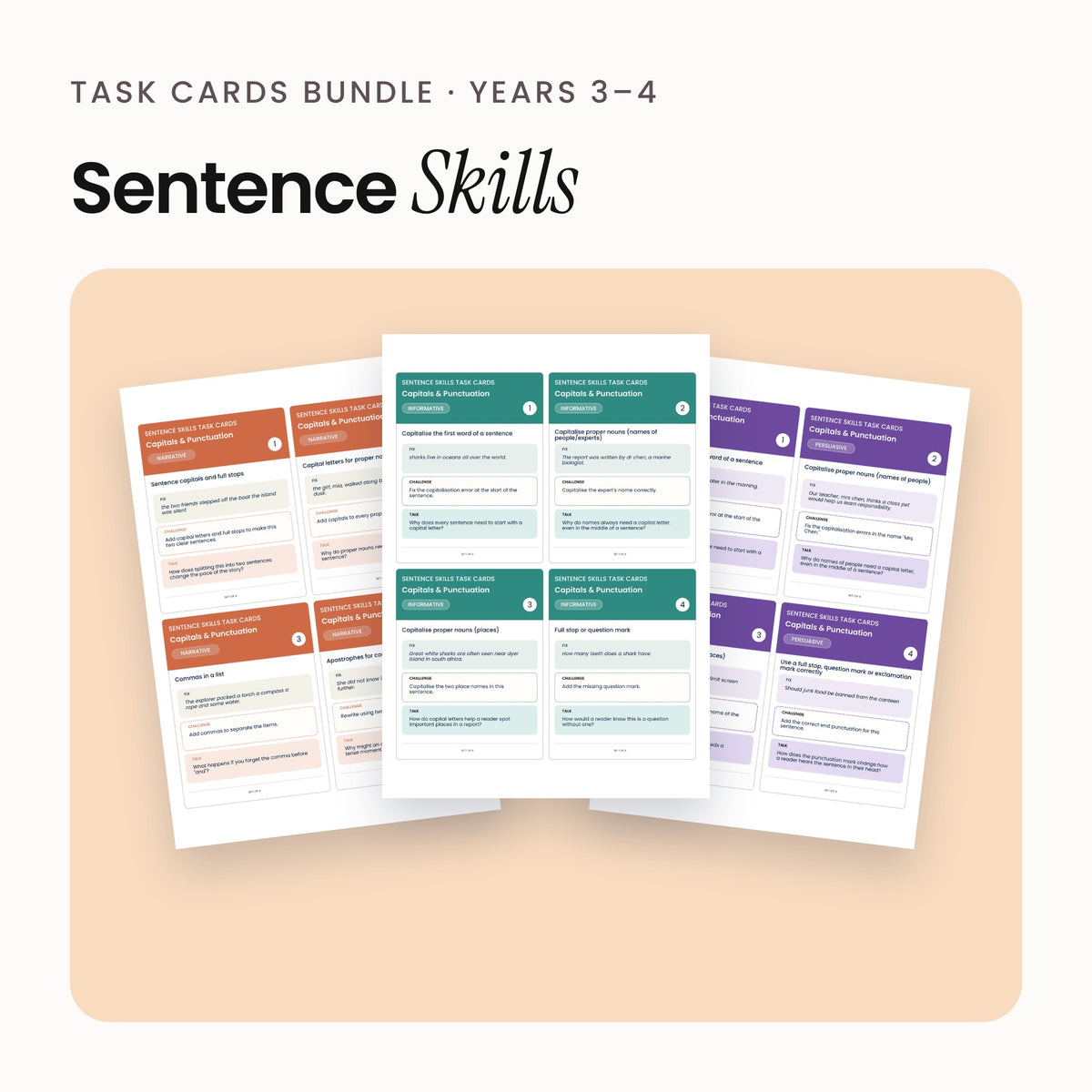
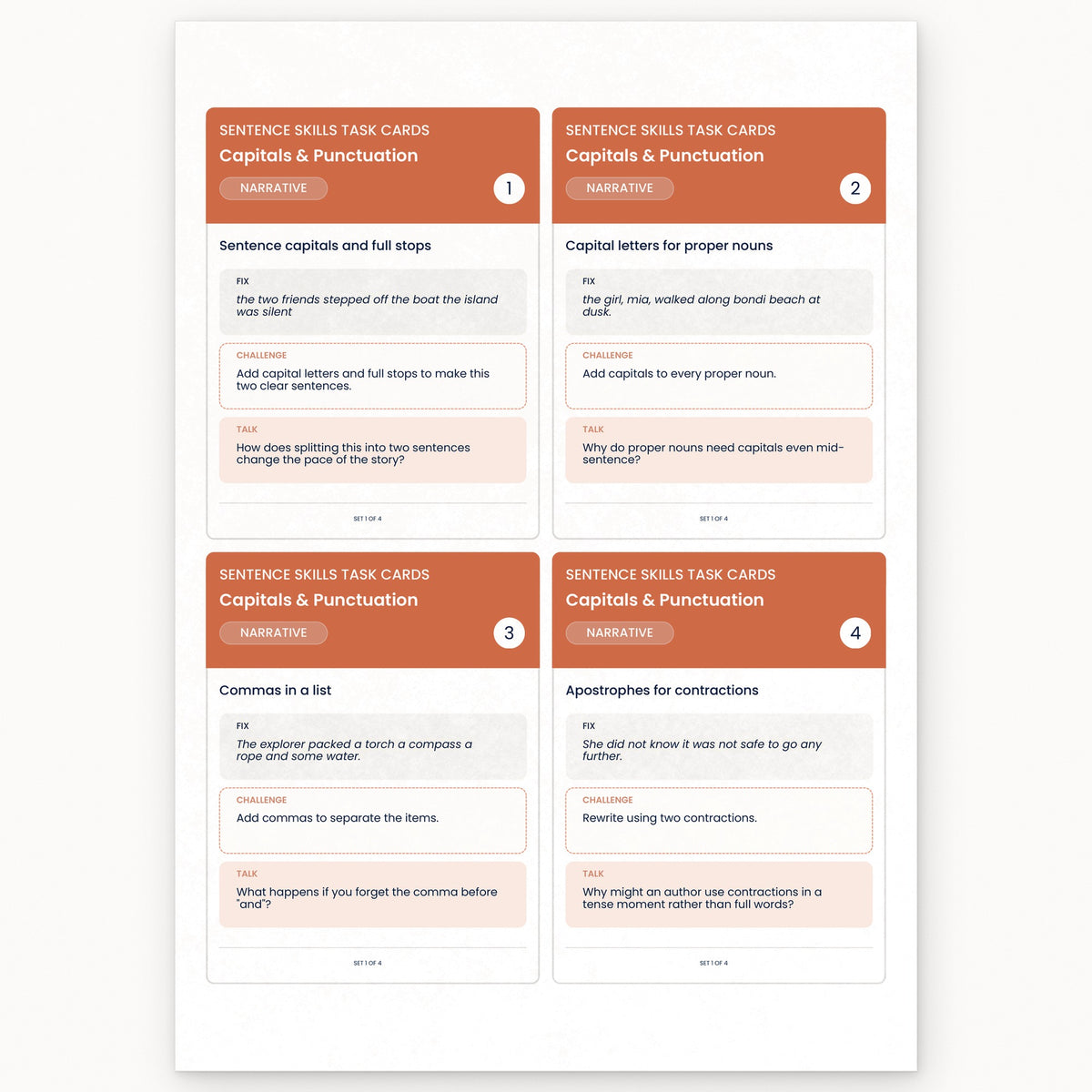
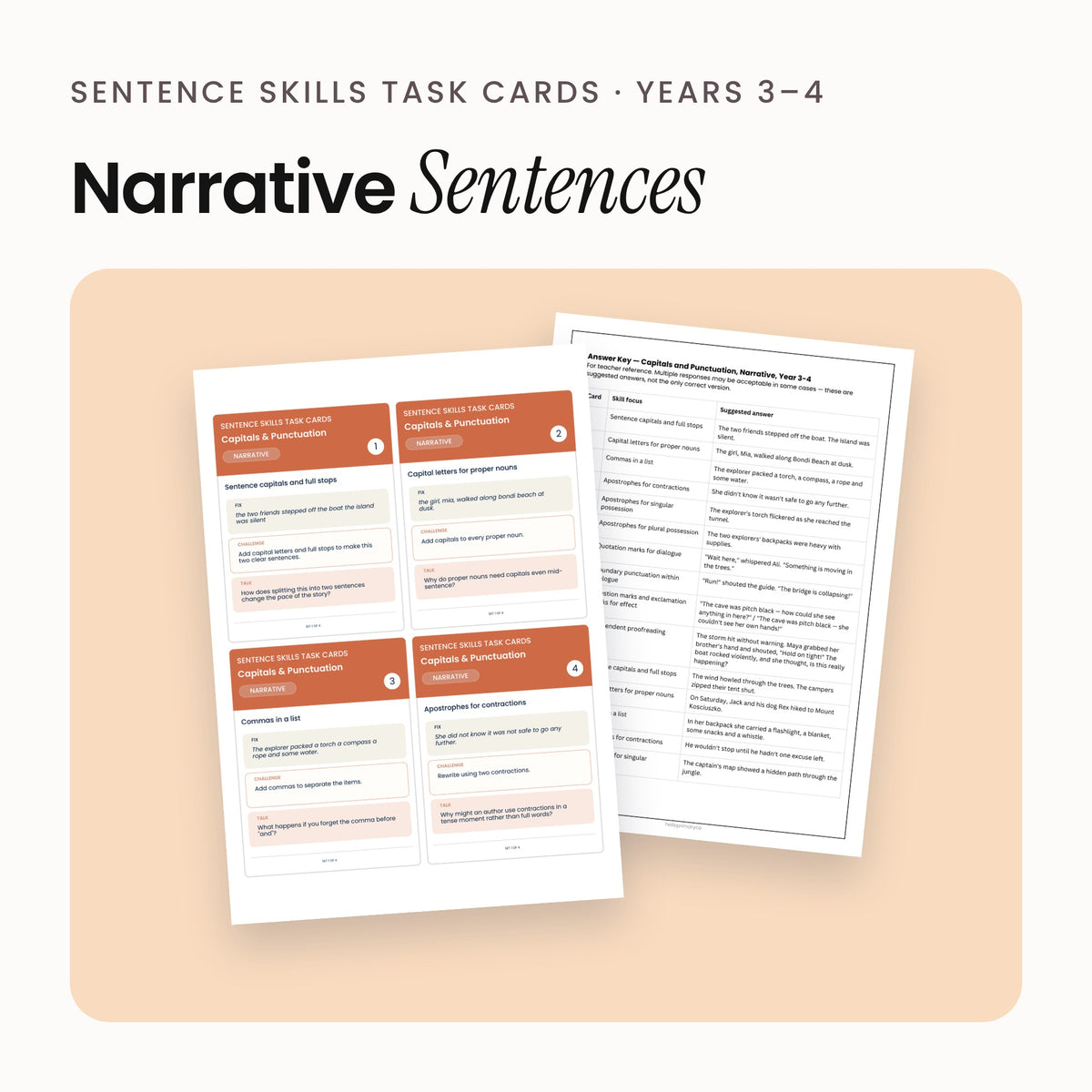
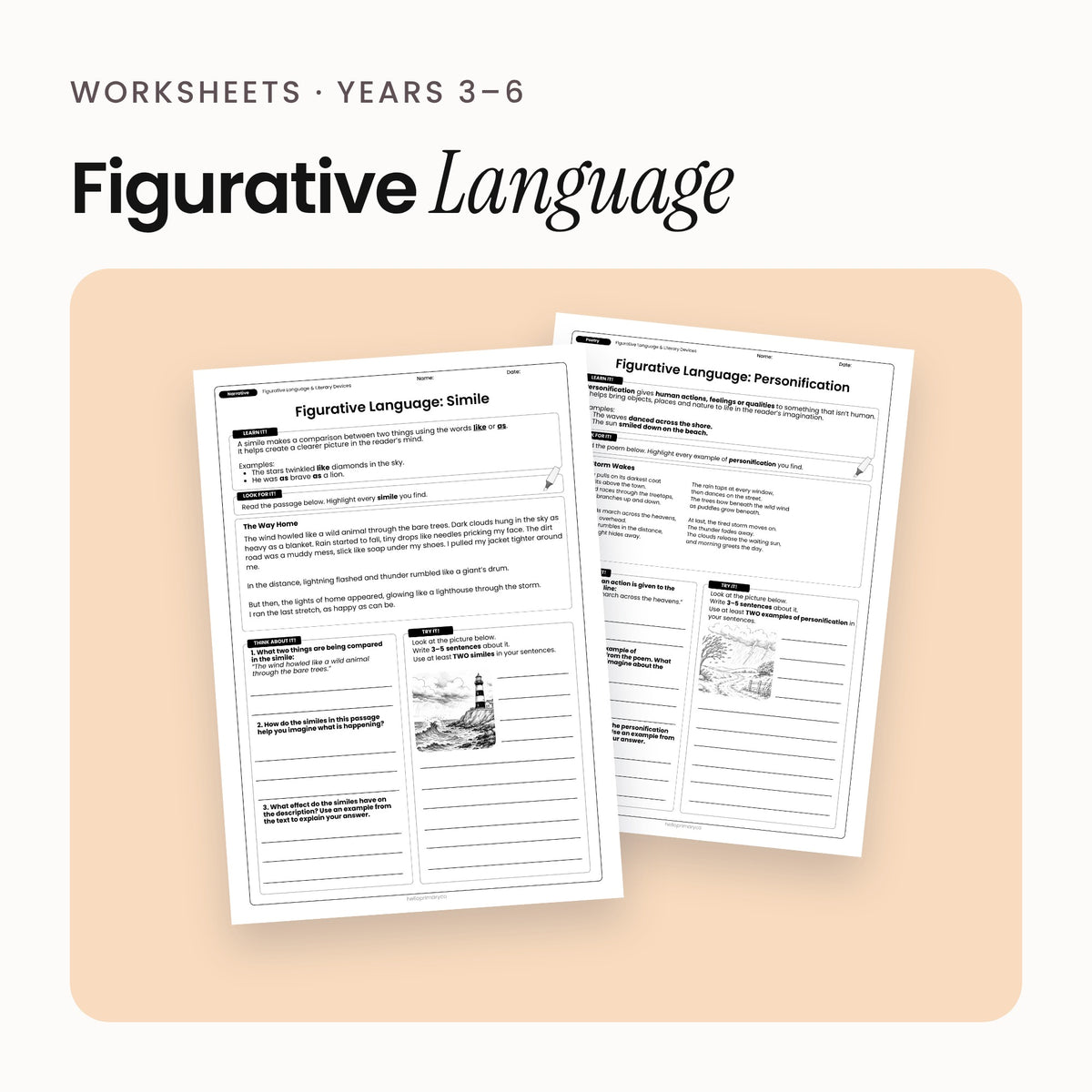
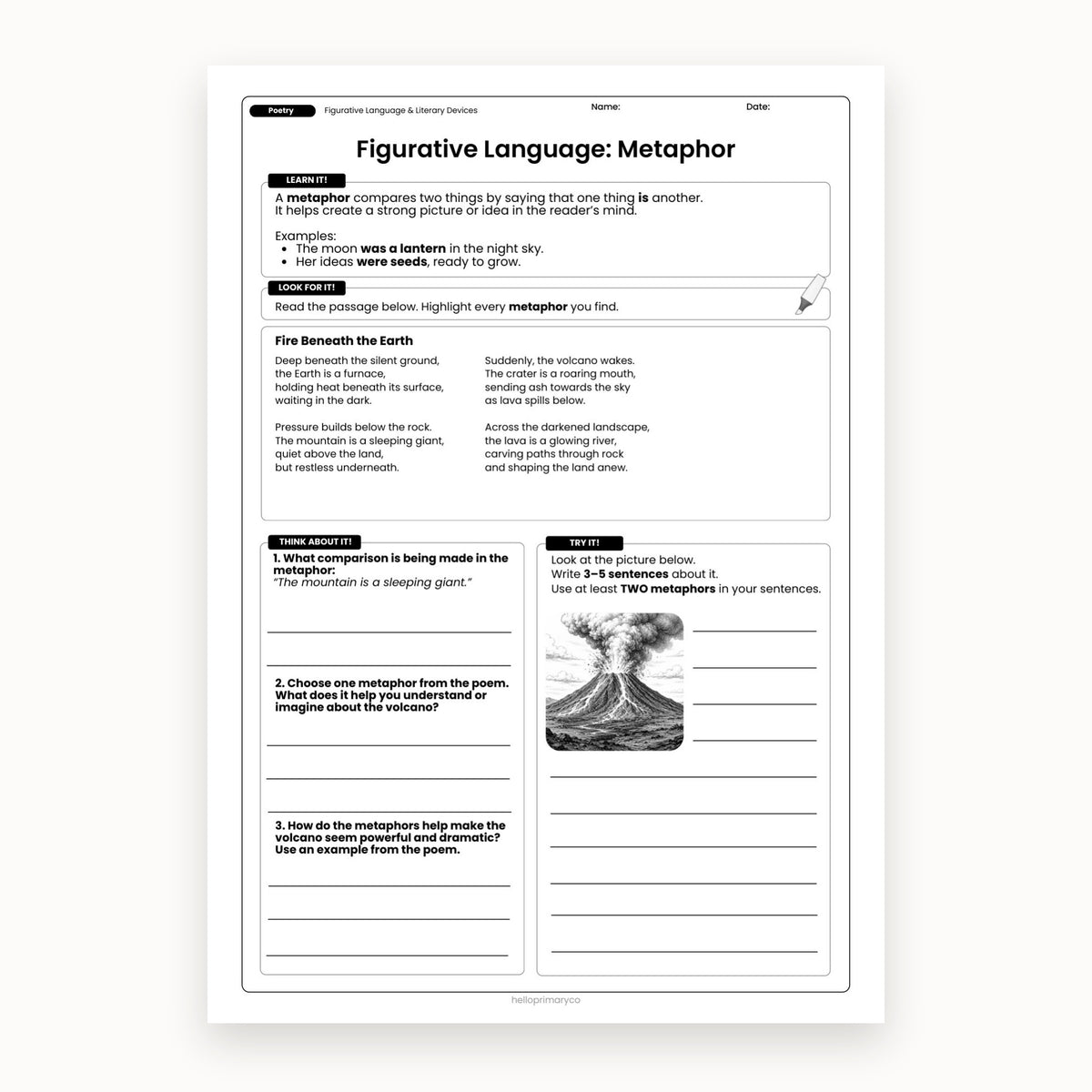
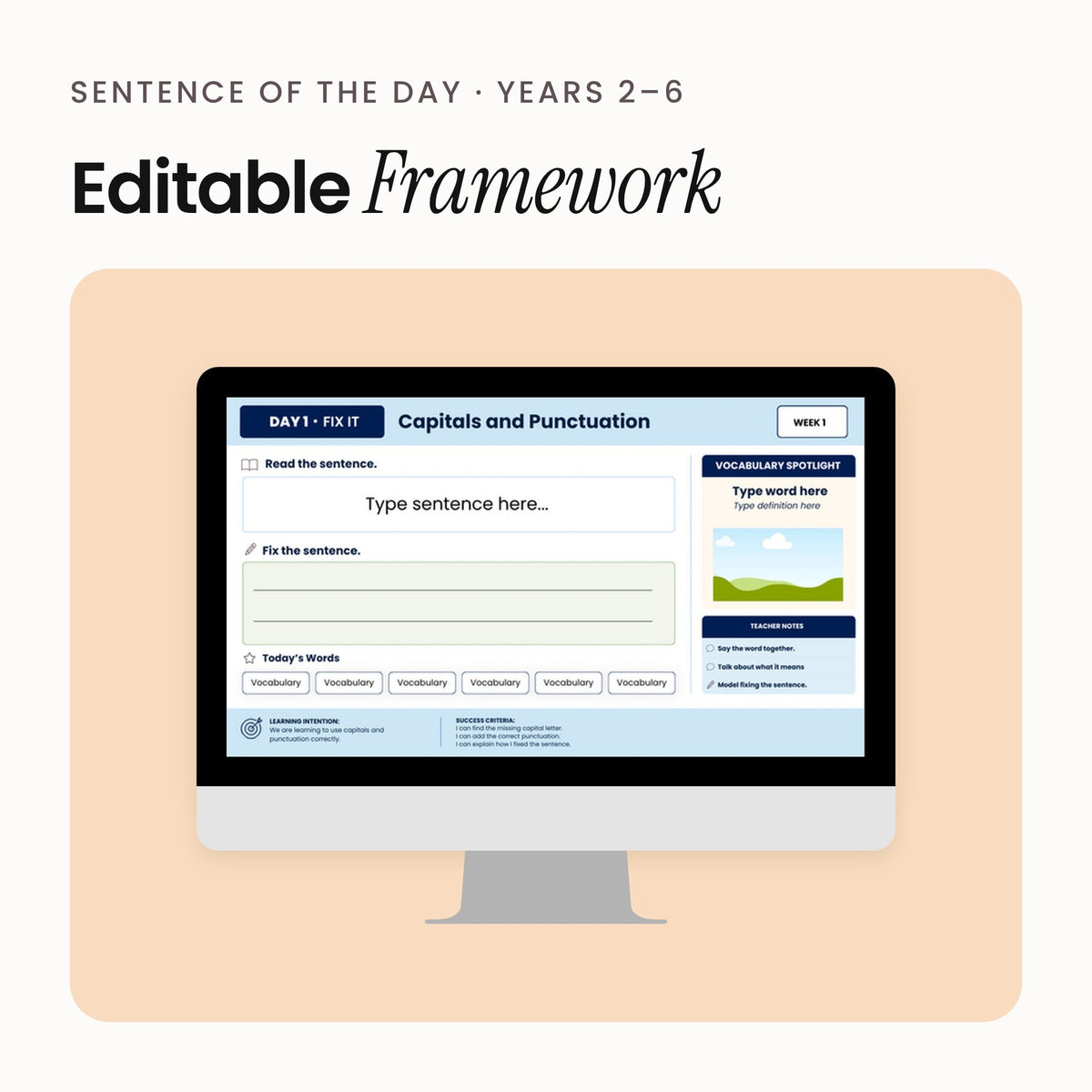
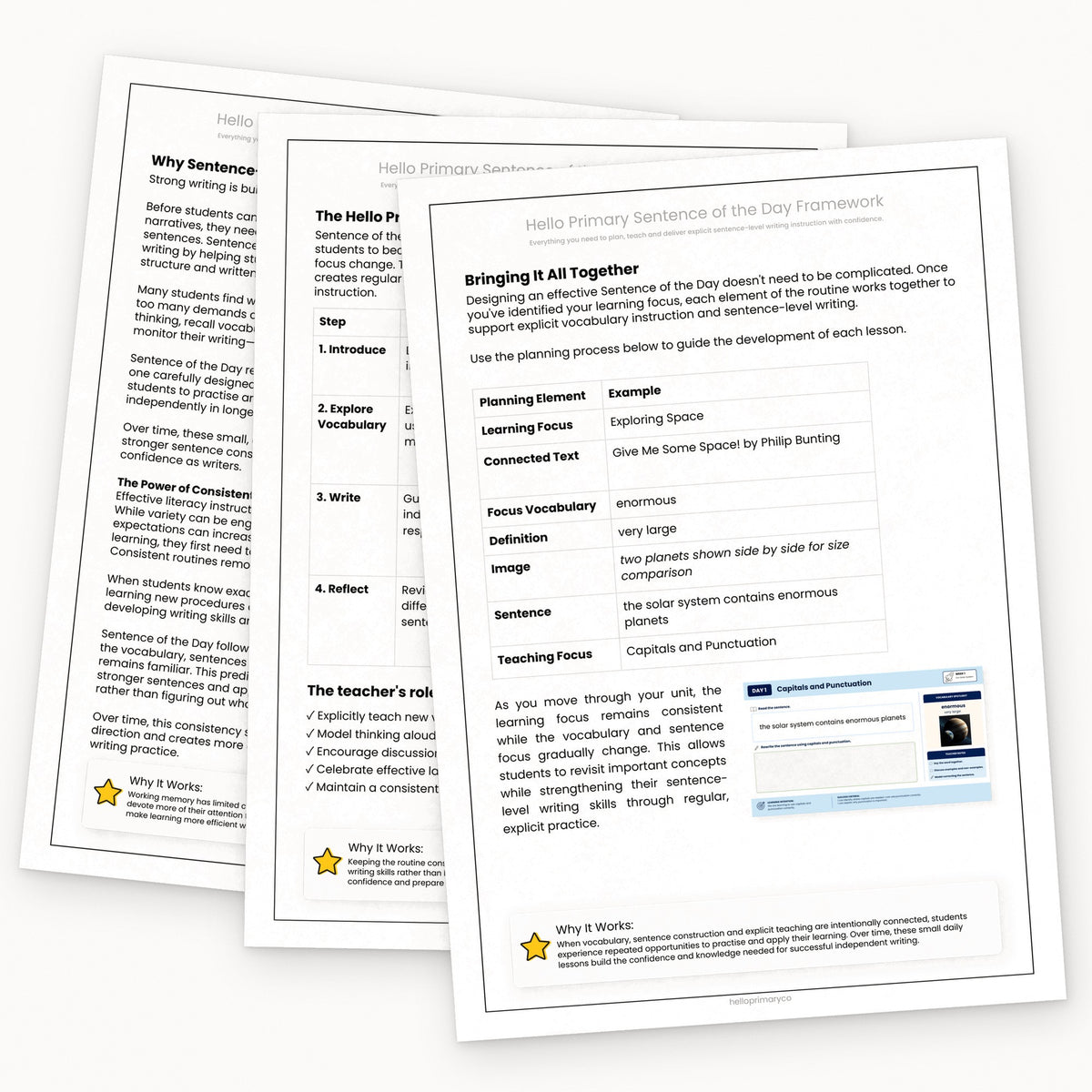
Sentence of the Day for Years 2–6, plus vocabulary mats, sentence skills task cards and figurative language worksheets. Want to write your own? The Sentence of the Day Framework shows you how.
Literacy, Unpacked
Keep exploring
The connected literacy block
How fluency, Sentence of the Day and Quick Writes share one theme and one set of words.
Reading fluency
What fluent reading sounds like and how to run a four-day routine with three levels of one passage.
Quick Writes & Daily Review
Short daily routines that keep every student writing and revisiting skills.
- Coming soon
Reading comprehension
Literal and inferential understanding, thinking routines and measuring growth.
- Coming soon
Teaching writing
Explicit mini lessons, mentor sentences, revising and editing, and matched writing assessments.