
Literacy, Unpacked · Practical guide
Reading comprehension, unpacked
How a small set of comprehension strategies builds across a five-week block, the routine behind every lesson, and how comprehension flows straight into writing.
What you'll learn
- What comprehension involves, from literal to inferential to author's craft
- Why a few strategies, revisited over time, work better than a new one every lesson
- How quality mentor and supporting texts anchor a five-week block
- The lesson routine, how comprehension flows into writing and how to measure growth
No. 01 — What comprehension is
Reading between the lines
Comprehension is building meaning from a text. Good readers don't just collect facts as they go. They connect ideas, fill gaps with what they already know, notice how the author is shaping their response, and reread when something doesn't make sense.
It helps to think about comprehension in three layers, each asking a little more of the reader.
| Layer | What the reader does | Example question |
|---|---|---|
| Literal | Finds information the text states directly. | Where and when is the story set? |
| Inferential | Combines clues in the text with what they already know to work out what isn't said. | How is the character feeling? What clues tell you? |
| Author's craft | Thinks about the choices the author made and the effect they have. | Why did the author choose this word? How does it make you feel? |
Fluency and vocabulary come first. A student working hard to decode every word has little attention left for meaning, and a student who doesn't know the key words can't build an accurate picture of the text, however well they read aloud. That's why the connected literacy block builds fluency and vocabulary on the same theme, so by the time students think deeply about a text, their attention can go into understanding it.
No. 02 — A few strategies, built over time
Fewer strategies, deeper thinking
It's tempting to teach a new comprehension strategy every lesson. On paper it looks thorough. In practice, students meet each strategy once, rarely get the chance to use it with confidence, and move on before it sticks.
A stronger approach is to choose a small set of strategies and keep coming back to them. Each time students revisit a strategy, they apply it to a new part of the text, a new text or a new angle, and they go a little deeper. Making inferences might start with what a character says, then move to what they think, then to how they change across the story. It's the same strategy, used with more skill each time.
Revisiting also lightens the load. When students already know what a strategy asks of them, their thinking can go into the text itself.
No. 03 — Across a five-week block
Five strategies, five weeks
Each five-week block focuses on no more than five comprehension strategies, chosen to suit the texts. Every strategy is introduced, practised and revisited, so by the end of the block students can use it on their own. A block might focus on these five:
| Strategy | What students do |
|---|---|
| Making inferences | Combine clues in the text with what they already know to work out what the author doesn't say directly. |
| Summarising | Identify the most important ideas and retell them briefly in their own words, using gist statements. |
| Understanding text structure | Explain how a text is organised and how its parts work together to suit its purpose. |
| Identifying theme | Work out the big idea or message of a text and support it with evidence. |
| Evaluating the author's choices | Explain how the author's choices of language, character, setting and events affect the reader. |
Start with quality literature. Each block is built around a carefully chosen mentor text: one rich enough to return to across five weeks, with characters, ideas and language worth unpacking. Alongside it sit supporting texts, such as picture books, poems or short stories by different authors, chosen because they explore similar themes in different ways. Students apply the same strategies in a new context, compare how each author approaches the same big idea, and see that there's more than one way to tell a story.
No. 04 — The lesson routine
Six steps, every lesson
Comprehension is taught four days a week, and every lesson follows the same six-part routine. Because the routine stays the same, students know what's coming and can put their effort into thinking about the text.
| Step | What happens | Why it helps |
|---|---|---|
| Review | Revisit the previous lesson's learning and the text so far. | Brings back what students need before the new reading begins. |
| Read | The teacher reads today's text or section aloud. | Every student hears the text read fluently, so they can focus on meaning. |
| Teach and model | The teacher shows the strategy in action and thinks aloud. | Makes the thinking behind the strategy visible. |
| Practise together | Students talk it through with a partner or as a class. | Every student tries out their thinking before they write. |
| Respond in writing | Students apply the strategy on their own in a short written response. | Shows what each student can do independently. |
| Check | A quick check for understanding. | Shows who's ready to move on and who needs more support. |
A few talk routines, used again and again. Rather than a new activity every lesson, the same small set of routines, such as Think, Pair, Share, See, Think, Wonder and Show me, comes back with different content. Students learn each routine once, so it never gets in the way of the thinking. And because each routine asks students to explain how they know, they practise exactly the reasoning that inference needs.
No. 05 — How a strategy builds
Model, practise, apply
Each strategy moves gradually from teacher modelling to independent use across the block.
| Stage | What happens |
|---|---|
| First time | The teacher models the strategy and thinks aloud, so students see and hear exactly what it looks like. |
| Revisited | Students practise it together, with support, on new parts of the text. |
| Over the block | Students apply it on their own, to new sections and new texts. |
Name the focus. Every lesson names the strategy students are working on, with that lesson's angle in brackets, such as Making inferences (from dialogue) or Summarising (a longer section). Students always know what they're practising, and they can see the strategy deepening rather than changing.
No. 06 — Straight into writing
From reading to writing
Writing is taught straight after comprehension, drawing on the same texts.
By the time the writing lesson starts, students have already read the text, talked about it and thought carefully about how it works. They bring their understanding of the content, the vocabulary and the author's choices with them, so they never start from a blank page.
The writing lesson then explicitly teaches students how to use those choices in their own writing. The dialogue they made inferences from in comprehension can become the model for writing their own dialogue. The structure they unpacked becomes the structure for their own narrative.
No. 07 — Reading like a writer
Notice it, then use it
Reading like a writer isn't a separate task or a set step in the lesson. It sits underneath the whole program.
Throughout the block, students look closely at how authors choose words, structure sentences and organise ideas. They talk about why those choices work and the effect they have on the reader, then try similar techniques in their own writing.
Over time, students begin to notice these choices on their own, in any text they read.
No. 08 — Assessing growth
Measure growth, not just a score
A single comprehension test tells you where a student is on one day, with one text. Matched pre and post assessments tell you something far more useful: how much they've grown, and in which skills.
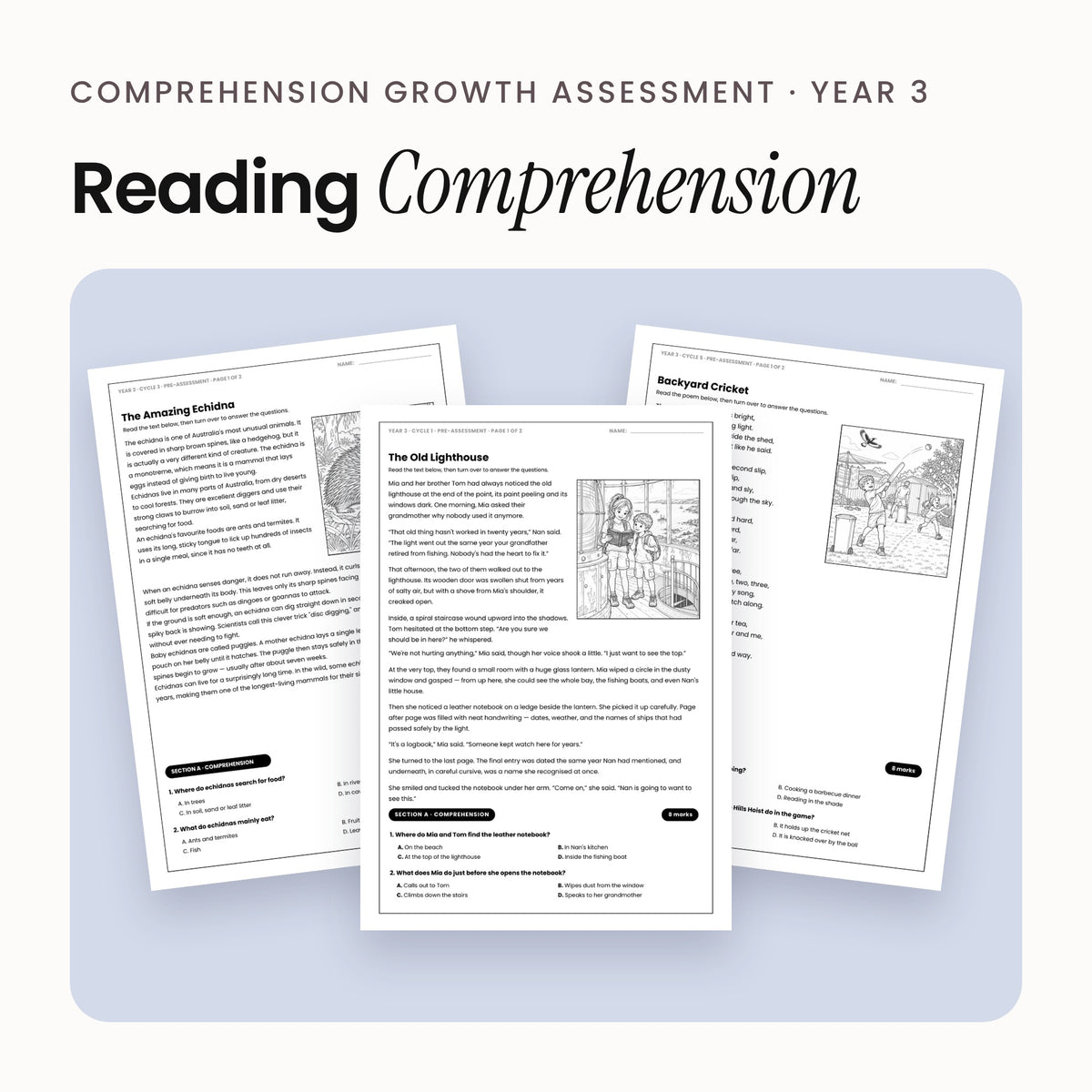
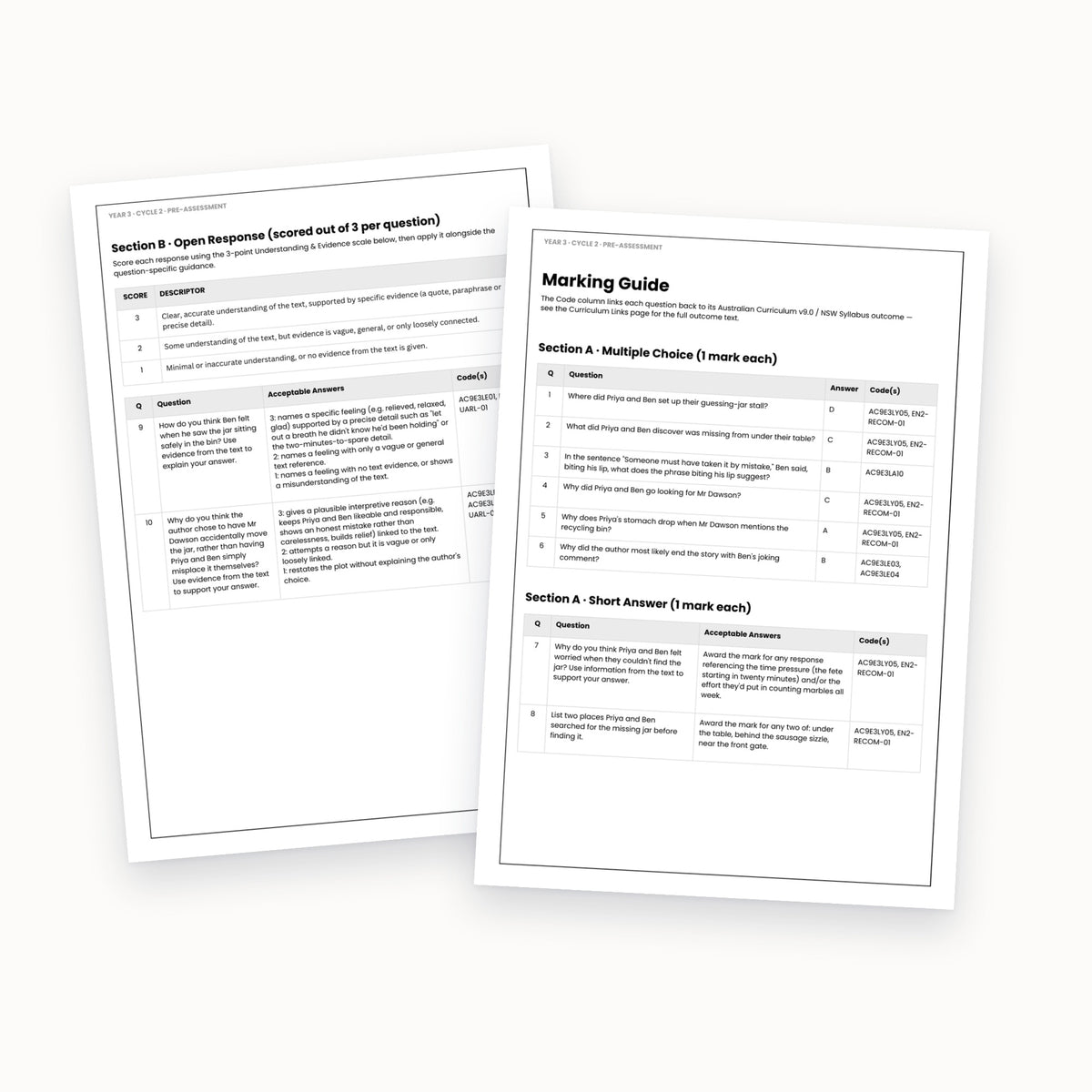
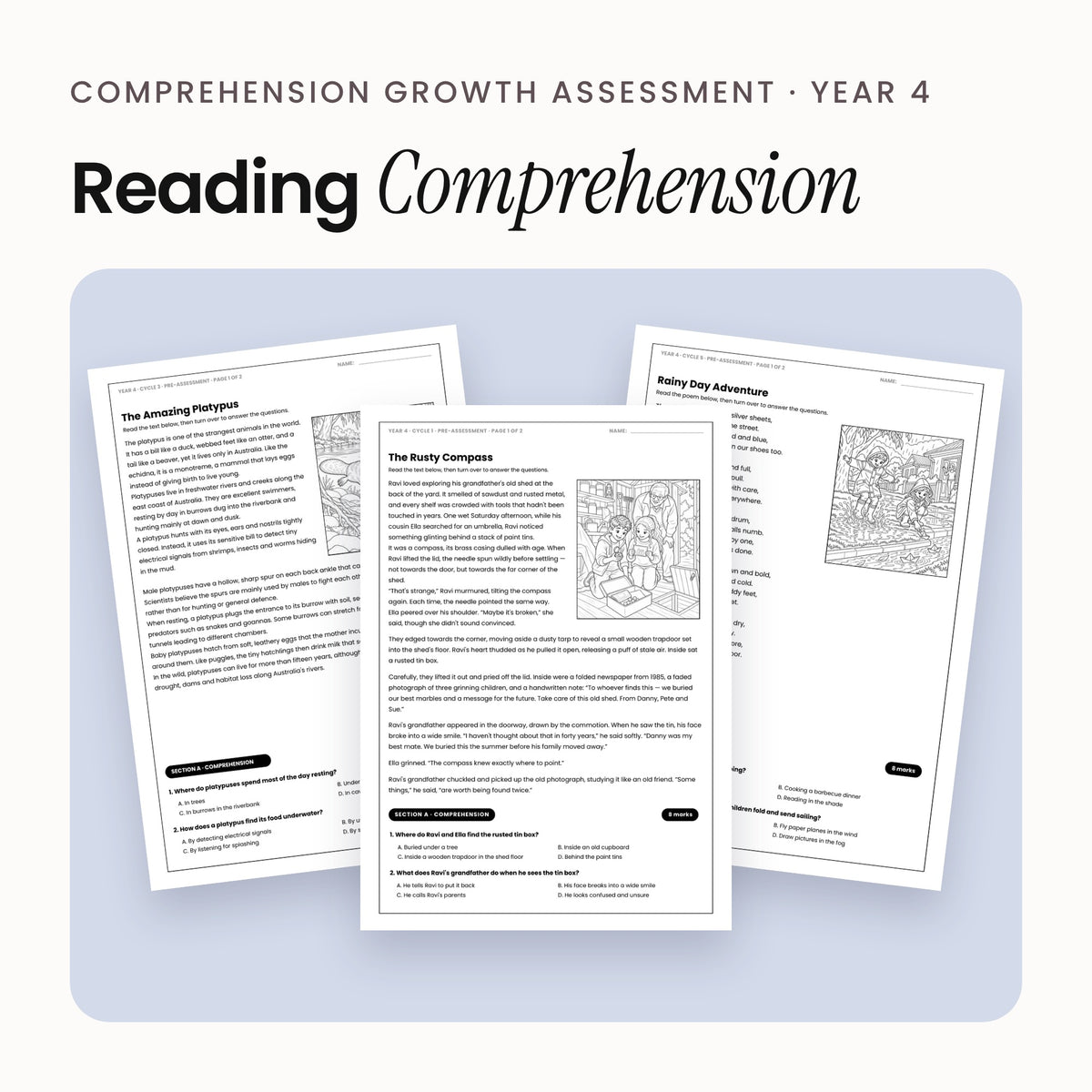
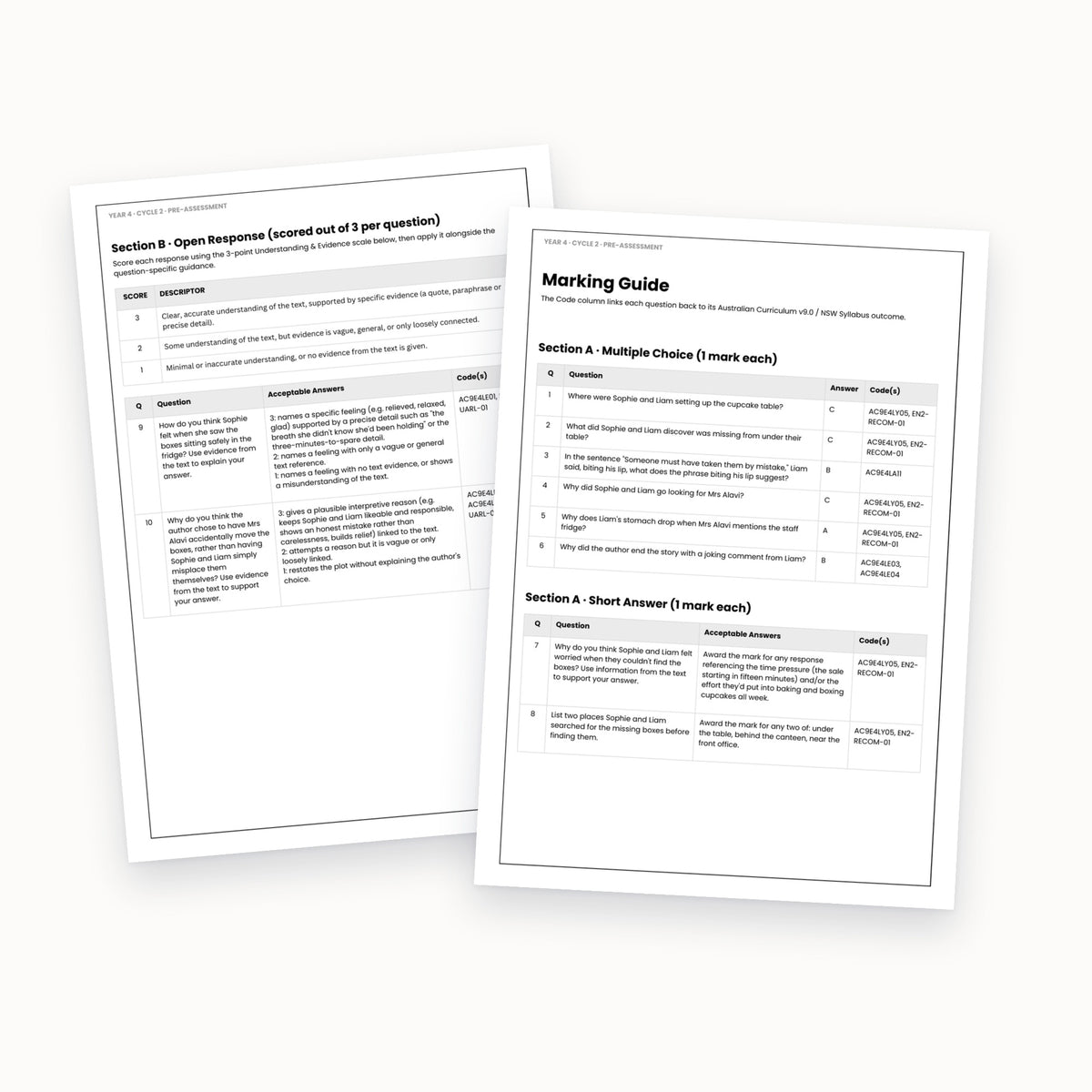
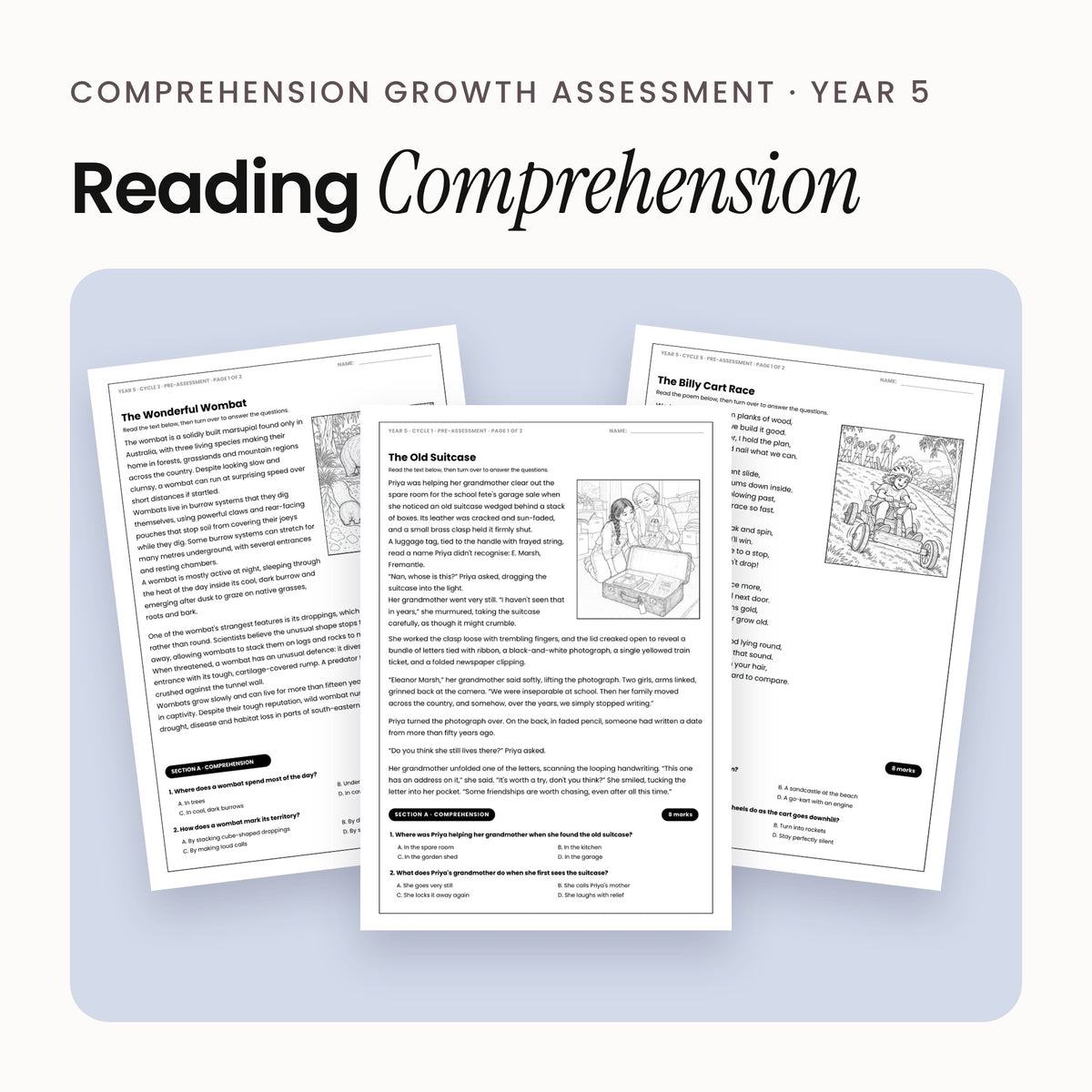
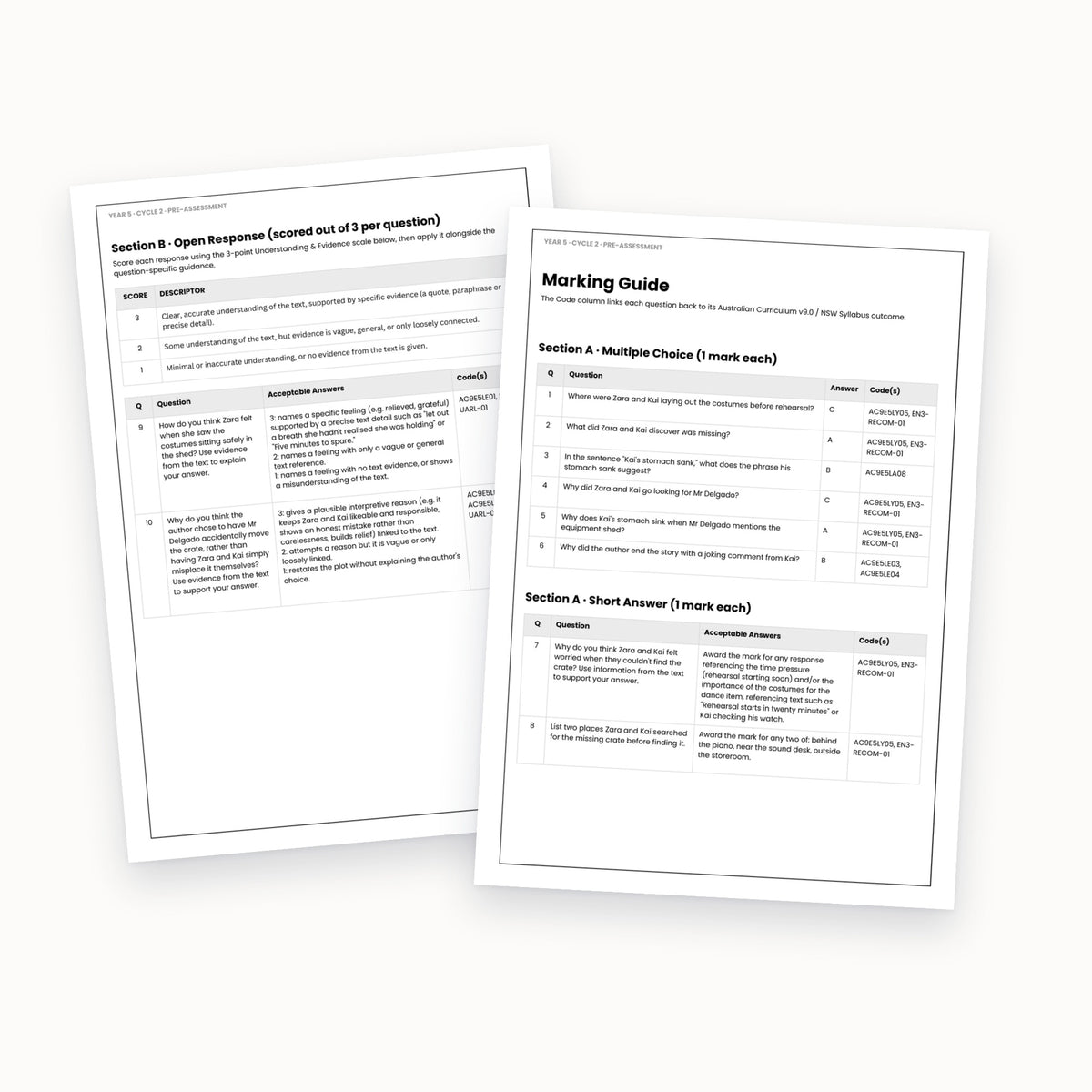
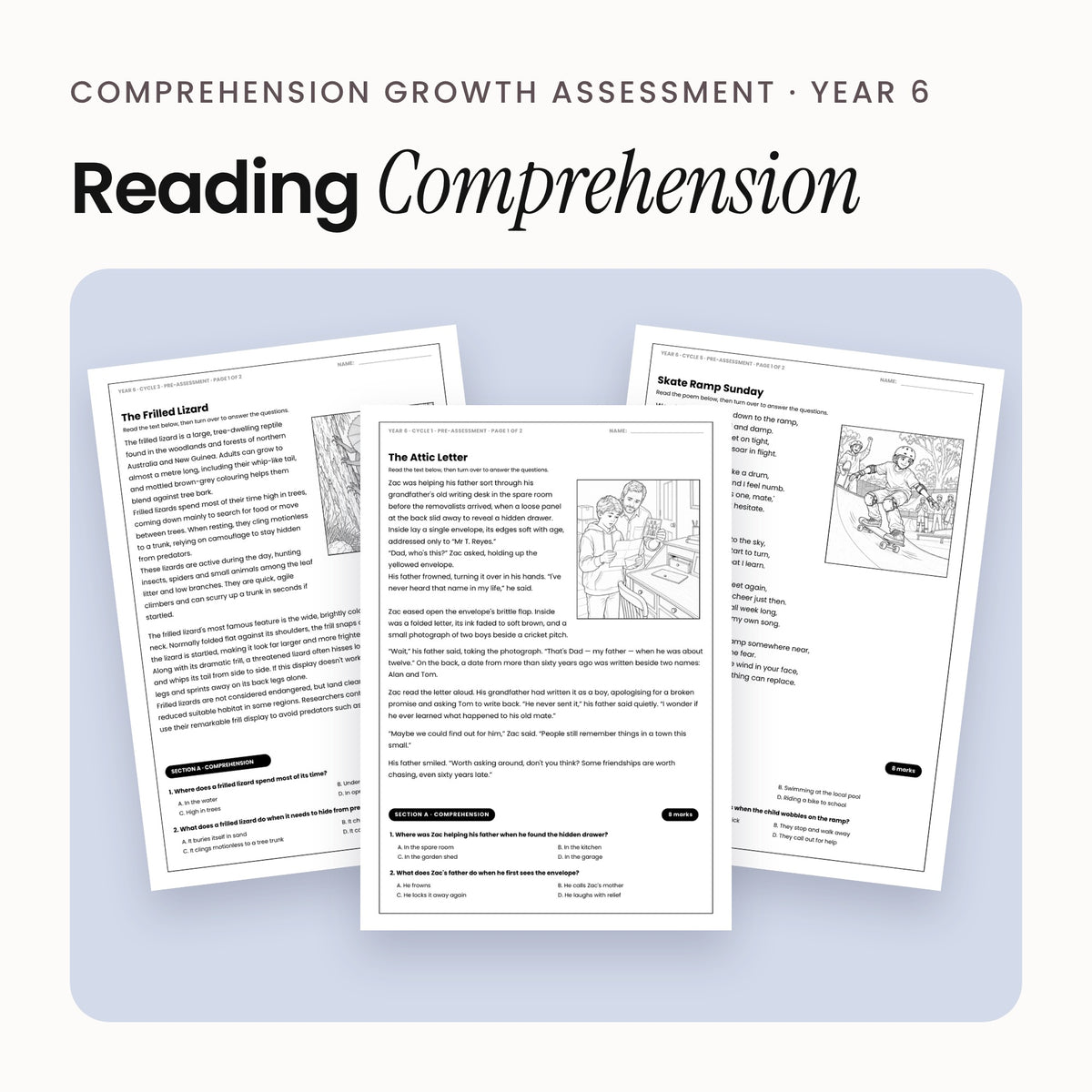
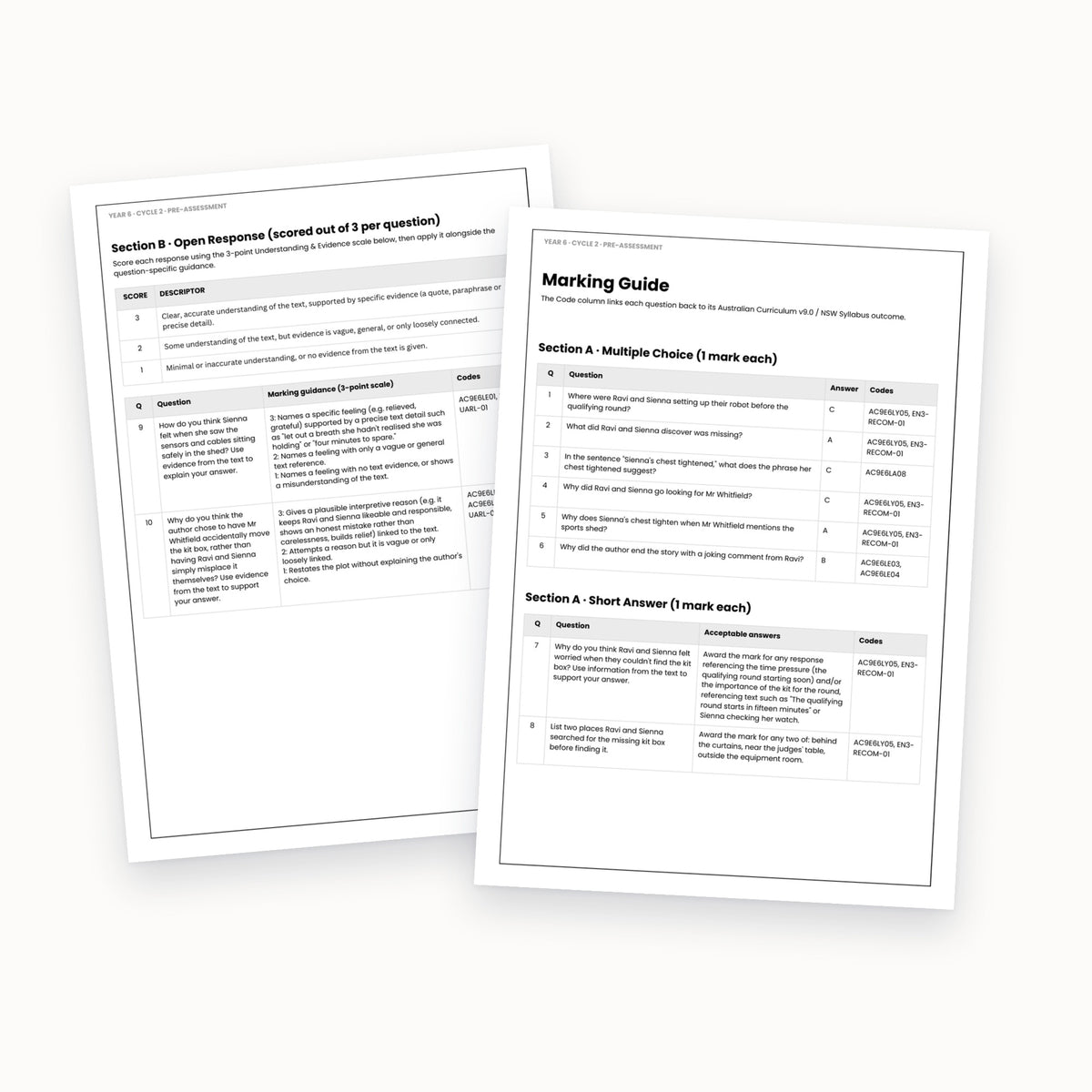
The Reading Comprehension Growth Assessments give you matched pre and post tasks for Years 3–6, with a marking guide for each.
| Step | What happens |
|---|---|
| Pre-assess | Students complete a short comprehension task independently. |
| Mark | Score it quickly with the marking guide and look for patterns across the class. |
| Teach | Target the skills students found hardest, such as inference or vocabulary in context. |
| Post-assess | Students complete a matched task on the same text type. |
| Compare growth | Compare pre and post scores to see each student's progress. |
Across the year. Running a cycle for each text type, narrative, informative, persuasive and poetry, gives you a clear picture of growth across the whole year and evidence for reporting.
No. 09 — Curriculum links
Where it sits in the curriculum
Comprehension teaching addresses these outcomes from the NSW English K–10 Syllabus (2022) and these content descriptions from the Australian Curriculum: English v9.0.
NSW English K–10 Syllabus
| Focus | Stage 2Years 3–4 | Stage 3Years 5–6 |
|---|---|---|
| Reading and comprehension | EN2-RECOM-01Reading, viewing and comprehending texts | EN3-RECOM-01Reading and comprehension |
| Understanding literature | EN2-UARL-01Understanding and responding to literature | EN3-UARL-01, 02Understanding and responding to literature |
| Vocabulary | EN2-VOCAB-01Vocabulary | EN3-VOCAB-01Vocabulary |
Australian Curriculum: English v9.0
| Focus | Years 3–4Year 3 · Year 4 | Years 5–6Year 5 · Year 6 |
|---|---|---|
| Comprehension strategies | AC9E3LY05 · AC9E4LY05Building literal and inferred meaning | AC9E5LY05 · AC9E6LY05Building literal and inferred meaning and evaluating ideas |
| Author's craft | AC9E3LE03 · AC9E4LE03How authors portray characters, settings and eventsAC9E3LE04 · AC9E4LE04The effect of literary devices | AC9E5LE03 · AC9E6LE03Point of view and author styleAC9E5LE04 · AC9E6LE04Imagery and sound devices |
| Vocabulary | AC9E3LA10 · AC9E4LA11Extending vocabulary | AC9E5LA08 · AC9E6LA08Vocabulary for precision and effect |
Year 2 resources link to the matching NSW Stage 1 outcomes and Year 2 content descriptions.
Coming Term 1
Something new on the way
Two complete comprehension and writing programs, designed to sit alongside Reading Fluency, Sentence of the Day and Quick Writes in your connected literacy block.
- Coming Term 1
The Kindness Project
A five-week comprehension and writing program built around The Kindness Project by Deborah Abela, with supporting texts that explore kindness through different authors.
- Coming Term 1
Storm Boy
A five-week comprehension and writing program built around Storm Boy by Colin Thiele, with supporting texts that explore similar themes through different authors.
Comprehension resources
Matched pre and post comprehension tasks for Years 3–6, with a marking guide for each, so you can see how much students have grown and in which skills.
Literacy, Unpacked
Keep exploring
Reading fluency
What fluent reading sounds like and how to run a four-day routine with three levels of one passage.
Spelling & vocabulary
A four-lesson weekly sequence for vocabulary, spelling and Sentence of the Day.
The connected literacy block
How fluency, Sentence of the Day and Quick Writes share one theme and one set of words.
- Coming soon
Teaching writing
Explicit mini lessons, mentor sentences, revising and editing, and matched writing assessments.